Associate — Foundations of Jyotishप्रवेश · Pravesha — the Entrance
The alphabet, grammar and vocabulary of the science of light. Cast and read a birth chart from first principles — by hand, then verified with software.
VolumeBook I of IV
Chapters10 modules · ~1 term
PrerequisiteOpen enrolment · curiosity
AccentTeal · हरित
Before We Begin
What is a Birth Chart?
आकाशदर्शन · Ākāśadarśana — "looking at the sky"
0.0 You don't need to know anything
You are holding this book because you are curious about something called Jyotish — Vedic astrology, the "science of light." Maybe someone showed you your birth chart and said "this is you." Maybe you grew up hearing about rāśis and grahas from your grandmother. Or maybe you just wandered into the astrology section of the internet and something caught your eye.
It doesn't matter. This book starts from zero. It assumes you have never seen a birth chart. It assumes you don't know what a "planet" means in astrology. It assumes you cannot tell Aries from Pisces and you're not sure what the difference is between a sign and a house. That's fine. That's why we're here.
By the time you finish this book — all ten chapters, all the exercises, all the self-quizzes — you will be able to look at any birth chart and read its basic story. You'll know how the chart is built, what each piece means, and — most importantly — when to stop and admit you need more tools (that's what Books II, III, and IV are for).
What you need
A notebook. A pen or pencil. Access to a computer (to run Jagannatha Hora — free software we'll set up in Chapter 1). And your own birth details: date, time (as exact as you can get), and city of birth. That's it. No prior knowledge required. No expensive books. No guru (yet).
0.1 Look up at the sky
Step outside on a clear night. Look up.
You see stars — hundreds of them, thousands if you're away from city lights. You might see a planet: Venus is the brilliant white "evening star" in the west after sunset, Jupiter is the steady golden point that doesn't twinkle. You see the Moon somewhere — maybe a thin crescent, maybe a glowing full disc.
Now imagine freezing that sky. Taking a photograph of exactly what you see, right now, from exactly where you're standing. That photograph — of the positions of the Sun, the Moon, and all the visible planets against the background of the stars — is what astrologers call a birth chart.
Your birth chart is a snapshot of the sky at the moment you were born, from the place you were born. It is unique to you. If you were born at 11:35 AM in Delhi on June 16, 1992, your chart shows exactly where every planet was in the sky at that moment. Someone born in London at the exact same moment would have a slightly different chart because the sky looks different from London (the Earth is round — the horizon changes). Someone born one minute later in Delhi would also have a slightly different chart because the sky is moving (the Earth rotates — new stars rise every moment).
Fig 0-1 — Your birth chart is a snapshot of the sky at the moment and place of your birth. The positions of the Sun, Moon, and planets against the fixed stars are frozen forever in this one "photograph."
0.2 What do planets "mean"?
This is the question every beginner asks: how can a ball of gas millions of miles away say anything about my life?
Jyotish does not claim that Jupiter the planet causes things to happen. It claims that the positions of the planets reflect patterns that also exist in human life. The sky and the self are two expressions of the same underlying pattern. This is not a scientific claim in the modern sense — it's a philosophical one, rooted in the Vedic idea that the cosmos is one connected whole (ब्रह्माण्ड — brahmāṇḍa, "the cosmic egg").
Think of it like a clock. When the clock's hands point to 3:00, that doesn't cause it to be afternoon. The hands and the afternoon are both effects of the same underlying fact: Earth's rotation. The clock corresponds to the time. Similarly, Jyotish says the sky corresponds to the unfolding of a life.
The clock analogy
A clock tells you...
Jyotish tells you...
What time it is
What phase of life you're in
The clock doesn't make it 3 PM
The planets don't make things happen
You use the clock to plan — "3 PM, time for my meeting"
You use the chart to understand — "This period, my relationships will require patience"
The clock is a tool, not a master
The chart is a tool, not a master
This is the single most important idea in this entire book. Your chart does not control you. It describes you. Free will, effort, grace, and choice remain real. A good Jyotishi reads the weather — they don't pretend to control the sky.
0.3 What you'll actually see in a chart
Here is a birth chart in the North Indian style — the diamond-shaped layout you'll meet again in Chapter 1, where we compare it side by side with the South Indian grid:
Fig 0-2 — A very simple North Indian birth chart. Unlike the South Indian grid, here the twelve houses (bhāvas) are fixed by position — the diamond at the top centre is always the 1st house (the Lagna or ascendant — "what was rising on the horizon when you were born"). The small numbers are the signs (rāśis): with Leo rising, sign 5 sits in the 1st house and the numbers climb counter-clockwise around the chart. The letters (like "Su" for Sun) are the planets (grahas). Everything else — aspects, dignity, dashas — is built on top of these three things: houses, signs, and planets.
That diamond? That's all a birth chart is. Twelve compartments. Nine planets placed inside them. One fixed corner — the top — that always marks the ascendant. Everything else — the 27 lunar mansions, the planetary dignities, the aspects, the dashas — is just ways of reading this same diagram more deeply. The frame itself never changes. It's your canvas. The rest is interpretation.
0.4 What you'll learn in this book
Book I at a glance
Chapter
What you'll know by the end
Ch 1 — Orientation
What Jyotish is, where it comes from, and how to set up your software
Ch 2 — The 12 Rāśis
The 12 signs — what each one means, how to identify any sign instantly
Ch 3 — The 9 Grahas
The 9 planets — each one's personality, what it rules, who its deity is
Ch 4 — The 12 Bhāvas
The 12 houses — where life happens, how to classify any house
Ch 5 — Casting I
Finding the Lagna — the single most important point in any chart
Ch 6 — Casting II
Converting planetary positions and assembling a complete D1 chart
Ch 7 — 27 Nakṣatras
The lunar mansions — the older, finer star-map under the zodiac
Ch 8 — Dignity & States
How strong or weak each planet is — the quality of the actors
Ch 9 — Aspects
Who "sees" whom — the web of connections between planets
Ch 10 — Reading
Your first full reading — taking all 9 chapters and making a chart speak
0.5 A note about memorisation
Jyotish requires memorisation. There are 12 signs, 9 planets, 12 houses, 27 nakṣatras, and several tables of rules about dignities, friendships, and aspects. You cannot look up "what does Mars in Scorpio mean?" every time you read a chart — you need to know it.
But you don't need to know it all at once. Each chapter introduces a manageable chunk. By the end of Chapter 2, you should know the 12 signs by heart. By the end of Chapter 3, the 9 planets. By the end of Chapter 7, the 27 nakṣatras. We'll build the memory step by step.
Don't skip the practicum
At the end of every chapter, there's a practicum — a set of exercises to do in your notebook. Do them. Jyotish cannot be learned by reading alone. You must write. You must compute. You must draw charts. The exercises are not optional — they are the learning.
0.6 Meet Priya — your travelling companion
Throughout this book, we will follow one sample chart together. Her name is Priya.
Priya's birth data
Date
April 12, 1992
Time
14:30 IST (Indian Standard Time)
Place
Bangalore, India (12°58'N, 77°35'E)
Lagna
Leo (Siṃha) 21°15′ — Pūrva Phālgunī nakṣatra, pada 2
Ayanamsa (Lahiri, 1992)
~23°43′
Priya is not a real person — she's a synthetic chart designed to be rich in features. Throughout the book, every time you see "Meet Priya" in a practicum or a callout, we'll use her chart to demonstrate the concept you just learned. By Chapter 10, you'll have built Priya's complete D1 alongside your own, and you'll read them both.
Priya's chart is especially useful because it has a little bit of everything: planets in their own signs, planets in exaltation, planets in dusthana houses, a gandanta degree on one planet, a strong Lagna lord, a Moon that shifts the emotional landscape — all in one chart. We'll discover each of these features as we go.
0.7 What you need to do right now
Get a notebook. A real one. Paper and pen. Write "Jyotish — Book I" on the cover.
Find your birth details. Ask your parents or check your birth certificate. You need: date of birth, exact time (as close as possible — hospital records are best), and city of birth.
On the first page of your notebook, write down Priya's birth data. We'll start with her chart before we cast your own.
Go outside tonight. Look up. Find one planet — Venus in the west after sunset, or Jupiter if it's visible. Just notice it. Say "that moving point of light will be in my chart somewhere."
0.8 Self-quiz — are you ready to begin?
Self-quiz · Before We Begin (5 questions)
Q1: In one sentence, what is a birth chart?
Show answer
A snapshot (photograph) of the sky — the positions of the Sun, Moon, and planets against the background stars — at the exact moment and place of your birth.
Q2: True or false: The planets cause events in your life.
Show answer
False. Jyotish says the planets correspond to patterns in life, like a clock corresponds to the time of day. The chart describes; it doesn't control.
Q3: If someone tells you "your chart says you'll never be happy," what should you think?
Show answer
The person doesn't understand Jyotish. A chart shows tendencies and timing — it never pronounces a final verdict on your life. Free will, effort, and grace are always part of the picture. If a reading sounds fatalistic, the reader is wrong, not the chart.
Q4: What are the three core elements of a North Indian birth chart?
Show answer
Twelve houses (the bhāvas) fixed by position — with the 1st house (Lagna) always at the top centre, the signs written as numbers inside those houses, and nine planet symbols placed in the houses. Everything else — aspects, dignities, dashas — is built on top of these three.
Q5: Why do you need your exact birth time?
Show answer
The Lagna (ascendant) — the most important point in the chart — shifts about 1° every 4 minutes. If your birth time is off by even 15 minutes, your Lagna could be in the wrong navamsa segment (3°20′ wide), and the entire house structure might be wrong. Exact time = accurate chart.
Practicum — for your notebook
On page 1 of your notebook: write "Priya" at the top. Copy her birth data.
On page 2: write your own name and your birth details. Leave space — we'll fill in your Lagna degree, Moon nakṣatra, and planetary list as we go.
If you've never seen a sky chart before: search "current sky map" on your phone and look at where Venus, Jupiter, or Mars are tonight. Just notice the names. You'll be working with those same names soon.
Read the Table of Contents of this book. Get a sense of the journey. Don't memorise it — just know that Chapter 2 is about signs, Chapter 3 about planets, etc.
In your notebook, answer this question in your own words: "Why do I want to learn Jyotish?" Be honest. There's no right answer. Your reason will guide how you use this knowledge.
ॐ
Turn the page. The journey begins.
Front matter
Publisher's note
This is the first of four books that together form a complete Vedic astrology curriculum — from the alphabet of a chart to the doctoral frontier. Each book is a faithful, expanded reading of its source syllabus in this directory: every module becomes a chapter, every technique is worked through twice, every claim is sourced.
Jyotish is ज्योतिष — the "science of light." It is one of the six Vedāṅgas (limbs of the Veda) and, in the Indic frame, a contemplative discipline that maps the timing of ripening karma. It is not fortune-telling; it is rigorous pattern-reading with humility about what any chart can and cannot say.
Use this book on a phone, a tablet, or a laptop. The layout adapts, the table of contents follows your scroll, and you can switch to a parchment theme if the dark sky strains your eyes. Every calculation is reproducible by hand; every interpretation stays inside the chart.
How to read this book
Read once for narrative — skim the chapter head, the worked-example titles, and the conclusion.
Read again with a notebook — write the formulas, then do the worked examples yourself before peeking at the answer panel.
Compute your own chart — the practicum at the end of each chapter is designed around a sample dataset (yourself, or the "Anonymous Birth A / B" examples).
Verify with software — Jagannatha Hora (PVR Narasimha Rao), or a Python engine you build yourself, is the right companion. The book teaches the formula; the software removes arithmetic error.
Return to the classics — BPHS, Phaladeepika, Brihat Jataka, Jaimini Sutras. This book points to them; the original slokas remain the ground truth.
Conventions used throughout
Sanskrit terms
Always italicised and transliterated (IAST). Devanagari follows in parentheses on first use.
Longitudes
Tropical (T) and sidereal (S) are always distinguished. Sidereal = tropical − ayanamsa.
Degrees / minutes / seconds
Written as 23°51′14″ (degree, prime, double-prime). Decimals appear where software outputs them.
Houses
Numbered 1–12 starting from the ascendant (Lagna). Whole-sign unless Bhava Chalit is specified.
Worked examples
Two per chapter, marked Example 1 and Example 2. Calculations are collapsible; show them only after you have tried.
Table of contents
Ten chapters. One term. Cast and read a chart from first principles.
Explain what Jyotish is, its place as a Vedāṅga, and why it is called the "eye of the Veda."
Distinguish the sidereal zodiac from the tropical zodiac and articulate why Jyotish uses the former.
Define ayanamsa, trace the Lahiri/Chitra Paksha standard to the 1956 Indian Calendar Reform Committee, and state its current value (~24° in the 2020s).
Name the five limbs of the Panchanga (tithi, vara, nakshatra, yoga, karana) and describe each in one sentence.
Recognise the three Indian chart styles (North, South, East) and know which part of India uses each.
Set up Jagannatha Hora with Lahiri ayanamsa and enter a birth data set correctly.
1.1 What is Jyotish, and why does it exist?
Imagine a village in ancient India. A child is born. The family wants to know: what name will suit this child? When should their thread ceremony be held? Will the crops planted in this month thrive? The village elder — the Jyotishi — opens a palm-leaf manuscript, consults a set of tables, and answers. Not because the stars control the child or the crops, but because generations of observation have shown that the sky and the earth move in rhythm, and the rhythm can be read.
This is what Jyotish has always been: a practical, living tradition. Not a museum piece. Not a superstition. A tool for understanding the right moment and the right action. The word itself tells the story: ज्योतिषjyotiṣa comes from ज्योतिस्jyotis — "light." Jyotish is the study of light — specifically, the light of the heavenly bodies and what it reveals about earthly life.
1.1.1 What is the Veda? (A brief detour for the complete beginner)
Before we go further, you need to understand "Vedic" because the phrase "Vedic astrology" will appear everywhere. The Vedas are the oldest layer of Sanskrit literature — a vast body of hymns, rituals, and philosophical texts that form the foundation of what we now call Hinduism. They are not a single book but a library, compiled orally over millennia and written down much later. There are four Vedas: the ऋग्वेद (Ṛgveda), यजुर्वेद (Yajurveda), सामवेद (Sāmaveda), and अथर्ववेद (Atharvaveda).
To properly understand, recite, and apply the Vedas, ancient scholars developed six auxiliary disciplines — the Vedāṅgas (literally "limbs of the Veda"). Think of them as the six subjects a Vedic student had to master before they could handle the primary texts.
Vedāṅga
What it teaches
Everyday analogy
Śikṣā
Phonetics — how to pronounce each syllable correctly
Learning the alphabet before reading a poem
Chandas
Prosody — the rhythm and metre of verses
Learning the beat before singing a song
Vyākaraṇa
Grammar — how words combine and inflect
Learning sentence structure before writing an essay
Nirukta
Etymology — the origin and true meaning of words
Using a dictionary to understand what a word really means
Kalpa
Ritual procedure — the correct sequence of actions
Following a recipe to cook a dish correctly
Jyotiṣa
Astronomy & astrology — the correct TIME for action
Knowing when to cook the dish so it's fresh for the guests
Fig. 1-1 — The six Vedāṅgas mapped to the anatomical limbs of the Vedapuruṣa. Jyotish is the Cakṣuḥ (the Eye) — the faculty of sight and time-determination. Just as a body without eyes is blind in the world, sacred action without Jyotish is performed without temporal awareness. Pāṇinīya Śikṣā, verses 41–42.
The foundational text of Jyotish is the Vedāṅga Jyotiṣa, traditionally attributed to the sage Lagadha. It exists in two recensions — a Rigvedic version (36 verses) and a Yajurvedic version (44 verses, with 8 extra verses). Its astronomical content describes a sky from roughly 1400–1200 BCE (the winter solstice occurring when the Sun was in the star Dhaniṣṭhā, which today is ~24° away due to precession). The final written form may date to the last centuries BCE. (Witzel 2001; Subbarayappa 1989.)
— Yajur-recension, verse 3 (paraphrased) —Like the crest of a peacock and the jewel of a serpent, so does the knowledge of ज्योतिष stand at the head of all the sciences auxiliary to the Veda.
1.1.2 What is karma? (The beginner's version)
Jyotish is built on the idea of karma (कर्म). If you've heard this word, you've probably heard it simplified to "what goes around comes around" or "you get what you deserve." That's not wrong, but it's not complete.
Karma literally means "action." Every action — a word spoken, a choice made, a thought held — produces a result. Some results are immediate (you touch a flame, you get burned). Some are delayed (you study for years, you pass an exam). Some are so delayed that they ripen in a different phase of life — or, in the Vedic view, in a different lifetime.
Your birth chart, in Jyotish, is understood as a map of your accumulated karma — the sum of actions whose results are ready to ripen in this lifetime. The chart does not sentence you to a fate. It shows you the weather pattern you were born into. What you do with that weather — build a shelter, plant crops, dance in the rain — is your free will.
The weather analogy
Your chart tells you it will rain. It doesn't tell you whether you'll carry an umbrella. It tells you the soil is fertile. It doesn't tell you what you'll plant. The chart describes conditions; you decide actions. This is the single most important philosophical position in all of Jyotish. Any astrologer who tells you the chart forces something to happen has misunderstood the tradition.
Key distinction — Jyotish vs "Vedic astrology"
In contemporary English, "Vedic astrology" is the translation of ज्योतिष. Strictly, Jyotish encompasses both astronomy (Gaṇita) and astrology (Phalita). The word "astrology" alone understates its scope: Jyotish is also a calendar system, an electional tool (muhurta), and a contemplative discipline. This book uses "Jyotish" throughout to acknowledge the full tradition.
1.2 Sidereal vs tropical — two zodiacs, one sky
This is the single most important conceptual distinction in the entire programme. Getting it right at the start prevents every later positional error. I'm going to explain it slowly, with visuals, because if you misunderstand this, every chart you cast will be wrong.
There is only one sky. But there are two different ways of measuring where things are in that sky. Think of two rulers placed against the same wall, but one ruler starts slightly to the left of the other. Both rulers measure correctly — they just start from different zero points.
1.2.1 The tropical ruler (what Western astrology uses)
The tropical zodiac is anchored to the seasons. Its zero point — 0° of Aries — is the exact position of the Sun at the March equinox (spring in the northern hemisphere). This is a convenient, repeatable reference: every March, the Sun crosses the celestial equator, and tropical astrologers call that moment "0° Aries." The stars themselves don't matter. The seasons do.
This is what your daily horoscope column, your Western astrology app, and most English-language astrology content uses. If you've ever been told "I'm a Gemini," that was almost certainly a tropical Gemini — meaning the Sun was in the seasonal sign of Gemini at your birth.
1.2.2 The sidereal ruler (what Jyotish uses)
The sidereal zodiac is anchored to the fixed stars. Its zero point — 0° of Aries — is tied to a specific reference star (in the Lahiri standard, it's the point exactly opposite the star Spica / Chitrā). This means sidereal Aries actually aligns with the constellation Aries in the sky. The stars matter. The seasons don't.
Jyotish uses the sidereal zodiac because it cares about the stellar background — the actual constellations through which planets are moving. The 27 nakṣatras (lunar mansions, Chapter 7) are also fixed to specific stars, and they would drift away from their stellar anchors if we used the tropical frame.
1.2.3 Why are they different? — the wobble of the Earth
Here is the crucial piece. The Earth doesn't just spin and orbit. Its axis wobbles, very slowly — like a spinning top that's slightly tilted. This wobble is called the precession of the equinoxes. It takes about 25,800 years for the Earth's axis to complete one full wobble.
The practical effect: the tropical zero point (the March equinox) drifts backward through the fixed stars by about 50.27 arc-seconds every year. That's about 1° every 71.6 years. Over 2,000 years — roughly the time since the Greco-Roman period — the drift has accumulated to about 24°.
This means that today, when the Sun reaches the March equinox (tropical 0° Aries), it is actually sitting in front of the constellation Pisces, not Aries. The tropical "Aries" is about 24° behind the sidereal (actual) Aries.
Fig. 1-2 — The Sidereal vs Tropical measurement models. The tropical framework (orange) anchors 0° Aries to the moving March equinox. The sidereal framework (teal) anchors 0° Aries to the fixed stellar background (180° opposite star Chitrā/Spica). The accumulated gap between their zero points is the Ayanāṁśa (~24°13′ in 2026), expanding continuously at 50.27″ per year.
1.2.4 The ayanamsa — what it is, and why Lahiri
The word ayanāmśa (अयनांश) comes from ayana (movement, course) + aṃśa (part, portion). It means "the portion of movement" — the accumulated drift between the two zodiacs.
In 1956, the Government of India's Calendar Reform Committee, chaired by the renowned physicist Dr. Meghnad Saha, adopted the Chitra Paksha ayanamsa, computed by Nirmal Chandra Lahiri (1906–1980). This standard anchors 0° sidereal Aries to the point exactly opposite the bright star Spica (α Virginis, known in Sanskrit as Chitrā). This is the de facto pan-Indian standard — the default in Jagannatha Hora, Parashara's Light, and virtually all Indian almanacs.
Key numbers — Lahiri ayanamsa
Year
Lahiri ayanamsa (approx)
Notes
1900
22°28′
Pre-ICRC era
1956
23°14′
Year of ICRC adoption
2000
23°51′
Turn of the millennium
2026
~24°13′
Now
2100
~25°15′
Future students: use ~25°
The formula: Sidereal Longitude = Tropical Longitude − Ayanamsa
If the result is negative, add 360°. Example: a tropical planet at 15° Aries (15°) with Lahiri ayanamsa 24°13′ gives 15° − 24°13′ = −9°13′ → add 360° → 350°47′ = 20°47′ Pisces sidereal.
Common trap — forgetting to convert
Most online birth-chart calculators report tropical longitudes. If you feed a tropical longitude into a Jyotish reading without subtracting the ayanamsa, your planets shift back by ~24° — one entire sign. A "Gemini Moon" becomes a "Taurus Moon." The chart is wrong. Always convert. Always check which zodiac your source is using.
1.3 The Panchanga — the five flavours of a day
पञ्चाङ्गpañcāṅga — literally "five limbs" — is the traditional Vedic almanac. Every single day carries five qualities. Together they describe the "texture" or "flavour" of a moment in time. Think of it like cooking: a dish isn't just "spicy" — it's spicy + salty + sour + sweet + bitter, all at once. The Panchanga gives every moment its five flavour notes.
Limb
Sanskrit
What it measures
Cooking analogy
Tithi
तिथि
Lunar day — the phase angle between Sun and Moon (12° per tithi). 30 tithis per month.
The base flavour — is today sweet (śukla/waxing) or pungent (kṛṣṇa/waning)?
Vāra
वार
Weekday — governed by a specific planet (Sun-day, Moon-day, Mars-day…)
The dominant spice — who's in charge today? Mars makes it hot; Venus makes it smooth.
Nakṣatra
नक्षत्र
Lunar mansion — the 13°20′ star-segment the Moon occupies right now. 27 total.
The aroma — the emotional atmosphere. Some nakṣatras are calming; others are sharp.
Yoga
योग
Sum of Sun + Moon longitudes, divided into 27 segments of 13°20′ each
The texture — how the two lights combine. Smooth (auspicious) or gritty (challenging).
Karaṇa
करण
Half-tithi — 6° of Sun-Moon separation. The finest-grained limb. 11 types, 60 per month.
The finishing touch — the aftertaste. 60 micro-flavours cycling through the month.
Why does any of this matter? Because in traditional Indian life, nothing important is done without checking the Panchanga. A wedding date, a business launch, a journey, a medical procedure — all are scheduled for moments when the five limbs align favourably. You don't need to memorise the Panchanga now. But you need to know it exists, because later — in the Master level (Book III) — the Panchanga becomes the heart of muhurta (electional astrology): choosing the right moment.
All longitudes must be in degrees (0–360°). The "+1" converts a 0-based index to the traditional 1-based counting.
1.4 Worked examples — computing the Panchanga
Example 1 · Find the tithi for a specific day
Given: On a certain date at noon, the sidereal longitudes are:
Sun = Capricorn 0°43′ = 270°43′ (in decimal: 270.717°)
Moon = Scorpio 19°17′ = 229°17′ (in decimal: 229.283°)
Notice the Moon is behind the Sun — the Moon is at 229° and the Sun is at 270°. The Moon-Sun difference would be negative. So we add 360° to the Moon first.
Moon at 280°12′ = Capricorn 10°12′. Nakṣatra index = floor(280.2° / 13°20′) = floor(21.015) = 21. Index 21 (0-based) = Śravaṇa, ruled by the Moon. Śravaṇa is auspicious for ceremonies.
February 14, 2026 = Saturday (Śanivāra — ruled by Saturn).
The five-flavour read:
🟢 Nakṣatra (Śravaṇa): Excellent. Viṣṇu's star, auspicious for ceremonies.
🟢 Yoga (Siddhi): Excellent. "Success/accomplishment."
🟡 Vāra (Saturday): Neutral. Saturn's day — stable but not celebratory.
🟡 Karaṇa (Bava): Neutral.
🔴 Tithi (kṛṣṇa 14th / Rikta): Bad. The "empty" tithi — avoided for new beginnings and weddings.
Verdict: Three good limbs, one bad limb. The bad tithi overrides the good limbs for a wedding. A traditional Panchanga consultation would reject this date on the tithi alone. This is why all five must be read together — one spoiled ingredient can ruin the dish.
What is a Rikta tithi?
The four Rikta ("empty") tithis are the 4th, 9th, and 14th of each pakṣa (waxing and waning) — eight per lunar month in total. They are traditionally avoided for new ventures, marriages, travel, and any ceremony intended to produce a lasting result.
1.5 The three Indian chart styles
India uses three distinct visual layouts to display the same birth chart. They are geometrically different but mathematically identical. The data is the same; only the arrangement changes. A competent Jyotishi reads all three.
North Indian (उत्तर)
Diamond pattern. The houses are fixed in position; the signs change. The 1st house (Lagna) is always the top-centre diamond. House-centric: find the house first, read sign numbers inside. Used in Book I.
South Indian (दक्षिण)
Rectangular grid. The signs are fixed in position; the houses change. Top-row 2nd box is always Aries (मेष). The Lagna is marked with a diagonal stroke. Sign-centric.
East Indian (पूर्व)
Sequential triangular layout. Used in West Bengal, Odisha, and Assam. Central diamond is House 1 (Lagna); the remaining houses flow counter-clockwise in clean geometric sequence.
Which style should you learn first?
This book uses North Indian notation throughout, so make that your home base. Its great virtue is that the houses never move — the 1st house (Lagna) is always the top-centre diamond — so the moment you glance at a chart you know exactly where the ascendant, the 7th, the 10th, and every other house sits. You read the signs as numbers that rotate through those fixed houses. Once you're fluent in North Indian, the South Indian grid (signs fixed, Aries always top-left) is a quick mental rotation, and East Indian is useful if you work with Bengali or Odia sources. A competent Jyotishi can read all three — but we'll build your fluency in one first.
1.6 Setting up Jagannatha Hora — your digital companion
Jagannatha Hora (JHora) is the free, highly respected Windows software created by P.V.R. Narasimha Rao. It contains the entire Lahiri ephemeris, computes all chart styles, divisional charts, dashas, and much more. At the Associate level, you use it to verify the calculations you do by hand. At higher levels, you use it as a full astrological workstation.
Setup checklist — follow this exactly
Download JHora from vedicastrologer.org/jh. It's free. It works on Windows. (Mac/Linux users can run it via Wine, or use the free web alternative at astro.com — select "Sidereal / Lahiri" as the zodiac in the Extended Chart Selection.)
On launch: File → New Chart.
Enter: name, birth date (DD/MM/YYYY or MM/DD/YYYY depending on your locale), birth time (24-hour format — 2:30 PM = 14:30), and place of birth (type the city name or enter latitude/longitude manually).
Set timezone correctly. For India: IST = UTC +5:30. For other countries, verify the correct offset. A wrong timezone = wrong Lagna = wrong everything.
Verify that Ayanamsa = Lahiri (Chitra Paksha) — this is usually the default, but always check.
Set house system = Whole Sign. (Preferences → House Calculation → Whole Sign.)
Click OK. JHora will generate the D1 (Rashi chart).
Scroll through the output. Find these items: Lagna degree, Moon nakshatra, planetary longitudes, and the Panchanga section.
Try switching chart views: View → Chart Type → North Indian / South Indian / East Indian.
Priya Thread — enter Priya's data in JHora
Meet Priya: Born April 12, 1992 · 14:30 IST · Bangalore, India. Enter this data into JHora now. You should see:
Lagna: Leo (Siṃha) 21°15′ — Pūrva Phālgunī nakṣatra, pada 2
Moon: Cancer (Karka) 9°44′ — Puṣya nakṣatra, pada 2
Ayanamsa used: ~23°43′ (Lahiri, for year 1992)
Write these three numbers in your notebook under "Priya — Chapter 1." You'll refer to them constantly. Compare your JHora output to mine. If they don't match, check: timezone (IST +5:30), ayanamsa (Lahiri), and birth date format.
1.7 The Interactive Vedic Planet Simulator & 2D Orrery — Your Visual Sky Laboratory
While hand-calculation gives you foundational mastery and Jagannatha Hora generates static charts, the living sky is continuous motion. To bridge the gap between abstract numbers on paper and the actual cosmos overhead, this curriculum comes with an integrated, high-precision visual tool: the 2D Celestial Plane & Vedic Orrery.
The simulator runs 100% in your browser with zero installation needed. It models the celestial sphere across a 200-year timeline (73,414 days), backed by NASA JPL DE431 numerical integration via Swiss Ephemeris with sub-arcsecond accuracy, plus an autonomous client-side Keplerian fallback engine.
What you can observe immediately in Chapter 1:
The Lahiri Ayanamsha in Real Time: Look at the top-left badge. It shows the exact Lahiri (Chitra Paksha) ayanamsha value for the current moment. Move the 200-year timeline slider from 1900 to 2100: you will visually watch the ayanamsha value advance from ~22°27′ (in 1900) to ~24°14′ (in 2026) to ~25°15′ (in 2100) at precisely the classical rate of ~50.29 arc-seconds per year.
The 12 Rashis (Zodiac Signs): The outer ring displays the 12 signs of 30° each (Mesha to Meena) with their traditional Sanskrit symbols, names, and boundary divisions.
The 27 Nakshatras & 108 Padas: The middle concentric band displays the 27 lunar mansions of 13°20′ each, subdivided into 108 Navamsha quarters of 3°20′ each.
The Lagna (Eastern Horizon Line): The tangent plane across the central Earth disc represents the local horizon for the observer station (Nieuw-Nickerie, Suriname). As you advance time throughout a day, watch the eastern horizon point sweep through the entire zodiac — completing one full cycle of all 12 Lagnas every 24 hours.
Geocentric vs. Heliocentric Perspectives: Click the toggle buttons in the top bar to switch between the topocentric Earth-centered view (how the sky looks to us on Earth) and the Sun-centered view (how the planets actually orbit in space).
🔭 Chapter 1 Lab Activity — Exploring Ayanamsha with the Simulator
Click Launch Simulator (or open it from the top navigation menu).
Check the Lahiri badge in the drawer: note today's value (~24°14′).
Use the timeline slider to drag back to 1992-04-12 (Priya's birth date). Notice the Lahiri ayanamsha is ~23°43′ — exactly matching the value we entered into JHora!
Drag to the year 1900: notice ayanamsha is 22°27′59″.
Drag to 2100: notice ayanamsha has grown to 25°15′12″. You have just observed two centuries of Earth's axial precession in ten seconds.
Self-quiz — check your understanding
Self-quiz · JYO-101 (7 questions)
Q1: What does "Vedāṅga" mean, and why is Jyotish classified as one?
Show answer
"Limb of the Veda" — one of six auxiliary disciplines needed to properly understand and apply the Vedas. Jyotish is the Vedāṅga of correct timing.
Q2: If someone's Sun is at tropical 5° Aries and the ayanamsa is 24°, what is their sidereal Sun sign?
Show answer
5° − 24° = −19° → add 360° → 341°. Sign index = floor(341/30) = 11 = Pisces (Mīna) 11°. Their tropical "Aries" Sun is actually a sidereal Pisces Sun.
Q3: You read that "today is tithi 8, śukla pakṣa." What does this mean?
Show answer
The Moon is 8 × 12° = 96° ahead of the Sun (waxing). It's the 8th day of the bright half — Aṣṭamī. Halfway to the full Moon.
Q4: Why does the ayanamsa grow by ~50″ each year?
Show answer
Because the Earth's axis precesses (wobbles) — the March equinox point drifts backward through the fixed stars at ~50.27 arc-seconds per year. The accumulated drift is the ayanamsa.
Q5: True or false: The North Indian chart style keeps the houses fixed and rotates the signs.
Show answer
True. In the North Indian diamond (the style this book uses), the 1st house (Lagna) is always the top-centre diamond, and the signs — written as numbers — rotate through the fixed houses depending on the ascendant. The South Indian grid does the opposite: the signs are fixed (Aries always top-left) and the Lagna mark moves.
Q6: You enter a birth time as 11:30 AM but forget to set the timezone from UTC to IST. What happens?
Show answer
The software treats 11:30 as UTC, which is 5.5 hours off from IST. The Lagna shifts by ~82° — roughly two and a half signs. The entire chart is wrong. Always verify the timezone.
Q7: In your own words: what does it mean when Jyotish says your chart reflects karma, not fixes your fate?
Show answer
Open-ended. A good answer: the chart shows the weather you were born into, but you choose what to do with the weather. The chart describes conditions; you decide actions.
Practicum — for your notebook
Set up JHora. Enter your own birth data. Confirm: Ayanamsa = Lahiri, House = Whole Sign. Screenshot or write down your Lagna degree, Moon nakṣatra, and Panchanga for your birth date.
Enter Priya's data in JHora. Confirm her Lagna = Leo 21°15′, Moon nakṣatra = Puṣya pada 2. If the numbers don't match, find the error (timezone, date format, ayanamsa).
In JHora's Panchanga section for today's date, find the tithi. Compute it yourself using the formula floor((Moon−Sun)/12)+1 with the longitudes JHora shows you. Do your manual answer and JHora's answer match?
Look at your chart in all three styles (South → North → East). In each one: find the Lagna mark. Find the Sun. Find the Moon. Practice until you can spot these three instantly in any style.
Write a one-paragraph answer in your notebook: "Why does Jyotish not make me a puppet of the planets?" Use the weather analogy or the clock analogy — whichever makes more sense to you.
Common pitfalls in this chapter
❌ Using tropical longitudes for Jyotish
The #1 mistake. Always convert. Always check what zodiac your source uses. If in doubt, subtract the ayanamsa and see if the resulting sign makes sense for the date (e.g. the Sun in mid-June should be in sidereal Gemini/Taurus, not Gemini tropically).
❌ Thinking a tithi is the same as a calendar day
A tithi is angular — 12° of Moon-Sun separation. It can be shorter than 24 hours (if the Moon is moving fast) or longer (if the Moon is slow). You can wake up in tithi 5 and go to bed in tithi 6.
❌ Ayanamsa precision anxiety
Lahiri vs Raman vs KP differ by a few arc-minutes. At the Associate level, use Lahiri. The differences between ayanamsas matter only at the Master/Doctorate level for divisional-cusp judgments and rectification. Don't obsess over this now.
Chapter 1 — in a breath
Jyotish = the Vedāṅga of correct timing. The "eye of the Veda."
Sidereal zodiac (Jyotish) is tied to the stars. Tropical zodiac (Western) is tied to the seasons. The difference is the ayanamsa — ~24° in the 2020s, growing by ~50.27″/year due to Earth's precession.
Lahiri ayanamsa = Indian national standard since 1956. Adopted by the Calendar Reform Committee under Dr. Meghnad Saha.
Pañcāṅga = five limbs of the day: tithi (lunar day), vara (weekday), nakṣatra (lunar mansion), yoga (Sun+Moon sum), karaṇa (half-tithi). Tithi = floor((Moon−Sun)/12°)+1.
Three chart styles: North (houses fixed), South (signs fixed — our style), East (sequential). Same data, different geometry.
Karma = the chart shows ripening tendencies. It describes conditions; you decide actions. Free will is always real.
JHora = your free, standard-issue astrological software. Set Lahiri, Whole Sign, correct timezone. Verify everything by hand.
JYO-102 · Chapter 2 of 10
The 12 Rāśis
राशिचक्र · Rāśicakra — "the wheel of signs"
Duration1 week
TypeMemorisation & identification
PrerequisiteJYO-101
Learning objectives
Recite all 12 rāśis in order (Saṃskṛta and English) together with element, modality, and ruler.
Classify any sign by its tattva (fire / earth / air / water) and karman (movable / fixed / dual).
Name the gender, direction, and body part (Kālapuruṣa limb) of each sign.
Understand the elemental temperament — what a "fire-dominant person" actually feels like.
Draw the full zodiac wheel and place all 12 signs from memory.
2.0 What is a rāśi — and what is it NOT?
Before we memorise 12 names, let's understand what we're memorising. A rāśi (राशि) is a 30° segment of the zodiac. There are exactly 12 of them because 12 × 30° = 360° = a full circle. Each one is named after a constellation that sits roughly in that segment — Aries, Taurus, Gemini, and so on.
But a rāśi is not the same as the constellation. The constellation Aries is a scattered group of stars. The rāśi Meṣa is a fixed 30° slice of the sky that happens to line up with that constellation (in the sidereal system). Think of it like a postal address: "Aries" is the street name; 0°-30° is the house numbers on that street. The constellation is the physical houses; the rāśi is the official address range.
Critical: This is not your Instagram "star sign"
In Western pop astrology, "your sign" means your Sun sign — the rāśi the Sun was in when you were born. In Jyotish, your primary sign is your Lagna (ascendant) — the rāśi rising on the eastern horizon at your birth. The Sun sign still matters, but it is secondary. Your Lagna is your lens. Your Sun is your soul. They can be (and often are) in different rāśis.
2.1 The three-fold classification: what every sign is made of
Every rāśi has exactly three essential properties. If you know these three, you know the sign. Everything else — gender, direction, body part, symbolism — is extra. These three are the skeleton:
Property
Sanskrit
What it tells you
Options
Element
Tattva
The energy type — what kind of fuel the sign runs on
Fire, Earth, Air, Water
Modality
Karman
The movement style — how the sign's energy behaves
The planet in charge — which graha governs this sign
One of the 7 visible planets (each rules 2 signs except Sun & Moon)
2.1.1 The four elements — the fuel types
Fire 🔥 · Agni
Signs: Meṣa, Siṃha, Dhanu (Ar, Le, Sg) Runs on: Enthusiasm, initiative, courage, pride Feels like: A person who walks into a room and you immediately know they're there. Fire signs project. They radiate. They lead with heat — either warmth (Leo's generosity) or intensity (Aries's urgency). Fire doesn't plan — it acts. Fire burns out if it has no fuel — fire signs need purpose to sustain them. Body: Metabolism, digestion, circulation
Earth 🪨 · Pṛthvī
Signs: Vṛṣabha, Kanyā, Makara (Ta, Vi, Cp) Runs on: Stability, practicality, patience, accumulation Feels like: A person who grounds a conversation. Earth signs build. They measure twice, cut once. They notice what things cost — time, money, energy. Earth doesn't rush — it waits. Earth crumbles under sudden pressure — earth signs need time to process change. Body: Bones, muscles, skin, structure
Air 💨 · Vāyu
Signs: Mithuna, Tulā, Kumbha (Ge, Li, Aq) Runs on: Ideas, communication, connection, curiosity Feels like: A person who makes you think. Air signs connect. They move between topics, people, and ideas the way wind moves through branches — touching everything, staying nowhere. Air doesn't commit easily — it values freedom of movement. Air signs need mental stimulation or they grow restless. Body: Breath, nervous system, lungs
Water 🌊 · Jala
Signs: Karka, Vṛścika, Mīna (Cn, Sc, Pi) Runs on: Emotion, intuition, depth, connection Feels like: A person who makes you feel. Water signs absorb. They soak up the emotional atmosphere of a room without trying. Water doesn't explain — it experiences. Water can drown in its own depth — water signs need boundaries or they lose themselves in others. Body: Blood, lymph, bodily fluids, emotional regulation
2.1.2 The three modalities — how the energy moves
Modality
Sanskrit
Signs
What it feels like
Movable
Cara
Ar, Cn, Li, Cp
The initiators. They start seasons (spring, summer, autumn, winter). Movable signs push, catalyse, begin things. Their weakness: they start more than they finish. Like a runner at the starting line — all coiled energy, waiting for the gun.
Fixed
Sthira
Ta, Le, Sc, Aq
The sustainers. They anchor the middle of each season. Fixed signs persist, deepen, hold. Their weakness: they resist change even when change is needed. Like a deeply-rooted tree — immovable, reliable, but vulnerable to storms that uproot the stubborn.
Dual
Dvisvabhāva
Ge, Vi, Sg, Pi
The adapters. They close each season, bridging to the next. Dual signs balance, negotiate, hold two things at once. Their weakness: they can be indecisive or scattered — "both/and" energy without a clear direction. Like a river at a fork — flowing two ways at once.
The rhythm of the zodiac
The 12 signs follow a strict three-step dance: Movable → Fixed → Dual, repeated four times, once for each element. Fire signs go: Movable (Ar) → Fixed (Le) → Dual (Sg). Earth: Fixed (Ta) → Dual (Vi) → Movable (Cp). Air: Dual (Ge) → Movable (Li) → Fixed (Aq). Water: Movable (Cn) → Fixed (Sc) → Dual (Pi). This rhythm is the heartbeat of the zodiac.
2.2 The master table — everything in one place
This table is the reference. You will return to it constantly. Memorise it. Not in one day — one row per day for 12 days.
#
Saṃskṛta & Hindi
English
Tattva
Modality
Ruler
Gender
Dir
Kālapuruṣa
1
मेष Meṣa (Mesh)
Aries
🔥 Fire
Movable
Mars ♂
♂
E
Head
2
वृषभ Vṛṣabha (Vrishabh)
Taurus
🪨 Earth
Fixed
Venus ♀
♀
S
Face & neck
3
मिथुन Mithuna (Mithun)
Gemini
💨 Air
Dual
Mercury ☿
♂
W
Arms & shoulders
4
कर्क Karka (Kark)
Cancer
🌊 Water
Movable
Moon ☽
♀
N
Heart / chest
5
सिंह Siṃha (Singh)
Leo
🔥 Fire
Fixed
Sun ☉
♂
E
Stomach
6
कन्या Kanyā (Kanya)
Virgo
🪨 Earth
Dual
Mercury ☿
♀
S
Hips & waist
7
तुला Tulā (Tula)
Libra
💨 Air
Movable
Venus ♀
♂
W
Belly / below navel
8
वृश्चिक Vṛścika (Vrishchik)
Scorpio
🌊 Water
Fixed
Mars ♂
♀
N
Genitals
9
धनु Dhanu (Dhanu)
Sagittarius
🔥 Fire
Dual
Jupiter ♃
♂
E
Thighs
10
मकर Makara (Makar)
Capricorn
🪨 Earth
Movable
Saturn ♄
♀
S
Knees
11
कुम्भ Kumbha (Kumbh)
Aquarius
💨 Air
Fixed
Saturn ♄
♂
W
Calves
12
मीन Mīna (Meen)
Pisces
🌊 Water
Dual
Jupiter ♃
♀
N
Feet
Fig. 2-1 — The Master Sidereal Zodiac Wheel (राशि-नक्षत्र-पाद चक्र). Source: Reddit Vedic Astrology Mandala. An all-in-one astronomical synthesis displaying the 360° celestial coordinate circle, the 12 Rāśis (with Hindi/Sanskrit names, elemental Tattvas, and sign glyphs), all 27 Nakṣatras, and all 108 Nakṣatra Pādas (Navāṃśas) with Vimśottarī Lord colour bands. Click to open in interactive lightbox (zoom, pan, rotate).
2.2.1 Deconstructing the Master Zodiac Chakra
The wheel in Fig. 2-1 is the single most important synthetic diagram in Vedic astrology. It unites astronomy, geometry, sign psychology, lunar mansions, and divisional harmonic mathematics into one unified mandala. Below is a layer-by-layer breakdown of everything visible on this cosmic map:
1. The 360° Celestial Coordinate Scale (Inner Core)
At the very centre of the mandala sits the celestial hub, defining the fundamental angular reference frame of the sidereal ecliptic (Nirayana Cakra). The coordinate scale spans the complete celestial circumference:
The fiducial origin point ($\lambda_0 = 0^\circ\ 00'\ 00''$) anchors the sidereal zero, aligned with the exact start of Aries (मेष) / Aśvinī (अश्विनी Nakṣatra) in the sidereal zodiac (the Chitra Paksha / Lahiri fiducial zero, situated exactly $180^\circ$ opposite Spica / Chitrā).
A. The 12 Rāśi (Zodiacal) Intervals
The primary circle is divided into 12 equal solar sectors (Rāśis), each subtending exactly $30^\circ$:
For any spoke index $m \in \{0, 1, 2, \dots, 107\}$, its exact ecliptic coordinate is:
$$\lambda_m = m \times \Delta \lambda_{\text{Pāda}} = m \times 3^\circ 20' = m \times \left(\frac{10^\circ}{3}\right)$$
Division Unit
Fraction of Circle
Degrees (°)
Arc-Minutes (′)
Arc-Seconds (″)
Spoke Count
Full Ecliptic Circle (Cakra)
$1$
$360^\circ$
$21{,}600'$
$1{,}296{,}000''$
$1$
Rāśi (Zodiac Sign)
$1/12$
$30^\circ$
$1{,}800'$
$108{,}000''$
$12$
Nakṣatra (Lunar Mansion)
$1/27$
$13^\circ 20'$
$800'$
$48{,}000''$
$27$
Pāda (Navāṁśa Quarter)
$1/108$
$3^\circ 20'$
$200'$
$12{,}000''$
$108$
2. The 12 Signs (Rāśis / राशियाँ) with Hindi Names & Visual Glyphs
The middle ring divides the 360° ecliptic into 12 equal 30° sectors. Each sign features its Sanskrit/Hindi name, number (1 to 12), Western name, classical pictorial glyph, and elemental icon:
1. Aries · मेष (Mesh) [0°–30°] — Orange sector. Symbol: Ram (भेड़ का सिर). Ruled by Mars (Mangal ♂). Initiative, pioneering force, head of Kālapuruṣa.
4. Cancer · कर्क (Kark) [90°–120°] — Cyan/Sky Blue sector. Symbol: Crab (केकड़ा). Ruled by Moon (Chandra ☽). Emotional depth, mothering, chest & heart.
5. Leo · सिंह (Singh) [120°–150°] — Golden Yellow sector. Symbol: Lion (सिंह/शेर). Ruled by Sun (Surya ☉). Sovereign power, nobility, stomach & upper back.
6. Virgo · कन्या (Kanya) [150°–180°] — Lime Green sector. Symbol: Maiden with grain & lamp (कुमारी कन्या). Ruled by Mercury (Budh ☿). Precision, healing, hips & digestive tract.
7. Libra · तुला (Tula) [180°–210°] — White sector. Symbol: Balance Scales (तराजू). Ruled by Venus (Shukra ♀). Harmony, negotiation, pelvis & lumbar.
8. Scorpio · वृश्चिक (Vrishchik) [210°–240°] — Deep Magenta/Pink sector. Symbol: Scorpion (बिच्छू). Ruled by Mars (Mangal ♂) & Ketu. Transformation, research, occult, genitals.
10. Capricorn · मकर (Makar) [270°–300°] — Midnight Navy sector. Symbol: Crocodile / Sea-Goat (मकर). Ruled by Saturn (Shani ♄). Duty, public governance, knees & skeleton.
11. Aquarius · कुम्भ (Kumbh) [300°–330°] — Azure Blue sector. Symbol: Water Bearer with pot (घड़ा/कलश). Ruled by Saturn (Shani ♄) & Rahu. Collective consciousness, innovation, shins & calves.
12. Pisces · मीन (Meen) [330°–360°] — Lemon Yellow sector. Symbol: Two fishes swimming in opposite circles (मत्स्य युगल). Ruled by Jupiter (Guru ♃). Moksha, transcendence, feet.
3. The Four Tattva (Element) Visual Glyphs
Notice the four distinctive elemental icons embedded inside each sign sector:
🔥 Agni (Fire / अग्नि) — Triple Flame: Placed in signs 1 (Mesh), 5 (Singh), 9 (Dhanu). Forms the Dharma Trikona (spiritual purpose, action, vision).
🪨 Pṛthvī (Earth / पृथ्वी) — Mountain Peak & Sprout: Placed in signs 2 (Vrishabh), 6 (Kanya), 10 (Makar). Forms the Artha Trikona (material structure, wealth, career).
💨 Vāyu (Air / वायु) — Swirling Wind Waves: Placed in signs 3 (Mithun), 7 (Tula), 11 (Kumbh). Forms the Kāma Trikona (desire, intellectual exchange, networking).
🌊 Jala (Water / जल) — Water Droplet & Crest: Placed in signs 4 (Kark), 8 (Vrishchik), 12 (Meen). Forms the Mokṣa Trikona (emotional release, liberation, devotion).
4. The 108 Pādas (Quarters / पाद) — The Mathematical Engine of Navāṃśa
Between the signs and the nakshatra labels lies the pāda ring, subdivided into 108 slots with numbers 1 · 2 · 3 · 4. This ring demonstrates the deepest mathematical secret of Jyotish:
Each of the 27 Nakṣatras spans exactly $13^\circ 20'$ ($800'$ of arc).
Divided by 4, each pāda spans exactly $13^\circ 20' \div 4 = \mathbf{3^\circ 20'}$ ($200'$ of arc).
Exactly 9 pādas fit into each 30° Rāśi ($9 \times 3^\circ 20' = 30^\circ 00'$).
Total pādas in the zodiac = $27 \times 4 = \mathbf{108}$ pādas.
The Navāṃśa Connection: In D9 (Navāṃśa), every sign is divided into 9 harmonic parts of $3^\circ 20'$ each ($12 \times 9 = 108$). Therefore, every single Nakṣatra Pāda in this wheel is identical to one Navāṃśa chart placement! When a planet enters a specific pada, its Navamsa sign is instantly fixed.
Split Nakṣatras: Observe how some nakshatras are contained wholly within one rāśi (e.g. Aśvinī, Bharaṇī in Aries), while others bridge across two signs:
• Kṛttikā: Pada 1 in Aries (0°–30°), Padas 2, 3, 4 in Taurus.
• Mṛgaśīrṣa: Padas 1, 2 in Taurus, Padas 3, 4 in Gemini.
• Punarvasu: Padas 1, 2, 3 in Gemini, Pada 4 in Cancer.
• Uttara Phālgunī: Pada 1 in Leo, Padas 2, 3, 4 in Virgo.
• Citrā: Padas 1, 2 in Virgo, Padas 3, 4 in Libra.
• Viśākhā: Padas 1, 2, 3 in Libra, Pada 4 in Scorpio.
• Uttarāṣāḍhā: Pada 1 in Sagittarius, Padas 2, 3, 4 in Capricorn.
• Dhaniṣṭhā: Padas 1, 2 in Capricorn, Padas 3, 4 in Aquarius.
• Pūrva Bhādrapadā: Padas 1, 2, 3 in Aquarius, Pada 4 in Pisces.
5. The 27 Nakṣatras & The 3 Gaṇḍānta Junctions
The outer white ring lists all 27 Nakṣatras in clockwise order, from 1 (Aśvinī) to 27 (Revatī). Crucially, the wheel highlights the three dramatic Gaṇḍānta (गण्डान्त) points — the cosmic junctions where a Water sign and a Mercury-ruled nakshatra end simultaneously, followed immediately by a Fire sign and a Ketu-ruled nakshatra:
120° Junction: Cancer 30° / Āśleṣā Pada 4 $\longrightarrow$ Leo 0° / Maghā Pada 1 (Water $\to$ Fire, Mercury $\to$ Ketu).
In classical Jyotish, these three transitions represent intense transformational thresholds where old karmas dissolve and new spiritual beginnings ignite.
6. The Vimśottarī Planetary Lord Colour Palette (Outer Scallop Tabs)
The 27 outer numbered scallop tabs are colour-coded to reveal the Vimśottarī Daśā planetary rulerships. The 9 planetary lords cycle in exact sequence three times across the 27 stars ($9 \times 3 = 27$):
Lord (Svāmin)
Tab Colour
1st Cycle (1–9)
2nd Cycle (10–18)
3rd Cycle (19–27)
Ketu (केतु)
🟤 Brown / Copper
1. Aśvinī
10. Maghā
19. Mūla
Venus / Śukra (शुक्र)
⚪ Cream / White
2. Bharaṇī
11. P. Phālgunī
20. P. Āṣāḍhā
Sun / Sūrya (सूर्य)
🟠 Amber / Orange
3. Kṛttikā
12. U. Phālgunī
21. U. Āṣāḍhā
Moon / Candra (चन्द्र)
🩵 Turquoise / Light Blue
4. Rohiṇī
13. Hasta
22. Śravaṇa
Mars / Maṅgala (मंगल)
🔴 Coral / Red-Orange
5. Mṛgaśīrṣa
14. Citrā
23. Dhaniṣṭhā
Rāhu (राहु)
🔘 Silver / Grey
6. Ārdrā
15. Svātī
24. Śatabhiṣā
Jupiter / Guru (गुरु)
🟡 Golden Yellow
7. Punarvasu
16. Viśākhā
25. P. Bhādrapadā
Saturn / Śani (शनि)
🔵 Royal / Navy Blue
8. Puṣya
17. Anurādhā
26. U. Bhādrapadā
Mercury / Budha (बुध)
🟢 Emerald Green
9. Āśleṣā
18. Jyeṣṭhā
27. Revatī
2.3 The Polarity Game — signs in conversation
Every sign has an opposite — the sign exactly 180° away, six houses apart. These pairs are not enemies. They are complementary halves of a single theme. Understanding the six axis-pairs helps you read charts because planets on opposite sides of a chart are always in conversation.
Axis
Sign 1
Sign 2
The theme they share
Self ↔ Other
♈︎ Aries — "I am"
♎︎ Libra — "We are"
Identity: the individual vs the relationship
Mine ↔ Yours
♉︎ Taurus — "I have"
♏︎ Scorpio — "We share"
Resources: personal wealth vs shared inheritance/intimacy
Here ↔ There
♊︎ Gemini — "I know nearby"
♐︎ Sagittarius — "I believe far"
Knowledge: local facts vs universal truth
Home ↔ Public
♋︎ Cancer — "I nurture at home"
♑︎ Capricorn — "I build in the world"
Security: private mothering vs public ambition
Self-expression ↔ Collective
♌︎ Leo — "I shine alone"
♒︎ Aquarius — "We shine together"
Creativity: personal glory vs group innovation
Service ↔ Surrender
♍︎ Virgo — "I fix what's broken"
♓︎ Pisces — "I accept what can't be fixed"
Wholeness: practical repair vs spiritual release
When you see planets occupying opposite signs in a chart, those planets are having a conversation about that axis's theme. Saturn in Cancer opposite Mars in Capricorn? The "Home ↔ Public" axis is alive with tension.
2.4 The Kālapuruṣa — the Cosmic Man
Ancient Jyotish texts describe the zodiac as the body of the Kālapuruṣa (कालपुरुष) — the "Cosmic Man" or "Time-Being." His body maps directly onto the 12 signs, from head to feet. This isn't just mythology — it's a practical medical-astrology tool. A planet in Leo affects the stomach; a planet in Pisces affects the feet.
Fig. 2-2 — The Kālapuruṣa. 12 signs = 12 body parts. A planet in any sign may indicate a tendency or sensitivity in that body region. This is used in constitutional (medical) Jyotish at the Master level. BPHS Ch. 4.
2.5 Worked examples
Example 1 · Identify a sign from a planet's longitude
Given: A planet's sidereal longitude is 127°45′. What sign is it in? What element, modality, and ruler does the sign have?
Answer: Siṃha (Leo) 7°45′ — Fixed Fire, ruled by the Sun. Eastern direction. Stomach region in Kālapuruṣa. This planet carries the energy of a fixed fire: steady, radiant, proud, and authoritative.
Example 2 · What does a Libra Lagna tell you about a person?
Given: Lagna = Tulā (Libra) 8°10′. Element = Air. Modality = Movable. Ruler = Venus.
What this means in plain English
Air ascendant: This person processes the world through ideas and relationships. They think before they feel. They connect dots. They need mental space. Too much emotional pressure feels suffocating. They thrive on conversation, variety, and intellectual exchange.
Movable modality: They initiate in the realm of relationships. They're the person who says "let's work together on this" or "let's talk about us." They start things in the social sphere. Their challenge: finishing what they start, staying with one relationship or one social commitment when the novelty wears off.
Venus as chart ruler: Venus — the planet of love, beauty, harmony, art, and pleasure — rules their entire life-path. Their spine is Venusian. This means their core life theme involves relationships, aesthetics, and balance. A Libra Lagna person needs partnership and beauty to feel whole. This is not a weakness — it's their design.
Triangulation — the polarity partner
Libra's opposite sign is Aries — the Self. The Libra person is constantly balancing "what I want" (Aries, their 7th house) with "what the relationship needs" (Libra, their 1st house). This is the Self↔Other axis at full volume. Their spiritual task is to learn that they can have both — self and other — without losing either.
One-line read: "You see the world through a relational lens. Your life is about partnership, balance, and beauty. Venus is in charge. Your growth lies in learning that your needs and others' needs can co-exist — the scale doesn't have to tip."
Priya Thread — what sign is she looking through?
Priya's Lagna = Leo (Siṃha) 21°15′. This means:
Element: Fire. She radiates. People notice her when she enters a room, whether she wants them to or not. She leads with warmth, confidence, and presence.
Modality: Fixed. She sustains. Once she commits to something or someone, she doesn't let go easily. She can be stubborn. Change takes her time.
Ruler: The Sun. Her entire life-path is ruled by the Sun — the planet of soul, self-expression, authority, and fatherhood. The condition of her Sun (where is it? in what sign? what house? what dignity?) is the single most important question about her chart. We'll answer it in Chapter 6.
Kālapuruṣa: Stomach. She may have a sensitive digestion, or — positively — a strong metabolism and appetite for life.
Write in your notebook: "Priya's lens = Leo. Fixed Fire. Sun-ruled. She sees the world like a stage — she assumes she's visible, and she behaves accordingly."
Self-quiz — check your understanding
Self-quiz · JYO-102 (8 questions)
Q1: What are the three essential properties of every rāśi?
Show answer
Element (tattva — Fire/Earth/Air/Water), modality (karman — Movable/Fixed/Dual), and ruler (svāmin — the planet that governs the sign).
Q2: If a planet is at 95° sidereal, what sign is it in?
Show answer
floor(95/30) = 3. Index 3 = Karka (Cancer). Degree in sign = 95 − 90 = 5° Cancer.
Q3: What is the rhythm of modalities across the 12 signs?
Show answer
Movable → Fixed → Dual, repeated four times, once per element group. The four movable signs (Ar, Cn, Li, Cp) each start a season.
Q4: True or false: In Jyotish, "your sign" primarily means your Sun sign.
Show answer
False. In Jyotish, "your sign" primarily means your Lagna (ascendant) — the sign rising at birth. The Sun sign is secondary.
Q5: Which sign rules both Taurus and Libra?
Show answer
Venus (Śukra). Venus rules Taurus (fixed earth) and Libra (movable air) — two very different energies from the same planet.
Q6: A person with a Scorpio Lagna has a Mars-ruled ascendant. What is Scorpio's element and modality?
Show answer
Water + Fixed. Fixed water: the deep, still lake with something beneath the surface. Intense, secretive, transformative.
Q7: What body part does Dhanu (Sagittarius) govern in the Kālapuruṣa?
Show answer
Thighs. Sagittarius is number 9 in the zodiac, the thighs of the Cosmic Man. Historically, this is why long journeys (Sagittarius theme) were undertaken on foot.
Q8: The sign opposite Aries is Libra. What theme do they share?
Show answer
The Self↔Other axis. Aries is "I am" (individual identity), Libra is "We are" (relationship identity). Both are about identity — seen from opposite ends of the same spectrum.
Practicum — for your notebook
Write the 12 rāśis in order from memory — Saṃskṛta name, element, modality, ruler. Check against the master table. Do this once a day until you get all 12 right, three days in a row.
In your own chart: what is your Lagna rāśi? What is its element, modality, and ruler? Write a 3-sentence description of "what it feels like" to see the world through that sign.
Find one planet in your chart occupying the same element as your Lagna. Example: if your Lagna is Libra (Air), find any planet in Gemini or Aquarius. A planet in the same element "supports" your ascendant energy.
Draw the zodiac wheel from memory. Place your Lagna and label all 12 signs. Add the six axis-pairs (opposite signs) with a connecting line.
For Priya: write one paragraph describing "what it feels like to be Priya at a party." Use what you know about Leo ascendant — fire, fixed, Sun-ruled.
Common pitfalls
❌ Forgetting dual rulership
Mars rules Aries AND Scorpio. Venus rules Taurus AND Libra. Mercury rules Gemini AND Virgo. Jupiter rules Sagittarius AND Pisces. Saturn rules Capricorn AND Aquarius. Same planet, two very different signs. A Mercury in Gemini is clever and quick; a Mercury in Virgo is precise and analytical. Same ruler, different expression.
❌ Mixing tropical and sidereal sign labels
A tropical Gemini Sun at 24° becomes a sidereal Taurus Sun at ~0°. The sign changes. Always state which zodiac you're using.
Chapter 2 — in a breath
12 rāśis = 30° slices of the sidereal zodiac. Each defined by element (what fuel), modality (how it moves), and ruler (who's in charge).
Elements: Fire (initiative), Earth (stability), Air (ideas), Water (emotion).
Cycle = Movable→Fixed→Dual, repeating across the four elements. This is the heartbeat of the zodiac.
Six polarity axes — every sign has an opposite partner six houses away. They share a theme.
Kālapuruṣa maps signs to body parts — Ar=Head to Pi=Feet.
Your Lagna sign is your primary sign in Jyotish. The Sun sign is secondary.
JYO-103 · Chapter 3 of 10
The 9 Grahas
नवग्रह · Navagraha — "the nine seizers"
Duration1 week
TypeMemorisation & signification
PrerequisiteJYO-102 (signs)
Learning objectives
Recite the nine grahas in weekday order and name each one's core karakatva (natural signification).
Tell the mythic story behind each planet — who its deity is, what it rides, what it wants.
Classify each graha as natural benefic (saumya) or natural malefic (krūra) and understand what those labels actually mean.
Understand what Rāhu and Ketu are physically (the lunar nodes) and mythologically (the severed demon).
Locate each graha in your own chart and write its one-sentence signification.
3.0 What is a graha?
The Sanskrit word ग्रहgraha literally means "seizer" or "grasper." A graha is something that grips you. In modern English we call them "planets," but the Sanskrit word is more honest: a graha is an influence that takes hold of your life and won't let go.
There are nine of them: the Sun, the Moon, Mars, Mercury, Jupiter, Venus, Saturn, and the two lunar nodes — Rāhu and Ketu. Seven are actual celestial bodies you can see in the sky (on a clear night, you can spot five of them). Two are mathematical points — the intersections of the Moon's orbit with the Sun's path — but Jyotish treats them as full grahas because their influence is undeniable.
Each graha has a personality. Not a literal consciousness — but a consistent pattern of energy. Mars is always hot, fast, and sharp. Venus is always smooth, beautiful, and relational. Saturn is always slow, heavy, and demanding. These are not good or bad, any more than a hammer is good or bad. A hammer can build a house or break a window. The graha's nature is fixed; its effect depends on where it sits and what it rules.
The gardener's toolkit — a better way to think about benefics and malefics
A benefic planet is like a watering can — it nourishes, supports, and makes things grow easily. Jupiter and Venus are watering cans. The waxing Moon is a watering can. Mercury, when clean, is a watering can.
A malefic planet is like a pruning shear — it cuts, restricts, and removes what isn't needed. Mars, Saturn, the Sun, Rāhu, and Ketu are pruning shears. The waning Moon is a pruning shear.
A garden needs both. Water alone makes it swampy. Pruning alone makes it bare. A healthy chart needs both malefics and benefics. A chart with only benefics is a person who has never faced difficulty — and therefore has never built character. A chart with only malefics is a person forged in fire. Most charts are a mix, and that's exactly right.
Fig. 3-1 — The Navagraha. Seven visible bodies + two lunar nodes. Each carries a distinct colour, glyph, and natural domain. This is your cast of characters for every chart reading.
3.1 Meet the Nine — one graha at a time
☉ Sūrya · The Sun — the King
The Sun is the only star in our planetary system. Everything else reflects its light. In Jyotish, the Sun represents exactly that: the self that everything else orbits. Your ātmā — your soul, your core identity, your sense of "I am."
The Sun is your father (or father-figure), your relationship with authority, your vitality, your right eye, your heart, your bones. A strong Sun gives confidence, leadership, integrity, and physical energy. A weak Sun gives low self-esteem, timidity, or an absent/difficult father.
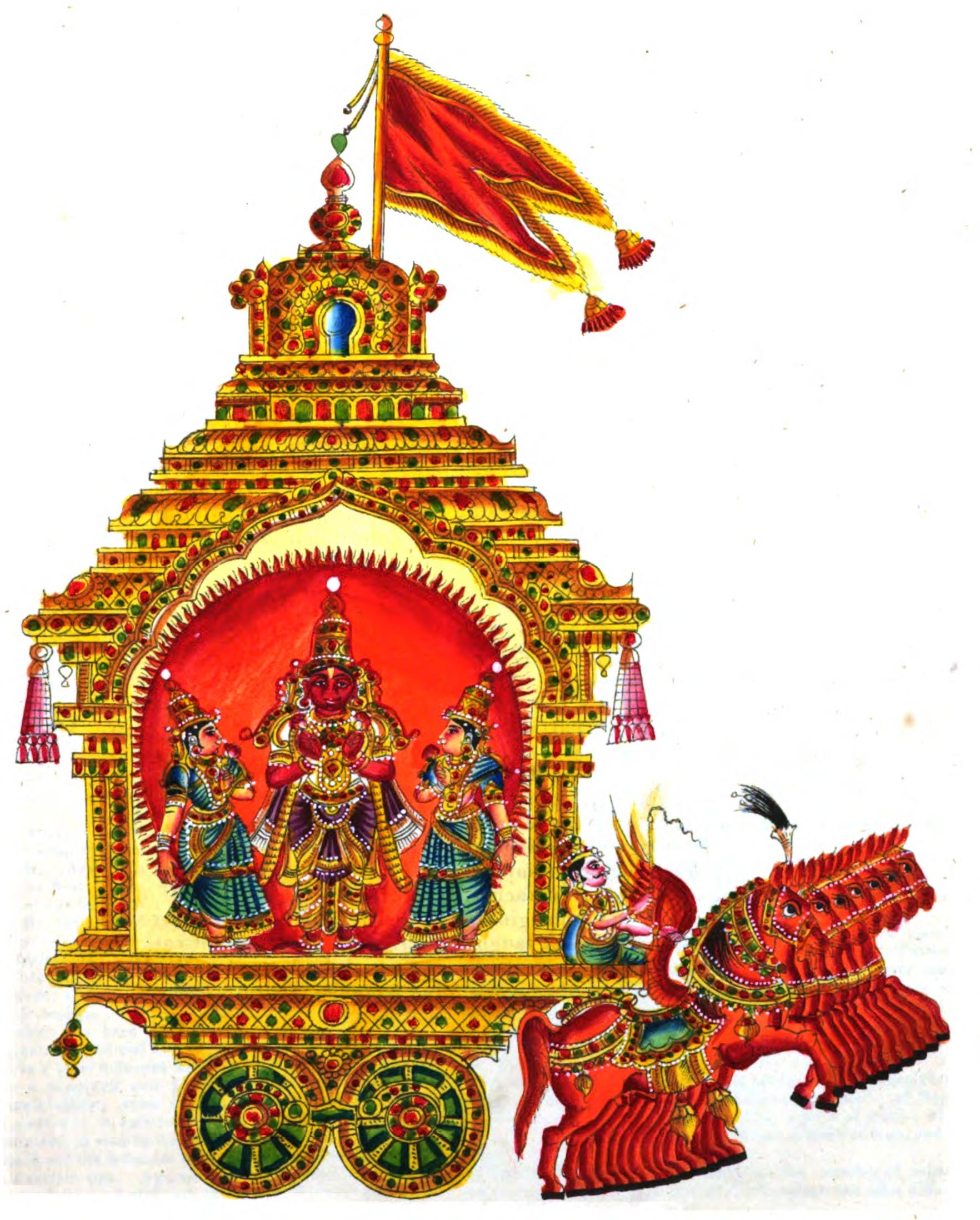
Myth: Sūrya rides a chariot pulled by seven horses — the seven colours of light, the seven days of the week. His charioteer is Aruṇa, the red dawn. He is married to Saṃjñā (consciousness) and Chāyā (shadow).
Sūrya · 7-horse chariot
☽ Chandra · The Moon — the Queen
The Moon is the fastest-moving graha — it races through all 12 signs in about 27 days. It rules your mind (manas), your emotions, your mother, the public, your left eye, your chest, and all the fluids in your body.
The Moon's phase matters enormously. A waxing Moon (śukla pakṣa — the bright half, from new moon to full moon) is strong, nourishing, and benefic. A waning Moon (kṛṣṇa pakṣa — the dark half, from full moon to new moon) is weakening and more malefic. A Moon within 72° of the full Moon point is at peak strength.
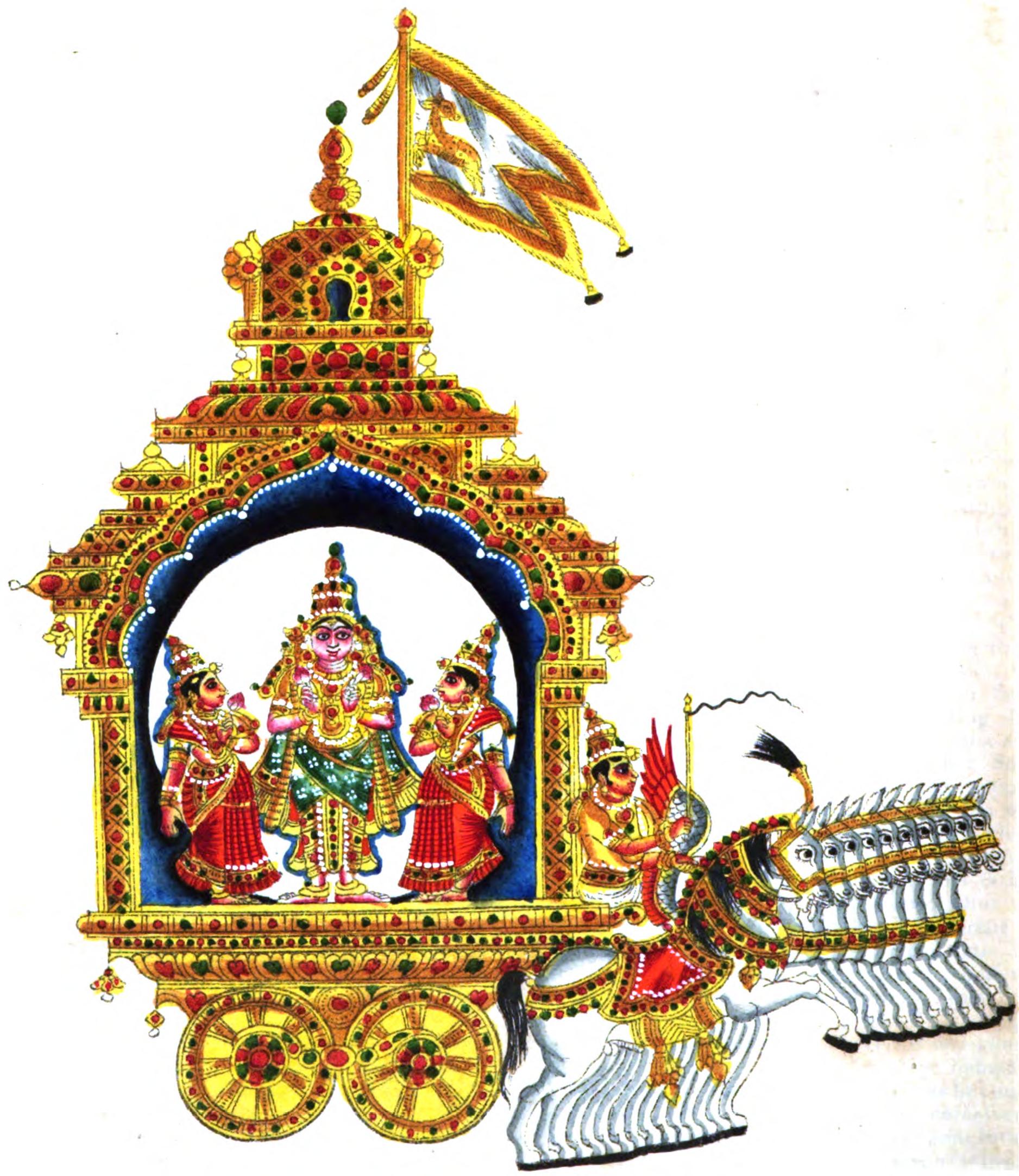
Myth: Chandra is the son of the ocean, born from the churning of the cosmic sea. He married the 27 daughters of Dakṣa — the 27 nakṣatras — but favoured only one, Rohiṇī. Dakṣa cursed him to waste away, which is why the Moon waxes and wanes. He rides a chariot of ten white horses.
Chandra · 10-horse chariot
♂ Maṅgala · Mars — the Warrior
Mars is fire. It rules energy, courage, aggression, siblings (especially younger ones), land, property, accidents, muscles, and bone marrow. Mars acts. It doesn't think — it moves. A strong Mars gives bravery, initiative, physical strength, and competitive drive. An afflicted Mars gives anger, impulsiveness, accidents, or conflict with siblings.
Mars is the natural karaka of the 3rd house (siblings, courage) and the 4th house (land, property — because land is conquered, and Mars is the conqueror).
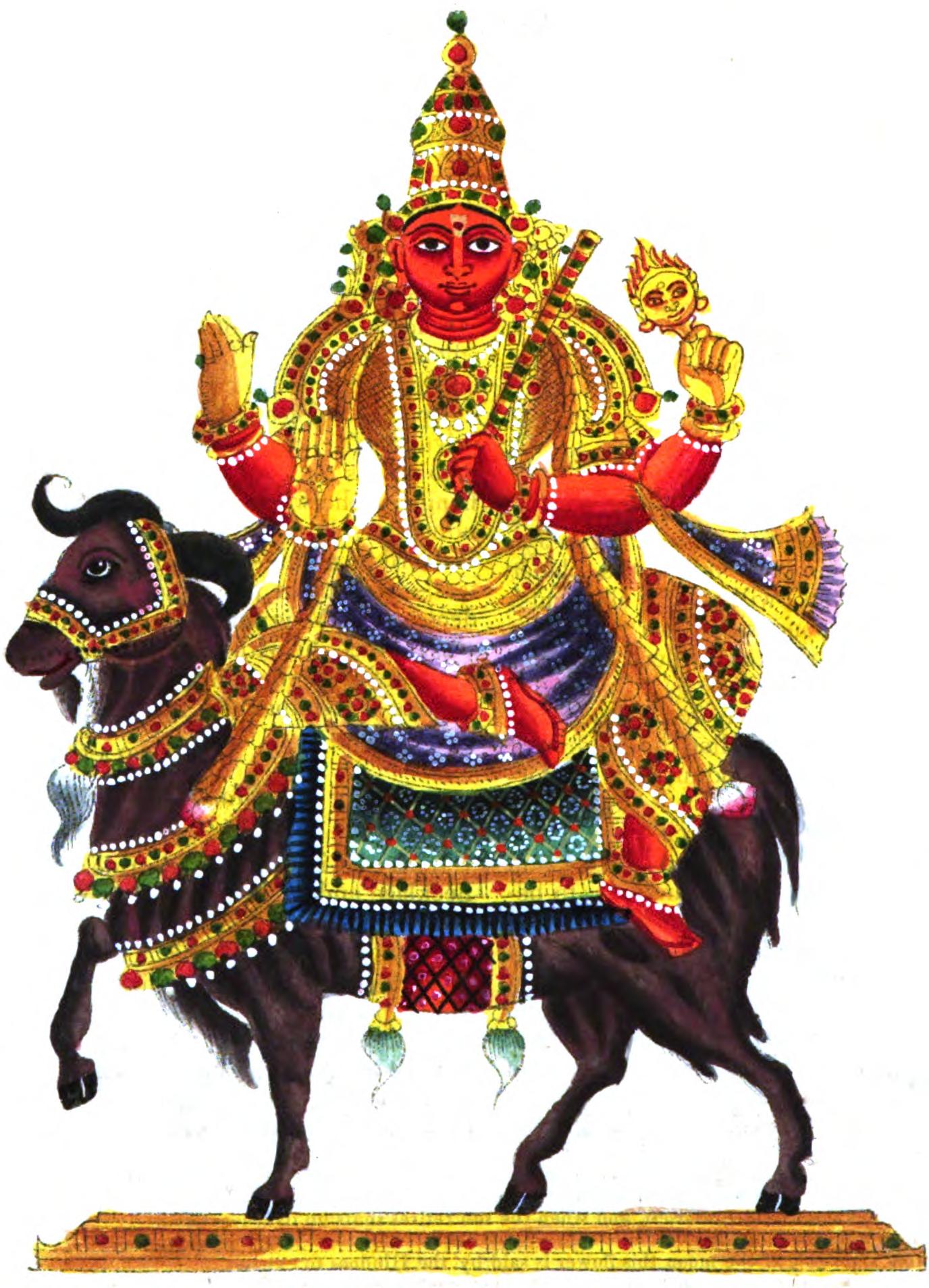
Myth: Kārttikeya (also called Skanda, Murugan, Subrahmaṇya) — the warrior son of Śiva, born from a spark of Śiva's third eye, raised by the six Kṛttikā sisters (the Pleiades). He rides a peacock and carries a spear. He is the commander of the devas' army.
Maṅgala · ram mount
☿ Budha · Mercury — the Prince
Mercury rules intellect, speech, commerce, communication, logic, humour, skin, nerves, and maternal uncles. It is the fastest thinking graha — it processes, connects, and articulates. It is also the most mutable: Mercury takes on the colour of whatever planet it sits with. With Jupiter, Mercury becomes wise. With Mars, Mercury becomes sharp-tongued. With Saturn, Mercury becomes calculating.
Mercury rules two signs: Gemini (airy, conversational, scattered) and Virgo (earthy, analytical, precise).
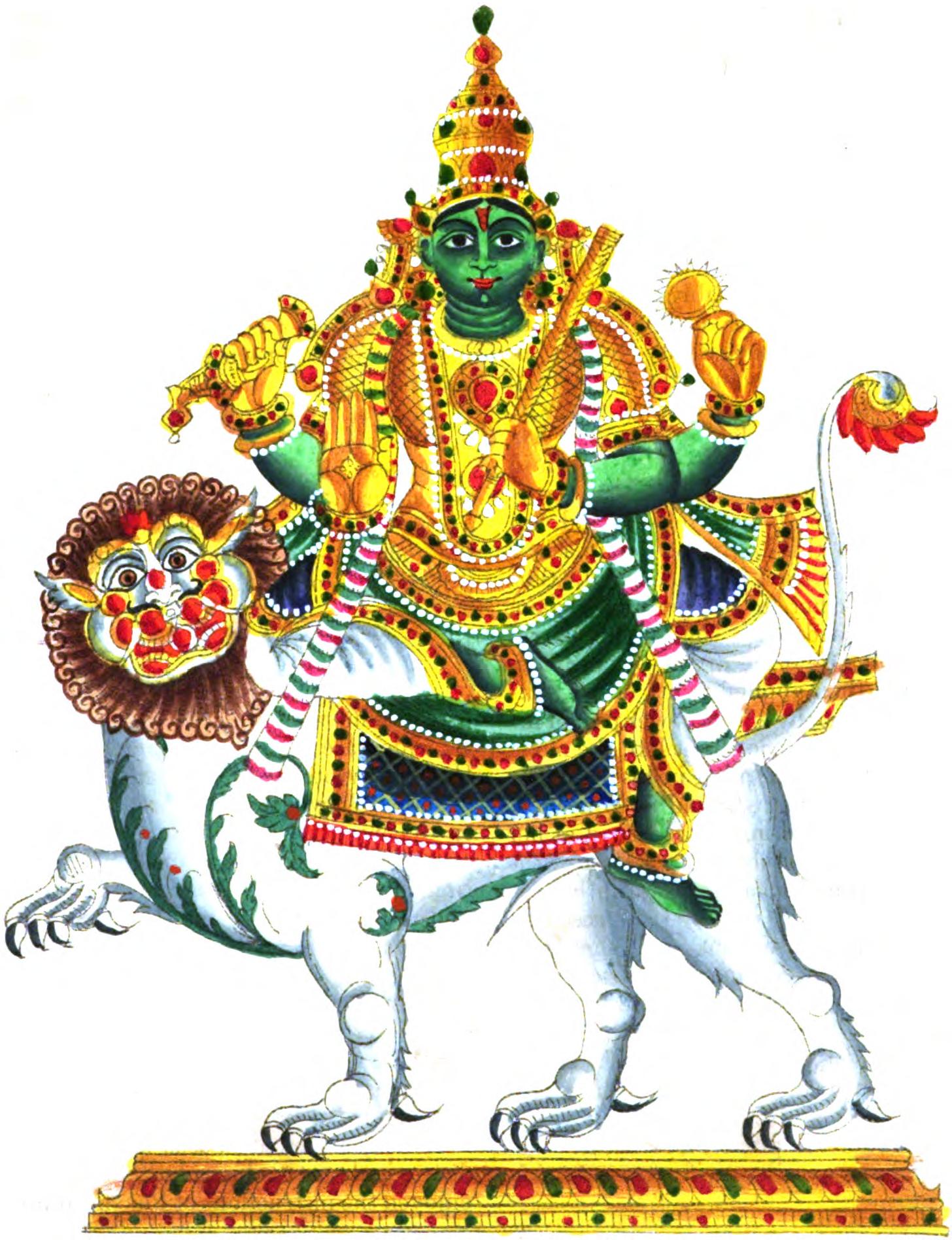
Myth: Budha is the son of the Moon (Chandra) and Tārā, the wife of Bṛhaspati (Jupiter). His birth caused a cosmic scandal — a war between the devas and asuras — which is why Mercury and Jupiter have a tense relationship in the friendship table. Budha is the only graha born from an affair. He is youthful, clever, and androgynous.
Budha · lion mount
♃ Guru · Jupiter — the Teacher
Jupiter is the great benefic — the most naturally generous, protective, and expansive planet in the chart. It rules wisdom, children, the husband (for a woman), gurus/teachers, wealth, fortune, law, religion, liver, fat, and optimism. Jupiter doesn't just give — it gives meaning. A strong Jupiter makes a person hopeful, philosophical, generous, and lucky. A weak Jupiter makes a person cynical, stingy, or prone to excess (too much expansion).
Jupiter is the karaka of the 5th house (children, intellect, past-life credit) and the 9th house (fortune, dharma, guru).
Myth: Bṛhaspati is the guru (teacher) of the devas — the gods. He is the priest who performs the yajña (sacrifice) that sustains cosmic order. He speaks with authority and wisdom. His wife is Tārā, whose affair with Chandra produced Budha. Bṛhaspati forgave her — but the rivalry lingers.
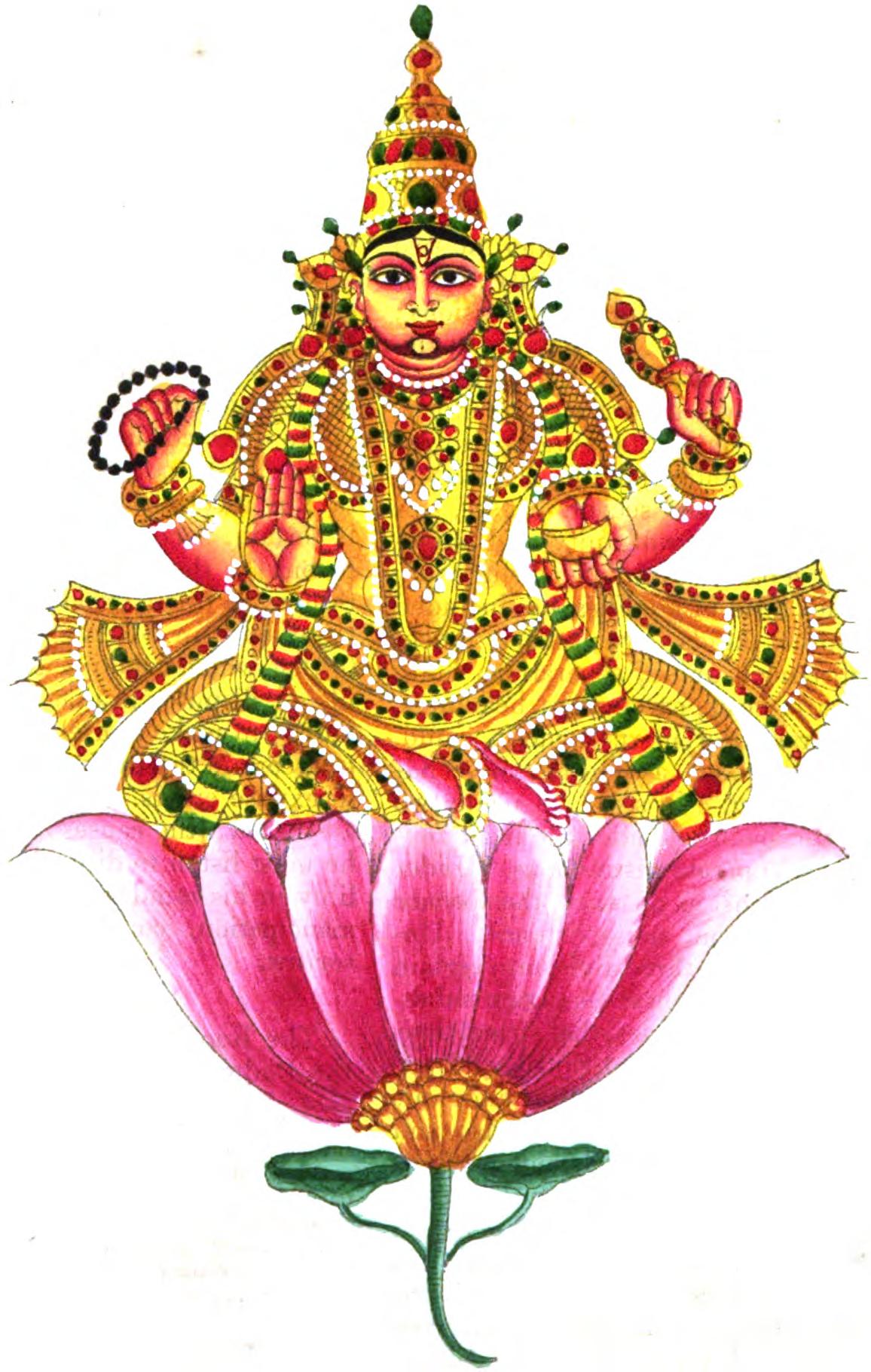
Bṛhaspati · pink lotus
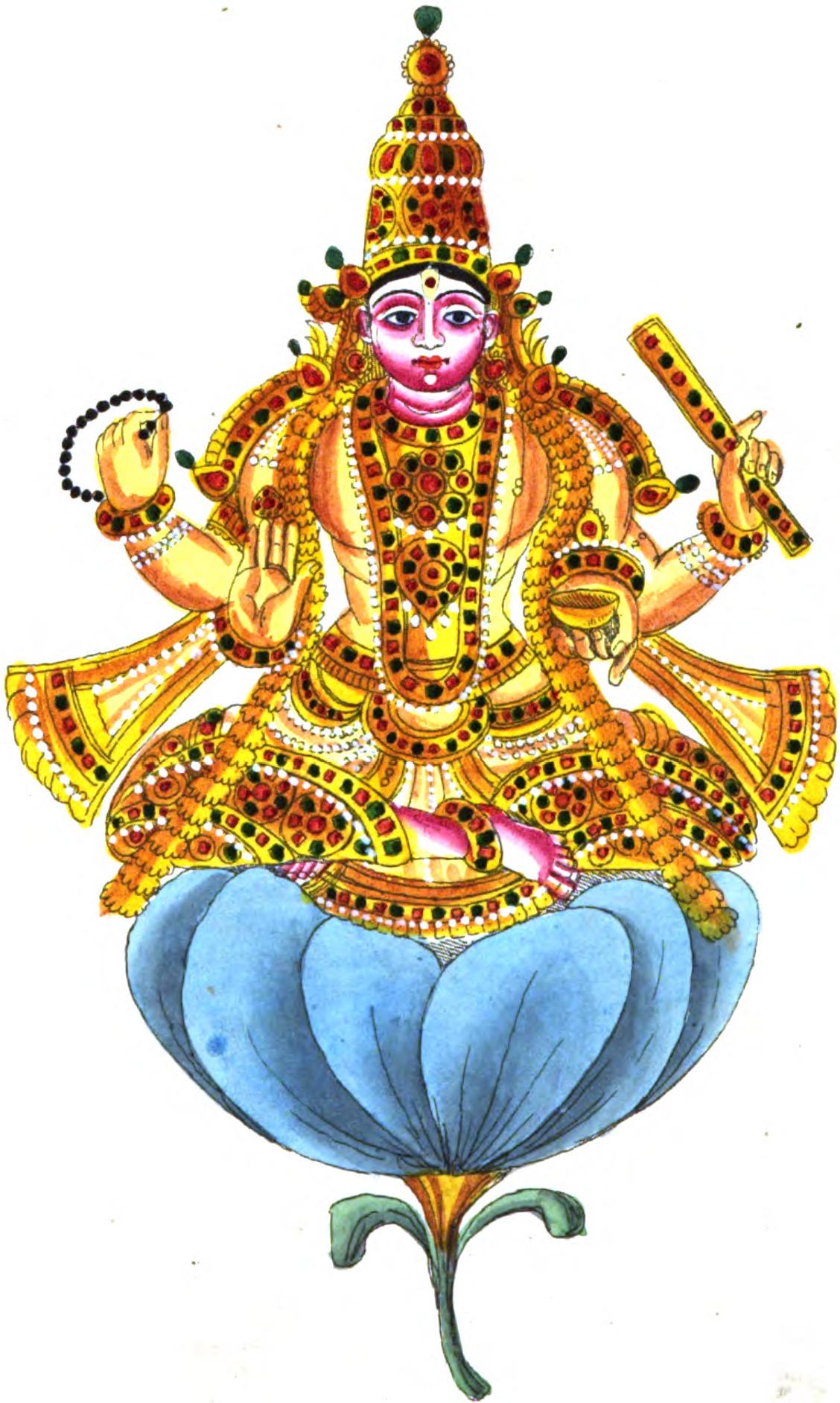
♀ Śukra · Venus — the Lover
Venus rules love, beauty, art, luxury, vehicles, relationships, marriage (the wife, for a man), semen, kidneys, and harmony. Venus is pleasure. It is what you desire, what attracts you, and what you create to attract others. A strong Venus gives charm, artistic talent, material comfort, and relational ease. A weak Venus gives insecurity about love, difficulty in relationships, or artistic frustration.
Venus rules Taurus (sensual, accumulating) and Libra (relational, balancing).
Myth: Śukrācārya is the guru of the asuras (demons). While Bṛhaspati teaches the gods, Śukra teaches the demons. He possesses the Saṃjīvanī vidyā — the secret knowledge of resurrection. He can bring the dead back to life, which makes him invaluable to the asura armies. Śukra is a teacher, but his students are on the "other side" — which is why Venus gives both beauty and a certain cunning.
Śukrācārya · blue lotus
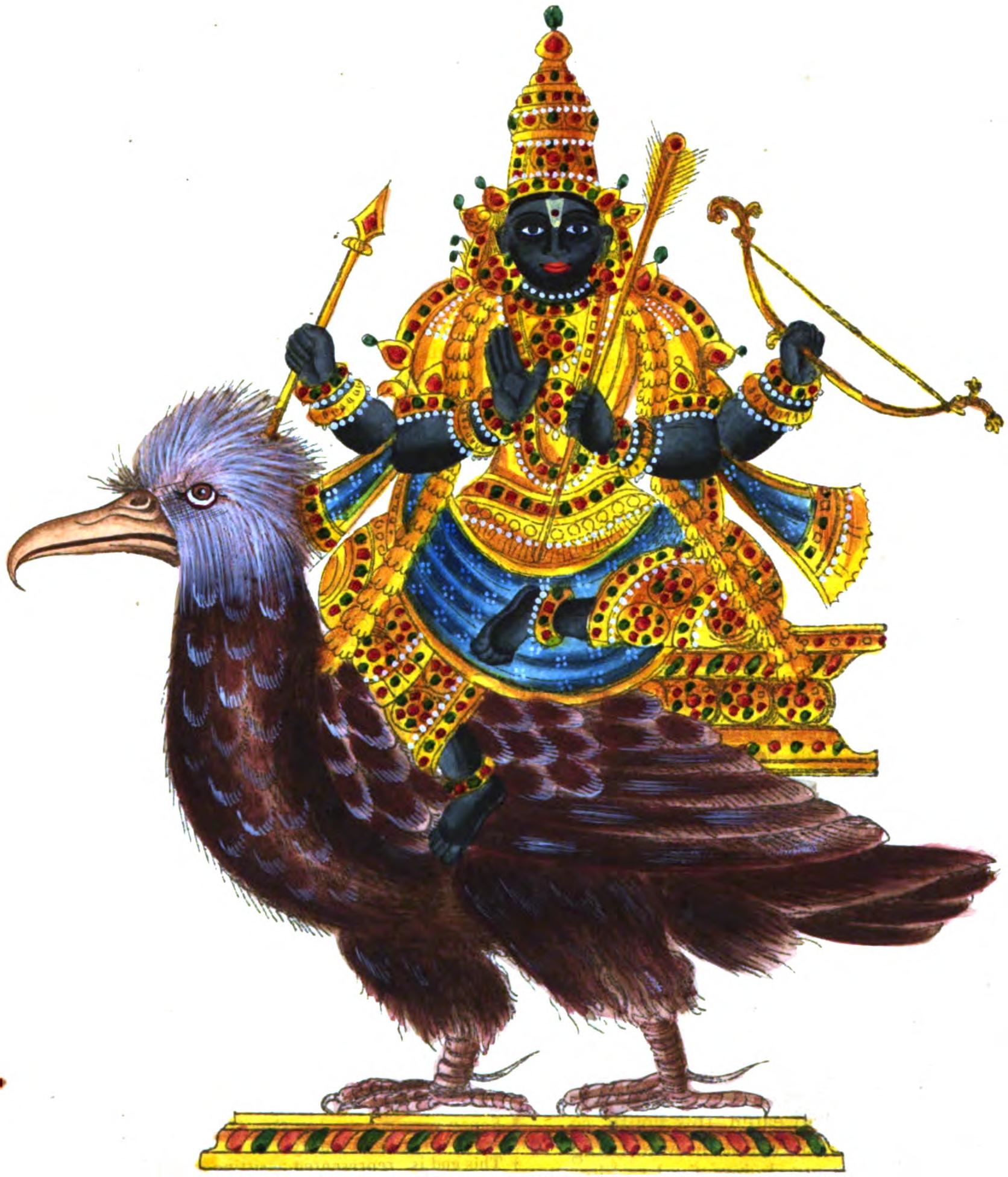
♄ Śani · Saturn — the Taskmaster
Saturn is the slowest visible planet — it takes ~29.5 years to circle the zodiac. It rules discipline, delay, hard work, servants, chronic illness, old age, teeth, bones, grief, and longevity (āyuṣ — how long you live). Saturn does not give easily. It demands effort, patience, and integrity. What Saturn gives, it gives permanently. What Saturn takes, it takes to teach.
Saturn is the most feared planet in Jyotish — and the most misunderstood. Saturn is not cruel. Saturn is just. It rewards effort and punishes laziness. Its transit (the famous Sāḍhe Sātī — 7.5 years of Saturn crossing the Moon) is feared, but those who do their work honestly during Sāḍhe Sātī often emerge stronger, clearer, and more established than before.
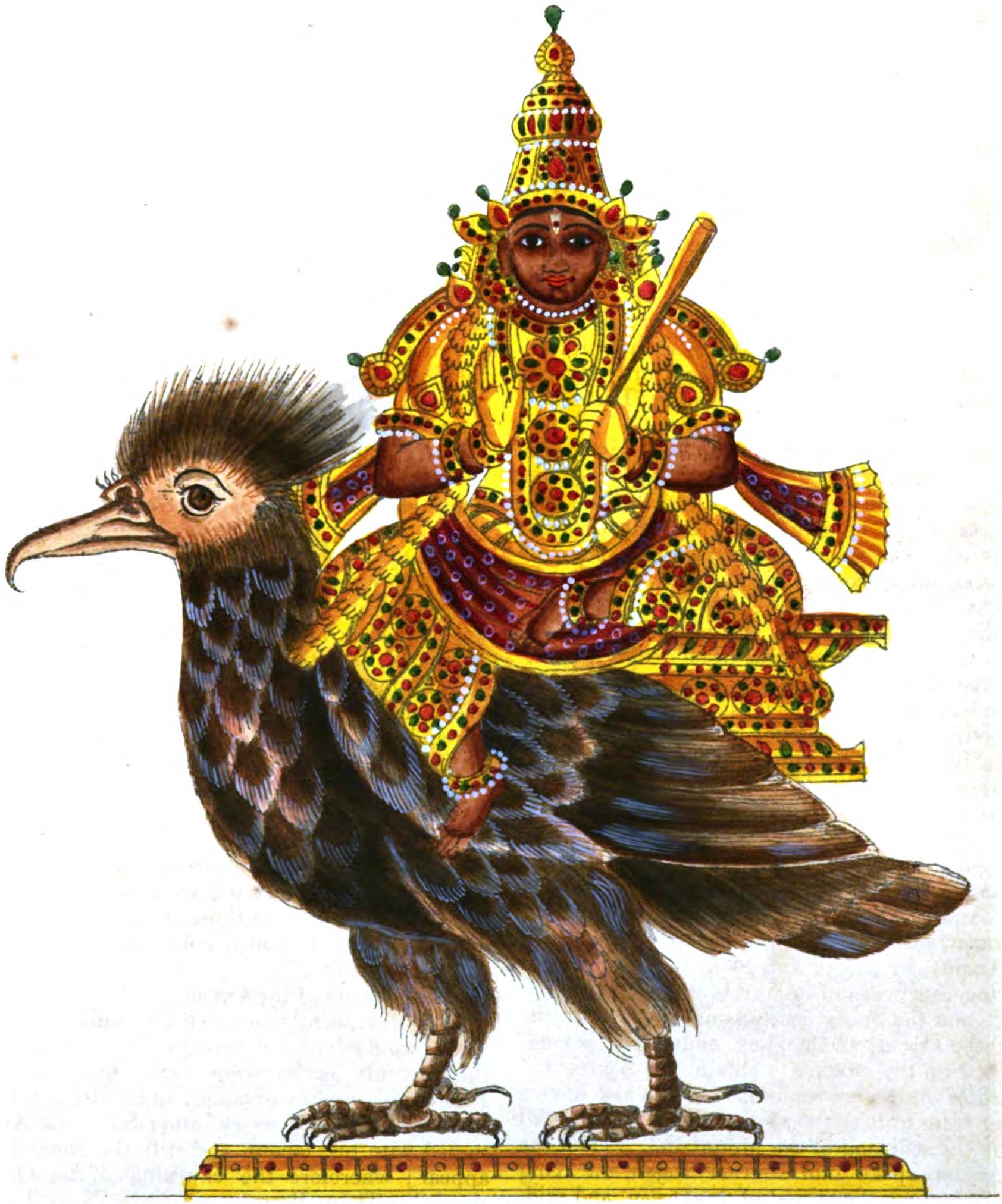
Myth: Śani is the son of Sūrya (the Sun) and Chāyā (Shadow). When Śani was born, his father the Sun looked at him and was eclipsed — because Saturn is dark, and the Sun cannot bear darkness. Father and son have been in tension ever since. Śani rides a crow (or a vulture) and carries a sword. He is the brother of Yama — the god of death — and in some ways Śani is the slow, living version of his brother.
Śani · crow mount
3.2 Rāhu and Ketu — the Head and the Tail
Rāhu and Ketu are not physical bodies. They are mathematical points — the two places where the Moon's orbit crosses the ecliptic (the Sun's path). Where the Moon crosses northward = Rāhu (the ascending node, ☊). Where the Moon crosses southward = Ketu (the descending node, ☋). They are always exactly 180° apart — if Rāhu is at 10° Aries, Ketu is at 10° Libra.
But Jyotish treats them as full grahas because what happens at these two points is powerful: eclipses. When the Sun and Moon align with a node, the light is blocked. A solar eclipse occurs near Rāhu or Ketu. This "swallowing of the light" is at the heart of their myth.
Fig. 3-2 — Rāhu and Ketu are the two points where the Moon's orbit (dashed teal line) crosses the ecliptic (solid line). At these points — and only at these points — eclipses can occur. They are always 180° apart.
The myth — the churning of the ocean
The most famous story in Jyotish. The devas (gods) and asuras (demons) were churning the cosmic ocean of milk to extract amṛta — the nectar of immortality. They used the serpent Vāsuki as the churning rope, wrapped around Mount Mandara.
When the amṛta finally emerged, a great dispute broke out: who would drink it? Viṣṇu took the form of the enchantress Mohinī and offered to distribute the nectar fairly. She served the devas first. But one asura — Svarbhānu — disguised himself as a deva and slipped into the line. He received a drop of amṛta on his tongue.
The Sun and the Moon saw the deception and alerted Viṣṇu. In an instant, Viṣṇu's discus — the Sudarśana Cakra — severed Svarbhānu's body. But the drop of amṛta had already touched his tongue. Both halves became immortal.
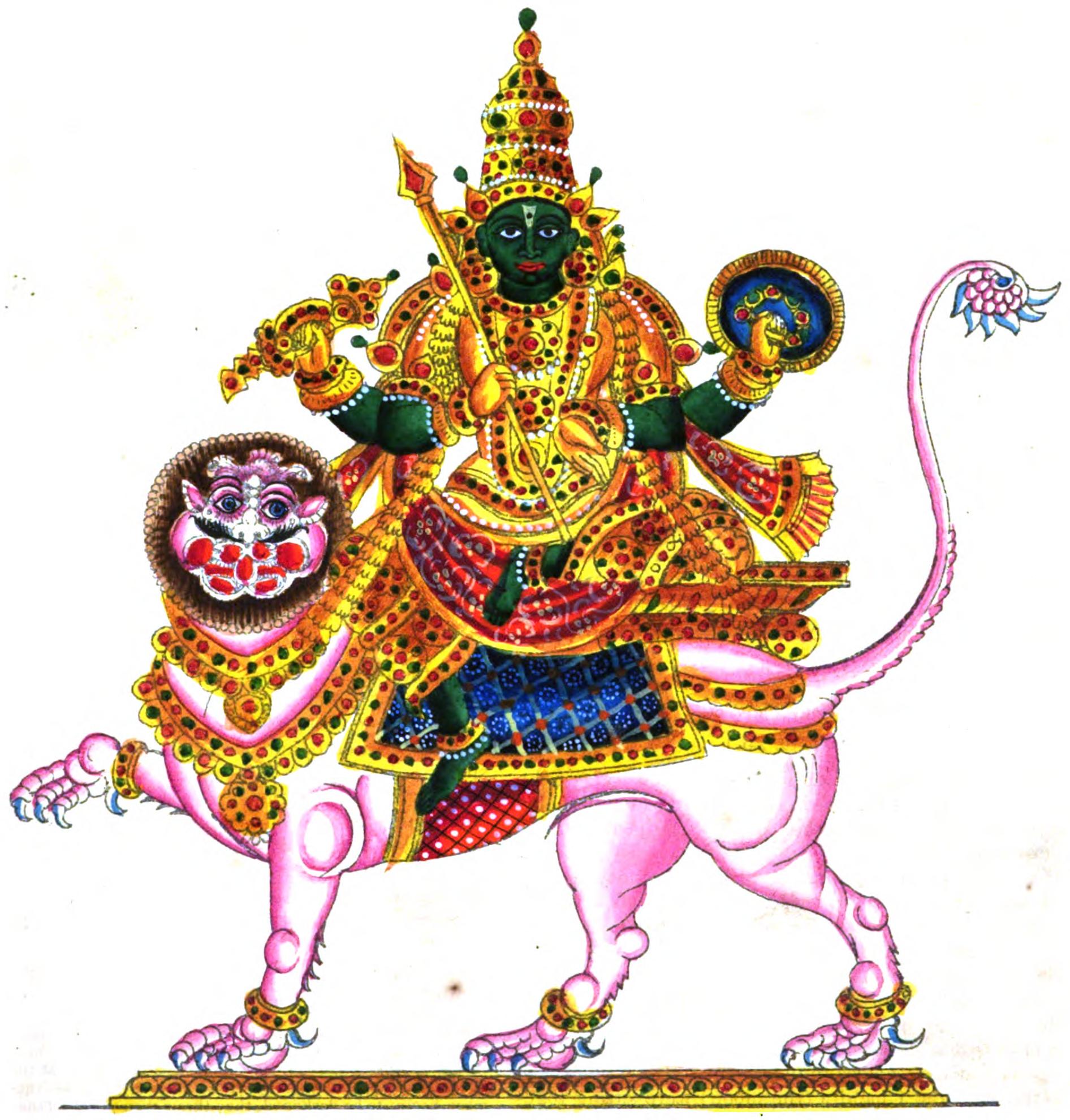
☊ Rāhu — The Cosmic Head
The head became Rāhu — severed, immortal, forever craving. Rāhu has no body, so it can never be satisfied. It amplifies whatever it touches because it is trying to fill a void that cannot be filled. Rāhu's perpetual enemies are the Sun and Moon who exposed him. Periodically, Rāhu swallows them — solar and lunar eclipses — but because he has no body, they pass through him and emerge again.
Rāhu · lion mount
☋ Ketu — The Cosmic Body
The tail became Ketu — the body without a head. Ketu has no mouth, no desire. It doesn't want anything. Ketu represents detachment, mokṣa (liberation), past-life mastery, isolation, and spiritual insight. Where Rāhu amplifies, Ketu dissolves. Ketu is the planet of letting go.
Spiritual inclination → Jupiter + Ketu (wisdom + detachment). Strong 12th house or strong Ketu = spiritual bent.
Relationship with siblings → Mars (younger siblings) + 3rd house. Is Mars well-placed? Is the 3rd house clean?
The rule: Every life topic is read through three lenses — the house, the house lord, and the natural karaka. If the karaka is weak, the topic suffers even if the house is fine. A weak Venus means love is hard; a strong Venus means love flows.
Example 2 · Map all 9 grahas in a sample chart and read their combined story
Given: A chart with the following planets. Read them as a team.
Planet
Sign
House (from Ar Lagna)
Natural nature
Sun
Cancer
4th
Krūra (malefic)
Moon
Pisces
12th
Saumya (waxing, benefic)
Mars
Scorpio
8th
Krūra
Mercury
Leo
5th
Mutable
Jupiter
Sagittarius
9th
Saumya
Venus
Libra
7th
Saumya
Saturn
Capricorn
10th
Krūra
Rahu
Aquarius
11th
Krūra
Ketu
Leo
5th
Krūra
The story these planets tell (before any dignity check)
Sun in the 4th (Cancer): The soul is immersed in home, mother, and emotional security. A krūra in a soft sign — the native may feel their identity is constrained by domestic needs.
Moon in the 12th (Pisces): The mind is in the house of loss, isolation, and spiritual release. This person daydreams, meditates, or escapes. A benefic in the 12th makes the "letting go" gentle.
Mars in the 8th (Scorpio, own sign): Energy goes into the house of transformation, secrets, and sudden events. Mars in own-sign Scorpio in the 8th is intense — a powerful researcher, fighter, or occultist.
Jupiter in the 9th (Sagittarius, own sign): The great benefic in its own sign in the house of fortune. This is one of the strongest placements in all Jyotish — luck, wisdom, and dharma flow naturally.
Rahu in the 11th (Aquarius): The amplifier in the house of gains, friends, and desires. Rahu loves the 11th — this person wants more from their social world, and they may get it.
Ketu with Mercury in the 5th (Leo): Detachment + intellect in the house of children and creativity. This person's creative mind is touched by the otherworldly. They may feel disconnected from their own creative output — or they may produce genius-level work while feeling it's "not really theirs."
Team verdict: This is a spiritually-grounded, fortune-blessed (Jupiter 9th), socially ambitious (Rahu 11th), emotionally introspective (Moon 12th) person with intense hidden depths (Mars 8th) and a creative-intellectual channel touched by something beyond (Ketu-Mercury 5th). Very rich chart.
Priya Thread — who lives in her chart?
Priya's 9 grahas form her cast of characters. Here are the key ones we know so far:
Lagna lord = Sun. The Sun rules Priya's entire life-path. Where is her Sun? We'll find out in Chapter 6. The condition of her Sun — its sign, house, dignity, and aspects — is the single most important question about her chart.
Moon = Cancer, Puṣya nakṣatra pada 2. Her mind is in Cancer (the Moon's own sign — strong). Puṣya is the "nourishing" star, ruled by Saturn, with Bṛhaspati (Jupiter) as deity. Her emotions are Saturn-ruled but Jupiter-blessed — discipline wrapped in wisdom.
Natural benefics in her chart: Jupiter, Venus, Mercury (when unafflicted), and her waxing Moon. These are her "watering cans."
Natural malefics: Sun, Mars, Saturn, Rāhu, Ketu. These are her "pruning shears."
Notebook: "Priya's cast: Sun rules her show. Moon in Puṣya gives Saturn-disciplined, Jupiter-nourished emotions. Her malefics will push her; her benefics will support her."
Self-quiz — check your understanding
Self-quiz · JYO-103 (7 questions)
Q1: What does the word "graha" literally mean, and why is it better than "planet"?
Show answer
"Seizer" or "grasper" — something that grips you. Better than "planet" because Rāhu and Ketu are not physical planets, yet they are full grahas in Jyotish. The word describes the effect, not the physics.
Q2: Name the natural karakas for: (a) mother, (b) younger siblings, (c) the wife (for a man), (d) children.
Show answer
(a) Moon, (b) Mars, (c) Venus, (d) Jupiter.
Q3: Why are Rāhu and Ketu always exactly 180° apart?
Show answer
Because they are the two intersection points of the Moon's orbit with the ecliptic — one where the Moon crosses going north, one going south. These two points are always opposite each other on the circle.
Q4: True or false: A malefic planet is "evil" and should be avoided.
Show answer
False. Malefics are pruning shears — they cut, restrict, and challenge. A chart needs malefics to build character, just as a garden needs pruning. A chart with only benefics produces a person untested by difficulty.
Q5: Which planet's myth involves an affair that started a war between gods and demons?
Show answer
Mercury (Budha). Born from Tārā (Jupiter's wife) and Chandra (the Moon). The scandal caused a war — and explains why Mercury and Jupiter have tension in the friendship table.
Q6: Mercury is called "mutable." What does this mean for a chart reading?
Show answer
Mercury takes on the colour of whatever planet it sits with. With Jupiter, it becomes wise. With Mars, it becomes sharp and argumentative. With Saturn, it becomes calculating. Mercury alone is neutral; Mercury in company is whatever the company is.
Q7: Why is Saturn feared — and why is that fear partially wrong?
Show answer
Saturn brings delay, hardship, and discipline — experiences nobody wants. But Saturn's gifts are permanent because they are earned. A Saturn transit (Sāḍhe Sātī) is hard, but people who do their work honestly during it often emerge more established than before. Saturn is justice, not cruelty.
Practicum — for your notebook
Write all nine grahas in weekday order from memory: Sun, Moon, Mars, Mercury, Jupiter, Venus, Saturn, Rāhu, Ketu. Next to each, write one key sentence about its myth (e.g. "Saturn — son of the Sun and Shadow, rides a crow").
In your own chart: list all nine grahas with their signs and houses. For each one, write whether it is a natural benefic or malefic. Which type dominates your chart?
Identify your strongest natural benefic (by sign placement). This planet represents your easiest-flowing life area. Identify your sharpest natural malefic. This planet represents your growth zone.
Find the Rāhu-Ketu axis in your chart. Which two houses do they occupy? These two houses are your "karmic axis" — the area Rāhu wants you to explore (your growth edge) and the area Ketu has already mastered (your comfort zone from past lives).
For Priya: write a one-sentence description of what each of her 9 grahas brings to her life, based on what you know so far. Use the karaka words (Sun → soul, Moon → mind, Mars → energy, etc.).
Visualizing Graha Motions in the Simulator: Open the 🪐 Live Planet Simulator. Notice how all 9 Grahas are mapped onto the celestial sphere. Turn on Trails: ON and press Play at 1 week/second. Watch: (a) the Moon racing through all 27 nakshatras in 27.3 days, (b) Mars, Jupiter, and Saturn looping into retrograde motion (Vakri) against the sidereal ring, and (c) Rahu and Ketu steadily moving clockwise (always retrograde) exactly 180° apart.
Common pitfalls
❌ Calling the Sun a "full malefic" in every context
The Sun is krūra (naturally malefic) because it burns, dominates, and separates. But it is also the ātma-kāraka — the significator of the soul. A well-placed Sun gives integrity, leadership, and vitality. The Sun is "harsh" in influence (ego, heat, separation) but not "evil."
❌ Thinking Rahu and Ketu cast aspects like real planets
In the Parashari (classical) system, Rāhu and Ketu do not have graha dṛṣṭi (planetary aspect). They receive aspects from real planets but do not send them. Some modern schools disagree; this book follows Parashara.
Chapter 3 — in a breath
9 grahas = 7 visible bodies + 2 lunar nodes. Each has a fixed personality, deity, and natural karaka.
Rāhu: North node — amplifies, obsesses, hungers. Ketu: South node — dissolves, detaches, liberates. Always opposite.
Every life topic is read through three lenses: the house, the house lord, and the natural karaka.
The myths are not decoration — they encode the behavioural pattern of each graha. Śani as the neglected son explains Saturn's seriousness; Budha as the child of scandal explains Mercury's adaptability.
JYO-104 · Chapter 4 of 10
The 12 Bhāvas
भावचक्र · Bhāvacakra — "the house-wheel"
Duration1 week
TypeMemorisation & positional math
PrerequisiteJYO-103 (grahas)
Learning objectives
Recite the meaning of each of the 12 bhāvas in one sentence.
Classify any house as kendra (angular), trikona (trinal), dusthana (difficult), upachaya (growing), or maraka (death-potential).
Compute the house of every planet using the whole-sign formula.
Identify which planet rules which house for any given Lagna.
Use bhavat bhavam (derivative houses) to answer specific life questions.
Distinguish bhāva (house) from rāśi (sign) — they overlap only for one specific Lagna.
4.0 What is a bhāva — and how is it different from a rāśi?
In Chapter 2, you learned the 12 rāśis — the signs. They are fixed slices of the sky. Aries is always Aries. It doesn't matter who you are or when you were born. The rāśis are the background.
Now we introduce the bhāvas — the houses. A house is not fixed to a particular sign. It is relative to your Lagna. Your 1st house is whatever sign your Lagna occupies. Your 2nd house is the next sign. And so on. The houses are the foreground — the arenas where your life story plays out.
Fig. 4-1 — The rāśis are fixed: Aries is always Aries. The bhāvas shift depending on your Lagna. If your Lagna is Leo, Leo becomes your 1st house, Virgo your 2nd, and so on. The Lagna sign is the hinge between the two systems.
4.1 The Twelve-Room House — a guided tour
Imagine a mansion with twelve rooms, arranged in a circle. You enter through Room 1 — that's your Lagna, the front door. From there, you walk through each room in order. Every room has its own purpose, its own furniture, its own view. This is your chart.
Room 1 — तनु Tanu · The Self
Where you enter the mansion. This room is you — your body, your character, your appearance, your approach to life. The planet that rules this room (your Lagneśa — chart ruler) is the master of the entire house. Whatever sign this room is painted in is the colour you see the world through.
Feels like: Standing in front of a mirror. Everything begins here.
Room 2 — धन Dhana · Wealth
The treasury. What you accumulate — money, possessions, knowledge acquired in childhood. Also your speech — the words that come out of your mouth are your first and most personal "wealth." Your family of origin lives here. Your face and right eye are mapped here.
Feels like: Opening your wallet, or opening your mouth to speak. What comes out?
Room 3 — सहज Sahaja · Siblings & Courage
The gymnasium. Your younger siblings, your courage, your initiative, your short journeys, your hands, your practical skills. This is where you do things — write, build, travel, compete. A strong 3rd house gives physical energy and a willingness to try.
Feels like: Lacing up your shoes. Ready to move.
Room 4 — सुख Sukha · Home & Mother
The heart of the mansion. Your mother, your home (the physical building), your emotional foundation, your vehicles, your real estate, your heart (the organ), your basic education, your sense of belonging. This is the room you return to when the world is too much.
Feels like: Curling up in a familiar chair. Safe.
Room 5 — पुत्र Putra · Children & Creativity
The nursery and the studio. Your children, your creative output, your romantic affairs, your past-life merit (pūrva puṇya — the good karma you brought into this life), your intelligence, your stomach. This room produces things — babies, art, ideas.
Feels like: Holding a paintbrush or a newborn. Creating.
Room 6 — अरि Ari · Enemies & Disease
The infirmary and the courtroom. Your enemies, your illnesses, your debts, your daily work/service routine, your pets, your maternal uncle. The 6th is the first of the three dusthana (difficult) houses — life's friction lives here. But friction builds muscle. This room also represents service — the work you do for others.
Feels like: Sweeping the floor or fighting a cold. Necessary discomfort.
Room 7 — युवति Yuvati · Spouse & Partnership
The marriage chamber. Your spouse or long-term partner, your business partnerships, your public dealings, contracts, lawsuits, the "other" in all forms. The 7th house is directly opposite the 1st — it is the mirror. Whoever sits opposite you in life is described by this room.
Feels like: Standing face-to-face with someone. Who are they?
Room 8 — आयु Āyu · Longevity & Secrets
The locked basement. Longevity (how long you live), sudden events, inheritance, the occult, hidden knowledge, sexual organs, transformation. The 8th is the second dusthana. It is the room you don't show guests. Everything hidden, intense, and irreversible lives here. It is also the house of research — digging deep.
Feels like: Opening a door you weren't supposed to open. What's inside?
Room 9 — धर्म Dharma · Fortune & Guru
The temple and the library. Fortune, dharma (purpose/righteousness), guru/teacher, father, long journeys, higher education, religion, law, past-life credit, the thighs. The 9th is the house of what saves you — the wisdom, luck, or teacher that pulls you out of the mud. The strongest trikona (trinal) house after the 1st.
Feels like: Being shown a map when you're lost. Blessed direction.
Room 10 — कर्म Karma · Career & Status
The office and the throne room. Your career, public status, profession, authority, government, fame, the knees. The 10th is the highest point in the chart — the midday Sun at its peak. Whatever you "do" in the world, whatever the public sees when they look at you, lives here.
Feels like: Standing on a stage. Everyone is watching. What do you do?
Room 11 — लाभ Lābha · Gains & Friends
The party room. Gains, income, profits, fulfilment of desires, social circle, friends, elder siblings, network, the calves. The 11th is the house of receiving. What comes to you from the world — money, opportunities, friendships — flows through here.
Feels like: A room full of people you love, and your cup is full.
Room 12 — व्यय Vyaya · Loss & Liberation
The back door — leading out. Loss, expenditure, foreign travel, bed pleasures, sleep, imprisonment, hospitalisation, mokṣa (liberation), the feet. The 12th is the third dusthana — the house of letting go. Everything you spend, release, or transcend passes through here. It is also the house of the unconscious — dreams, meditation, isolation.
4.2 The four house groups — the geography of a chart
Now that you've walked through every room, let's group them by function. These groups determine how planets behave when they occupy those houses.
Kendra (Angular) — ♢ The Pillars · 1, 4, 7, 10
These are the action houses. Planets in kendras act. They manifest visibly. They drive events. The kendras are named after Viṣṇu — the preserver. A chart with many planets in kendras is a chart of a person who does things. The rulers of kendras are powerful — they are the structural beams of the life.
Trikona (Trinal) — △ The Blessed · 1, 5, 9
These are the grace houses. Planets in trikonas flourish. They receive support, luck, and past-life credit. The trikonas are named after Lakṣmī — the goddess of fortune. A chart with strong trikona planets is a chart of a person who receives. The 1st house is both kendra and trikona — the most potent house in the entire chart.
Duṣṭhāna — ✕ The Swamp · 6, 8, 12
These are the difficulty houses. Planets in dusthanas struggle. They face obstacles, hidden enemies, and the consequences of past actions. But dusthanas are not curses — they forge the native. A person with strong dusthana planets has been through something. They are fighters, survivors, or spiritual seekers. The dusthanas are called triṣaḍāya in Sanskrit.
Upachaya — ↑ The Hill · 3, 6, 10, 11
These are the growth houses. Planets in upachayas start weak and get stronger over time. Malefics actually do well in upachayas because friction produces growth. These houses represent effort that pays off — the slow climb that builds the view. A planet in an upachaya house is a planet that improves with age.
Maraka houses — 2nd and 7th — handle with care
The 2nd and 7th houses carry the technical label "maraka" — death-inflicting. Their planetary rulers, during their dasha periods, can trigger the end of life if the chart supports a dangerous time. This is doctoral-level analysis requiring ≥3 converging techniques. Never predict death. At the Associate level, know the label exists. At higher levels, use it with extreme caution and clinical humility.
4.3 Computing a planet's house — the one formula you need
Whole-sign house formula
House = ((Planet_Sign_Index − Lagna_Sign_Index) mod 12) + 1
Where sign_index is 0-based (Aries=0, Taurus=1… Pisces=11). In whole-sign Jyotish, the entire sign becomes the house. If your Lagna is at 8°33′ Libra, the whole of Libra is your 1st house, the whole of Scorpio is your 2nd, etc. This is the simplest and most orthodox method.
4.4 Bhavat Bhavam — "house from house"
This is one of the most powerful techniques in Jyotish. Any house can become a temporary "ascendant" for a specific question. Count from that house just like you count from the Lagna.
Derivative formula
Derivative House = ((Target_House + Count − 1) mod 12) + 1
Question
Target
Count
Formula
Result
Spouse's wealth
7th
2nd from 7th
(7+2−1)%12+1
8th
Mother's career
4th
10th from 4th
(4+10−1)%12+1
1st
Child's education
5th
4th from 5th
(5+4−1)%12+1
8th
Father's longevity
9th
8th from 9th
(9+8−1)%12+1
4th
Sibling's marriage
3rd
7th from 3rd
(3+7−1)%12+1
9th
Grandchildren
5th
5th from 5th
(5+5−1)%12+1
9th
Boss's money
10th
2nd from 10th
(10+2−1)%12+1
11th
Spouse's siblings
7th
3rd from 7th
(7+3−1)%12+1
9th
Why this matters
Without bhavat bhavam, the 8th house is just "longevity and secrets." With it, the 8th is also: your spouse's money, your child's education, your inheritance, your research depth. Every house gains multiple meanings through derivation.
4.5 Worked examples
Example 1 · Find all planetary houses for a Libra Lagna
Given: Lagna = Tulā (Libra), sign index = 6. Planet at Gemini = index 2.
For Mercury in Gemini
House = ((2 − 6) mod 12) + 1 = ((−4) mod 12) + 1 = 8 + 1 = 9th house.
Mercury in the 9th house — the house of fortune, dharma, and guru. The intellect (Mercury) is channelled into higher knowledge and purpose. This is an excellent placement for a teacher, scholar, or philosopher.
Full table for this Lagna
Planet sign
Index
Formula
House
Classification
Libra
6
(6−6)%12+1
1
Kendra + Trikona
Scorpio
7
(7−6)%12+1
2
Maraka
Gemini
2
(2−6)%12+1
9
Trikona
Pisces
11
(11−6)%12+1
6
Dusthana + Upachaya
Key insight: A planet in Gemini (an airy, mercurial sign) is in the 9th house for a Libra Lagna — one of the three trikonas, the house of grace. The sign is Mercury's; the house is Jupiter's domain. This creates a blend: mercurial intellect in a jupiterian arena of wisdom and purpose.
Example 2 · Build the full house-lordship table for Scorpio Lagna
Given: Lagna = Vṛścika (Scorpio), sign index = 7. Walk through all 12 houses, assigning lords and classifications.
H
Sign
Lord
Classification
What this means
1
Scorpio
Mars
Kendra + Trikona
Mars rules the self AND a dusthana (6th). Dual role.
2
Sagittarius
Jupiter
Maraka
The great benefic rules a death-potential house. Complex.
3
Capricorn
Saturn
Upachaya
Saturn in an upachaya — slow growth, permanent results.
4
Aquarius
Saturn
Kendra
Saturn also rules a kendra — mixed lordship.
5
Pisces
Jupiter
Trikona
Jupiter also rules a trikona — the blessing returns.
6
Aries
Mars
Dusthana + Upachaya
Mars rules both 1 and 6 — self and enemies.
7
Taurus
Venus
Kendra + Maraka
Venus rules both marriage and loss (12th).
8
Gemini
Mercury
Dusthana
Mercury as dusthana lord — intellect faces hidden obstacles.
9
Cancer
Moon
Trikona
Moon in its trinal dignity — emotional fortune.
10
Leo
Sun
Kendra + Upachaya
Sun in career house + growth — public authority rising.
11
Virgo
Mercury
Upachaya
Mercury also in upachaya — intellectual gains grow.
12
Libra
Venus
Dusthana
Venus also rules loss — love and sacrifice intertwined.
Lordship pattern for Scorpio Lagna: Mars (1+6), Venus (7+12), Mercury (8+11), Jupiter (2+5), Saturn (3+4), Sun (10 alone), Moon (9 alone). Notice how every planet except Sun and Moon rules two houses — one "good" and one "difficult." This is the norm in Jyotish. The art is weighing whether a planet's "good" lordship or "difficult" lordship dominates in the native's life.
Priya Thread — her twelve rooms
Priya's Lagna = Leo (index 4). Build her whole-sign house table in your notebook:
1st (Leo): Kendra + Trikona. Ruled by Sun. Her front door is regal, visible, warm.
7th (Aquarius): Kendra + Maraka. Ruled by Saturn. Her marriage house is Saturnian — serious, delayed, or built through duty.
5th (Sagittarius): Trikona. Ruled by Jupiter. Her children/creativity house is blessed.
9th (Aries): Trikona. Ruled by Mars. Her fortune/dharma house is martial — courage-driven, action-oriented luck.
6th (Capricorn): Dusthana + Upachaya. Ruled by Saturn. Her house of enemies/service is Saturnian — enemies are patient and systematic.
Note especially: Priya's Sun (Lagna lord) and her 7th lord (Saturn) are the two planets that will define her most. We'll find them in Ch 6.
Self-quiz
Self-quiz · JYO-104 (6 questions)
Q1: What is the difference between a rāśi and a bhāva?
Show answer
A rāśi (sign) is a fixed 30° slice of the zodiac. A bhāva (house) is relative to your Lagna — it shifts depending on which sign rises at your birth. Aries is always Aries, but Aries could be your 1st house, your 5th house, or any other, depending on your Lagna.
Q2: Planet in Aquarius (index 10). Lagna = Leo (index 4). What house?
Show answer
((10−4)%12)+1 = 7. 7th house — marriage/partnership. For a Leo Lagna, Aquarius is the 7th house.
Q3: Which house group makes planets "struggle" but also builds character?
Show answer
Duṣṭhāna — houses 6, 8, 12. Planets here face obstacles, but survivors of dusthana placements are fighters.
Q4: Why is the 1st house the most potent?
Show answer
It is the only house that is both a kendra (action) and a trikona (grace). It carries Viṣṇu's sustaining energy AND Lakṣmī's blessing.
Q5: Your sibling's spouse — which derivative house?
Show answer
7th from 3rd = (3+7−1)%12+1 = 9th house.
Q6: Why do malefics do well in upachaya houses?
Show answer
Upachaya houses (3, 6, 10, 11) represent growth through effort. Malefics produce friction, and friction in a growth-oriented house accelerates development. A malefic like Mars in the 3rd (upachaya) makes the native fight — and win.
Practicum — for your notebook
For your own Lagna sign, list all 12 house lords. Then classify each house (kendra / trikona / dusthana / upachaya / maraka).
Compute the house of every planet in your chart using the formula. Verify each result in JHora.
Identify which of your planets sits in a dusthana (6/8/12). This planet is "under stress." Which planet is it? What does it rule?
Using bhavat bhavam, find: (a) your mother's career house, (b) your spouse's siblings, (c) your child's education.
Draw a 12-box grid with your Lagna in box 1, fill in the remaining signs in order, then place each planet. Label the kendras, trikonas, and dusthanas in different colours. This is your mental chart — carry it forward.
For Priya: write one sentence about what each of her four kendras (1, 4, 7, 10) means, given what you know about her Lagna (Leo) and its natural houses.
Common pitfalls
❌ Confusing bhāva (house) with rāśi (sign)
"Scorpio" is always a sign. "8th house" is always relative to the Lagna. For a Libra Lagna, Scorpio = 2nd house. For a Pisces Lagna, Scorpio = 9th house. Same sign, different house function.
Chapter 4 — in a breath
12 bhāvas = the arenas of life. House = ((planet_sign − lagna_sign) % 12) + 1.
Each house has a lord (the planet ruling the sign in that house). The lord's placement determines how the house delivers.
Bhavat bhavam: count from any house as a temporary ascendant. Every house gains multiple meanings.
The 1st house is the only house that is both kendra AND trikona — the most powerful house in any chart.
JYO-105 · Chapter 5 of 10
Casting the Chart I — the Lagna
लग्ननिर्णय · Lagnanirṇaya — "determining the ascending degree"
Duration1 week
TypeCalculation & concept
PrerequisiteJYO-104 (houses)
Learning objectives
Define the Lagna physically — the exact degree of the zodiac rising on the eastern horizon.
Understand why ±4 minutes of birth time matters profoundly.
Recognise the conceptual chain from clock time → LST → ascendant → sidereal Lagna.
Record a Lagna precisely in degree, rāśi, and nakṣatra.
Shift birth time by ±15 minutes and observe Lagna sign/navamsa boundary change.
5.1 What is the Lagna — physically?
Stand outside at dawn. Face east. The sky is brightening. As the Earth rotates, the horizon "sinks" below the stars, and new stars become visible above the horizon line. The Sun hasn't risen yet, but some constellation is crossing the eastern horizon right now. That constellation — that exact degree of the zodiac touching the horizon — is the Lagna.
At your birth, a specific degree of a specific sign was rising in the east from your birthplace. That degree is your Lagna. It is unique to your time and place. Two people born at the same minute on opposite sides of the world have different Lagnas because their horizons are different. Two people born in the same hospital one minute apart have Lagnas that differ by ~15 arc-minutes — because the Earth rotates 1° every 4 minutes.
This is why the Lagna is called the "ascendant" in Western astrology — it is the degree ascending at the moment of birth. In Jyotish, लग्न means "attached to" or "stuck to" — the degree of the zodiac that is attached to your eastern horizon at that instant.
Fig. 5-1 — The Lagna is the exact degree of the zodiac touching the eastern horizon at birth. The Earth rotates east-to-west, so new zodiac degrees rise every moment. The Lagna shifts ~1° every 4 minutes.
5.2 Why 4 minutes can change everything
The Earth rotates 360° in ~24 hours = 15° per hour = 1° every 4 minutes. A 4-minute error in birth time shifts the Lagna by ~1°. That might sound small — but the navamsa (D9, the 9th-divisional chart we'll study in Book II) has segments only 3°20′ wide. A 4-minute Lagna shift of ~1° can move the D9 Lagna one-third of the way to a different navamsa sign. A 12-minute shift (3°) can change the D9 Lagna completely.
This is why birth time must be as accurate as possible. Hospital records recorded within minutes of delivery are reliable. A mother's recollection of "around lunchtime" could be off by hours. If your birth time is uncertain, Book IV (JYO-701 — Rectification) teaches you to pin it down by matching dated life events to dasha periods. For now, use the best time you have and note the uncertainty.
The ±15-minute experiment
Open JHora. Enter your birth data with the stated time. Record your Lagna degree and D9 Lagna sign. Now shift the time −15 minutes and record again. Now shift +15 minutes. If your D9 Lagna sign changes in any of the three, your birth time is near a navamsa boundary and needs future rectification. This is the single most revealing test you can do right now.
5.3 How the Lagna is computed — the chain you need to understand
You don't need to hand-compute the Lagna. JHora does it. But you must understand the chain so you're not a black-box user. Here's what happens under the hood:
The Lagna chain (conceptual)
Step
What happens
Your job
1
Clock time → UTC (correct for timezone)
Enter correct timezone in JHora. IST = UTC+5:30.
2
UTC → Local Sidereal Time (LST). Adds longitude correction + sidereal offset.
Enter correct latitude/longitude for birthplace.
3
LST → Right Ascension of Midheaven + 90° → Oblique Ascension of the Ascendant
Trust the software.
4
Oblique Ascension → Tropical ecliptic longitude of Lagna, using obliquity formula
Trust the software.
5
Tropical Lagna − Ayanamsa = Sidereal Lagna
Verify ayanamsa = Lahiri.
The mathematical engine under step 3-4 involves the obliquity formula: tan(λ) = [sin(θ)·cos(ε) + tan(φ)·sin(ε)] / cos(θ) where λ = ascendant longitude, θ = LST hour-angle, φ = latitude, ε = obliquity (~23.44°). Don't compute this by hand. Know that it exists, and know that a 4-minute input error shifts the output by ~1°.
5.4 The whole-sign framework — the Lagna sign becomes the 1st house
Once JHora gives you a Lagna degree and sign, the rest follows mechanically:
House 1 = the entire sign of the Lagna (e.g. if Lagna = Leo 21°15′, all 30° of Leo are your 1st house).
House 2 = the next sign (Virgo). House 3 = Libra, and so on around the wheel.
The Lagna degree within the sign matters for: the navamsa (D9) Lagna sign, the dasha balance at birth, and Jaimini karakas (degree-based ranking). All of these are Book II and beyond. For Book I: know your Lagna sign, and know your Lagna degree to the minute.
5.5 Lagna nakṣatra — the subtle personality layer
Underneath your Lagna sign, there's a finer layer: the Lagna nakṣatra. Every 13°20′ segment of the zodiac is a nakṣatra (Chapter 7), and the specific nakṣatra rising at your birth adds texture to your personality that your Lagna sign alone cannot give.
Priya's Lagna = Leo 21°15′. Nakṣatra = floor(141.25° / 13.333°) = 10. Index 10 = Pūrva Phālgunī (0-based; 11th nakṣatra). Ruler: Venus. Deity: Bhaga (the god of marital bliss and prosperity). Symbol: the front legs of a bed / a hammock.
This means Priya's Leo ascendant is Venus-coloured at the nakṣatra level. Her "fixed fire" energy is softened by a Venus-ruled star of pleasure and comfort. She doesn't just command attention — she does it with charm. The Bhaga deity adds a flavor of enjoyment and sensual ease to her otherwise solar intensity.
5.6 Worked examples
Example 1 · The ±15-minute sensitivity test
Given: Birth at 11:35 AM IST, 28°N, 77°E. Lagna = Libra 8°33′, Svātī nakṣatra pada 1.
−15 min (11:20 AM)
Lagna ≈ Libra 4°48′. Still Libra, but now the navamsa segment shifts: 4°48′ / 3°20′ = 1.44 → 2nd navamsa of Libra (Sagittarius navamsa). Original was in 3rd navamsa (Capricorn navamsa). D9 Lagna changed sign — from Capricorn to Sagittarius. An apparently minor 15-minute ambiguity completely rewrites the marriage/dharma signature.
+15 min (11:50 AM)
Lagna ≈ Libra 12°18′. 12°18′ / 3°20′ = 3.69 → 4th navamsa of Libra (Aquarius navamsa). D9 Lagna changed again. Three different D9 Lagna signs from three birth times 15 minutes apart.
Lesson: A 30-minute ambiguity window (common in oral family records) can produce three different D9 Lagna signs. This is why rectification (JYO-701) uses dated life events to pin down which navamsa segment is correct. For now: use your best known time. If your time is uncertain, note it.
Example 2 · Build the whole-sign house structure for Priya
Given: Priya's Lagna = Leo (Siṃha) 21°15′, sign index = 4.
House
Sign
Index
Lord
Range
Class
1
Leo ♌︎
4
Sun
120°–150°
Kendra + Trikona
2
Virgo ♍︎
5
Mercury
150°–180°
Maraka
3
Libra ♎︎
6
Venus
180°–210°
Upachaya
4
Scorpio ♏︎
7
Mars
210°–240°
Kendra
5
Sagittarius ♐︎
8
Jupiter
240°–270°
Trikona
6
Capricorn ♑︎
9
Saturn
270°–300°
Dusthana + Upachaya
7
Aquarius ♒︎
10
Saturn
300°–330°
Kendra + Maraka
8
Pisces ♓︎
11
Jupiter
330°–360°
Dusthana
9
Aries ♈︎
0
Mars
0°–30°
Trikona
10
Taurus ♉︎
1
Venus
30°–60°
Kendra + Upachaya
11
Gemini ♊︎
2
Mercury
60°–90°
Upachaya
12
Cancer ♋︎
3
Moon
90°–120°
Dusthana
Priya's lordship summary: Sun rules 1 · Moon rules 12 · Mars rules 4+9 · Mercury rules 2+11 · Jupiter rules 5+8 · Venus rules 3+10 · Saturn rules 6+7. Note: Saturn rules both a dusthana (6th) and a kendra+maraka (7th). The 7th lord also being a dusthana lord creates complexity for marriage — a theme we'll track through all 10 chapters.
Self-quiz
Self-quiz · JYO-105 (5 questions)
Q1: If the Lagna shifts 1° every 4 minutes, how many degrees does it shift in 1 hour?
Show answer
15°. 60 minutes / 4 = 15. This is why a 1-hour time error shifts the Lagna by an entire half-sign.
Q2: Why does the D9 Lagna matter so much for birth-time accuracy?
Show answer
The D9 navamsa segments are only 3°20′ wide. A ~14-minute time error (3.5°) can place the D9 Lagna in a completely different navamsa sign — changing the marriage/dharma signature of the chart.
Q3: What is the "whole-sign" framework?
Show answer
The entire 30° of the Lagna sign becomes the 1st house. The next sign becomes the 2nd, and so on. No cusps. No fractional houses. This is the orthodox Jyotish method used throughout this book.
Q4: Priya's Lagna = Leo 21°15′. What is her Lagna nakṣatra?
Show answer
floor(141.25° / 13.333°) = 10 → Pūrva Phālgunī (11th nakṣatra, 0-based index 10). Ruled by Venus. Deity: Bhaga. This adds a Venusian charm to her solar Leo ascendant.
Q5: True or false: You should hand-compute the Lagna using the obliquity formula for every chart.
Show answer
False. Let JHora do the trigonometry. Your job is to ensure the inputs are correct (time, timezone, place, ayanamsa) and to understand the sensitivity (4 min = 1°).
Practicum
Enter your birth data in JHora. Record your Lagna to the degree. Perform the ±15-minute experiment. Does your D9 Lagna change sign? Note the result.
Find your Lagna nakṣatra using: floor(Lagna_longitude / 13.333°). Look up its lord, deity, and symbol. Write one paragraph on what this nakṣatra adds to your Lagna sign.
Draw a simple horizon diagram: East on the right, your Lagna rising, the 7th house (descendant) setting in the west. Label the four kendras.
Build Priya's complete house structure table (as in Example 2 above) in your notebook. This table is her skeleton — you'll use it in every remaining chapter.
Observing the Horizon & Lagna in the Simulator: Open the 🪐 Live Planet Simulator. Observe the orange Eastern Horizon line crossing Earth at the observer axis (Nieuw-Nickerie, Suriname). Advance the clock in 1-hour increments: notice the Lagna display in the drawer and watch the eastern horizon sweep through all 12 Rashis in 24 hours (~2 hours per sign).
Chapter 5 — in a breath
The Lagna = the exact zodiac degree rising on the eastern horizon at birth time and place.
It shifts ~1° per 4 minutes. Birth time must be accurate to within 4 minutes for a reliable chart.
The Lagna sign becomes the 1st house (whole-sign). All other houses follow in zodiacal order.
The Lagna nakṣatra adds a fine emotional texture underneath the sign's broad personality.
Let JHora compute the Lagna. Your job is correct inputs (time, timezone, location, ayanamsa) and awareness of the sensitivity.
JYO-106 · Chapter 6 of 10
Casting the Chart II — Planetary Positions
ग्रहनिर्णय · Grahamirṇaya — "determining the planets' places"
Duration1 week
TypeCalculation
PrerequisiteJYO-105 (Lagna)
Learning objectives
Read a standard ephemeris and extract tropical longitudes for all seven classical planets + the nodes.
Convert tropical longitudes to sidereal using the Lahiri ayanamsa.
Interpolate the Moon's position for births not at the ephemeris reference hour.
Determine sign index, degree-in-sign, house, and nakṣatra for every graha.
Assemble a complete D1 chart independently — Lagna + all 9 placements — then verify in JHora.
6.1 The postman's ledger — what an ephemeris is
Before computers, astrologers used a printed book called an ephemeris — a daily ledger of where every planet was, usually at midnight Universal Time (00:00 UT). Each row was one date. Each column was one planet. The astrologer would open the book to the birth date, copy down the numbers, do some arithmetic, and cast the chart.
Today, JHora does this arithmetic for you. But you still need to understand the pipeline — because one day you'll read a classical text that says "Mars was in Aries on such-and-such a date" and you'll need to verify it yourself. Or your software will throw an error and you'll need to know what it's doing wrong. Or you'll simply want the confidence that comes from knowing the numbers are right.
Fig. 6-1 — An ephemeris snippet: tropical positions (top row) → sidereal positions (bottom row). Note how the Moon shifts from tropical Pisces to sidereal Aquarius — a full sign jump.
6.2 The three-step pipeline — from ephemeris to placed planet
The one formula that runs the entire chapter
Sidereal Longitude = Tropical Longitude − Ayanamsa
If result < 0°, add 360°.
Walkthrough: Tropical Sun at 29°20′ Gemini = 89°20′ total (Gemini = 60°–90°). Subtract ayanamsa 24°13′: 89°20′ − 24°13′ = 65°07′. Sign = floor(65.117/30) = 2 = Gemini. Degree in sign = 65.117 − 60 = 5°07′ Gemini. In this case, sidereal and tropical Sun are both in Gemini — the Sun was deep enough in Gemini that the ayanamsa subtraction didn't push it out. But if the tropical Sun had been at 5° Gemini: 5° − 24°13′ = −19°13′ → +360° = 340°47′ → Pisces 10°47′. That's the entire point: a tropical Gemini Sun can be a sidereal Taurus Sun or a sidereal Pisces Sun depending on how deep into the sign it was.
6.3 Interpolating the Moon — because 13° per day matters
The Moon races through the zodiac at ~13° per day (12°–15° depending on orbital speed). If your ephemeris gives midnight UT positions and the birth was at 15:30 UT, the Moon has moved ~(15.5/24) × 13° ≈ 8.4° since midnight. That's over half a nakṣatra. If you don't interpolate, the Moon is in the wrong star — and the entire Vimshottari dasha sequence (the timing engine you'll learn in Book II) starts from the wrong period.
Example: Moon midnight UT = 14°05′ Pisces (tropical). Next midnight = 27°41′ Pisces. Daily motion = 27°41′ − 14°05′ = 13°36′. Birth at 15:30 UT = 15.5 hours since midnight. Interpolated = 14°05′ + 13°36′ × 15.5/24 = 14°05′ + 8°47′ = 22°52′ Pisces T.
Then convert: 22°52′ Pisces T = 352°52′ T − 24°13′ = 328°39′ = 28°39′ Aquarius S. The Moon jumped from tropical Pisces to sidereal Aquarius. Without the interpolation AND the conversion, both the sign and the nakṣatra would be wrong.
Software shortcut — use JHora, but verify once
JHora interpolates everything. At this level, hand-interpolate the Moon once to understand the process, then let the software handle the rest. The key skill is knowing that interpolation exists and why it matters — not doing it every time.
6.4 Worked examples
Example 1 · Einstein's Full D1 Cast
Given: Albert Einstein · March 14, 1879 · 11:30 AM · Ulm, Germany. Ayanamsa ≈ 22°17′. Lagna = Gemini 13°45′ S. Rodden Rating AA (verified birth record).
Planet
Tropical long
Sidereal long
Sign
° in sign
House (L=Ge)
Sun
Pis 23°21′
Ari 01°04′
Aries
1°04′
11
Moon
Sag 12°45′
Pis 20°28′
Pisces
20°28′
10
Mars
Cap 24°58′
Cap 02°41′
Capricorn
2°41′
8
Mercury
Aqu 27°33′
Aqu 05°16′
Aquarius
5°16′
9
Jupiter
Aqu 02°12′
Pis 09°55′
Pisces
9°55′
10
Venus
Ari 08°44′
Pis 16°27′
Pisces
16°27′
10
Saturn
Ari 03°14′
Pis 10°57′
Pisces
10°57′
10
Rahu
Cap 29°56′
Cap 07°39′
Capricorn
7°39′
8
Ketu
Can 29°56′
Can 07°39′
Cancer
7°39′
2
First glance: A massive 10th-house stellium — Moon, Jupiter, Venus, Saturn all in Pisces in the career house. Mars exalted in Capricorn in 8th (research). Sun exalted in Aries (11th, gains). The chart describes a man whose career consumed everything — which is exactly what happened.
Example 2 · Priya's Complete D1 Cast
Given: Priya · April 12, 1992 · 14:30 IST (09:00 UT) · Bangalore. Ayanamsa = 23°43′. Lagna = Leo 21°15′ S.
Planet
Sidereal long
Sign
° in sign
House (L=Le)
Nakṣatra
Sun
Ari 28°22′
Aries
28°22′
9
Kṛttikā p1
Moon
Can 9°44′
Cancer
9°44′
12
Puṣya p2
Mars
Aq 27°10′
Aquarius
27°10′
7
P.Bhādrapadā p3
Mercury
Pi 14°33′
Pisces
14°33′
8
U.Bhādrapadā p4
Jupiter
Le 6°12′
Leo
6°12′
1
Maghā p2
Venus
Pi 3°18′
Pisces
3°18′
8
U.Bhādrapadā p1
Saturn
Cp 24°40′
Capricorn
24°40′
6
Dhaniṣṭhā p1
Rahu
Sg 10°38′
Sagittarius
10°38′
5
Pūrvāṣāḍhā p1
Priya's D1 is born. Key placements: Jupiter in Lagna (Leo) — the great benefic in the 1st house, the best single placement for grace and presence. Sun (her Lagna lord) in the 9th (Aries) — her chart ruler is in the house of fortune, in a fire sign, in exaltation territory (Aries 10° is exact Sun exaltation, she's at 28° — close). Moon in 12th (Cancer) — her mind lives in the house of release, introspection, and foreign lands. Mars in 7th (Aquarius) — the warrior in the marriage house. Saturn in 6th (Capricorn) — the taskmaster in a dusthana/upachaya, where he rules (own sign). We'll grade all these in Ch 8.
Self-quiz
Self-quiz · JYO-106 (5 questions)
Q1: Tropical Jupiter = 14° Aquarius. Ayanamsa = 24°. What is sidereal Jupiter?
Q2: Why must the Moon be interpolated for birth times not at the ephemeris reference hour?
Show answer
The Moon moves ~13° per day. Without interpolation, the Moon could be in the wrong nakṣatra — and the entire Vimshottari dasha sequence starts from the wrong period.
Q3: Priya's Sun is in Aries 28°22′, in her 9th house. What two things does this tell you?
Show answer
(1) Her chart ruler (the Sun rules Leo Lagna) is in the 9th house of fortune/dharma — her core identity is tied to purpose and wisdom. (2) Sun at 28° Aries is deep into exaltation territory — this Sun is strong. We'll confirm the dignity grade in Ch 8.
Q4: If sidereal longitude = −5°, what do you do?
Show answer
Add 360°. −5° → 355° → Pisces 25°.
Q5: True or false: You should manually interpolate and convert every planet for every chart.
Show answer
False. JHora does the computation. Your job is to (a) verify your inputs are correct and (b) hand-calculate the Moon once to understand the process. For planets moving slower than ~2°/day (everybody except the Moon), interpolation is optional at the degree-precision level.
Practicum
Get your own birth data. In JHora, export the tropical longitudes of all 7 visible planets + Rahu/Ketu.
Convert each to sidereal by hand: subtract the ayanamsa JHora reports for your birth year. Confirm against JHora's output to the minute.
Compute each planet's sign, degree, house, and nakṣatra. Verify all in JHora.
Cast Priya's complete D1 in your notebook — the full table from Example 2. Draw it in North Indian format on a fresh page.
Write three immediate observations about Priya's chart: (a) where is her Lagna lord? (b) what house holds the most planets? (c) where is her Rāhu-Ketu axis?
Common pitfalls
❌ Forgetting the 360° wrap when subtracting ayanamsa
Tropical 5° Aries − 24° ayanamsa = −19° → +360° = 341° = Pisces 11°. If you drop the negative sign, you get gibberish.
❌ Not interpolating the Moon at all
A midnight ephemeris + a 11:45 AM birth = ~6° Moon shift. That's almost half a nakṣatra. The dasha sequence will be wrong.
Chapter 6 — in a breath
Sidereal = Tropical − Ayanamsa. If negative, add 360°. This is the fountain of all subsequent computation.
Interpolate the Moon. Interpolation optional for slower planets at this precision level.
You now have Priya's complete D1. Her chart is your companion for the remaining four chapters.
JYO-107 · Chapter 7 of 10
The 27 Nakṣatras
नक्षत्रमण्डल · Nakṣatramaṇḍala — "the circle of lunar mansions"
Duration1 week
TypeMemorisation & computation
PrerequisiteJYO-106 (casting)
Learning objectives
Recite the 27 nakṣatras in sequence with their ruling planets, deities, and symbols.
Compute any planet's nakṣatra index and pada from its sidereal longitude.
Identify the Janma nakṣatra (birth star) and understand what it says about the native's emotional nature.
Classify a nakṣatra by gana (deva/manuṣya/rākṣasa) and activity level.
Derive the Vimshottari dasha starting lord from the Moon's nakṣatra.
7.0 The oldest map of the sky
Long before the 12-sign zodiac was formalised, Indian sky-watchers divided the sky into 27 segments, each 13°20′ wide, marking where the Moon rested each night. The Sanskrit word नक्षत्र means "that which never decays" or "star." These 27 lunar mansions are older than the rāśis — they appear in the Vedāṅga Jyotiṣa (ca. 1400 BCE) as the primary timekeeping grid.
In Jyotish, the nakṣatras are the emotional texture layer. The rāśis tell you what a planet does (its behaviour). The nakṣatras tell you how it feels while doing it. Two Moons in Taurus: one in Kṛttikā (fierce, cutting star of Agni) and one in Rohiṇī (sensual, grounded star of growth) produce two completely different emotional landscapes despite the identical rāśi. The nakṣatra is the difference.
7.1 The Moon's 27 Wives — the Dakṣa myth
The story goes that Dakṣa Prajāpati, the progenitor god, had 27 daughters — the nakṣatras. He gave all 27 in marriage to Chandra, the Moon. But Chandra fell deeply in love with only one: Rohiṇī (the 4th nakṣatra, the red star Aldebaran). He spent all his time with Rohiṇī and neglected the other 26.
The neglected daughters complained to their father. Dakṣa confronted Chandra. The Moon promised to treat all wives equally. But he couldn't help himself — he returned to Rohiṇī. Dakṣa, furious, cursed Chandra: "You shall waste away to nothing."
Chandra began to shrink. Day by day, his light dimmed. The world panicked — without the Moon, the tides would stop, plants would die, the calendar would collapse. The gods intervened. They begged Dakṣa to modify the curse. Dakṣa relented: "He shall wane for 15 days, then wax for 15 days. He will never fully die, but he will never be permanently full."
This is why the Moon waxes and wanes. And this is why the Moon — in Jyotish — represents the mind: changeable, cyclical, pulled by desire, restored by rest. The Moon's transit through the 27 nakṣatras each month is Chandra visiting each wife, briefly, before returning to Rohiṇī.
What this myth tells us about nakṣatras
Each nakṣatra has a personality — an emotional quality. Rohiṇī is sensual, lush, and favoured. Ārdrā is the tear of Rudra — stormy, raw, purifying. Punarvasu is the return of light — hopeful, resilient. The myth encodes the emotional signature of every star.
Fig. 7-1 — The Complete 27 Nakṣatras & 108 Pādas around the Sidereal Zodiac Wheel. Source: Reddit Vedic Astrology Mandala. Each lunar mansion spans 13°20′ and contains four 3°20′ pādas (numbered 1–4). The outer scalloped tabs display the 9-planet Vimśottarī Lord sequence (Ketu → Venus → Sun → Moon → Mars → Rāhu → Jupiter → Saturn → Mercury), cycling 3 times across the 27 nakṣatras. Click to open in interactive lightbox.
7.2 The master table — nakṣatras 1–14
#
Name
Lord
Deity
Symbol
Gana
° range
1
Aśvinī
Ketu
Aśvinī Kumāras (twin healers)
Horse head
Deva
0°–13°20′ Ar
2
Bharaṇī
Venus
Yama (god of death)
Yoni
Manuṣya
13°20′–26°40′ Ar
3
Kṛttikā
Sun
Agni (fire)
Razor/flame
Rākṣasa
26°40′ Ar–10° Ta
4
Rohiṇī
Moon
Prajāpati/Brahmā
Chariot/cart
Manuṣya
10°–23°20′ Ta
5
Mṛgaśīrṣa
Mars
Soma
Deer head
Deva
23°20′ Ta–6°40′ Ge
6
Ārdrā
Rahu
Rudra (the storm)
Tear-drop/diamond
Manuṣya
6°40′–20° Ge
7
Punarvasu
Jupiter
Aditi (boundless mother)
Quiver/house
Deva
20° Ge–3°20′ Cn
8
Puṣya
Saturn
Bṛhaspati (Jupiter as priest)
Cow's udder/flower
Deva
3°20′–16°40′ Cn
9
Āśleṣā
Mercury
Nāgas (serpents)
Coiled serpent
Rākṣasa
16°40′–30° Cn
10
Maghā
Ketu
Pitṛs (ancestors)
Royal throne
Rākṣasa
0°–13°20′ Le
11
Pūrva Phālgunī
Venus
Bhaga (marital bliss)
Front legs of bed
Manuṣya
13°20′–26°40′ Le
12
Uttara Phālgunī
Sun
Aryaman (friendship)
Back legs of bed
Manuṣya
26°40′ Le–10° Vi
13
Hasta
Moon
Savitar (golden-handed)
Open hand
Deva
10°–23°20′ Vi
14
Citrā
Mars
Viśvakarmā (divine architect)
Bright jewel
Rākṣasa
23°20′ Vi–6°40′ Li
7.3 The master table — nakṣatras 15–27
#
Name
Lord
Deity
Symbol
Gana
° range
15
Svātī
Rahu
Vāyu (wind)
Coral bead/sprout
Deva
6°40′–20° Li
16
Viśākhā
Jupiter
Indra + Agni
Triumphal arch
Rākṣasa
20° Li–3°20′ Sc
17
Anurādhā
Saturn
Mitra (friendship)
Lotus/staff
Deva
3°20′–16°40′ Sc
18
Jyeṣṭhā
Mercury
Indra (king of gods)
Earring/umbrella
Rākṣasa
16°40′–30° Sc
19
Mūla
Ketu
Nirṛti (goddess of dissolution)
Bunch of roots
Rākṣasa
0°–13°20′ Sg
20
Pūrvāṣāḍhā
Venus
Āpas (waters)
Fan/elephant tusk
Manuṣya
13°20′–26°40′ Sg
21
Uttarāṣāḍhā
Sun
Viśvedevas (universal gods)
Elephant tusk/small bed
Manuṣya
26°40′ Sg–10° Cp
22
Śravaṇa
Moon
Viṣṇu (preserver)
Three footprints/ear
Deva
10°–23°20′ Cp
23
Dhaniṣṭhā
Mars
Vasus (eight elemental gods)
Drum/mṛdaṅga
Rākṣasa
23°20′ Cp–6°40′ Aq
24
Śatabhiṣā
Rahu
Varuṇa (ocean/cosmic order)
Empty circle/100 healers
Rākṣasa
6°40′–20° Aq
25
Pūrva Bhādrapadā
Jupiter
Aja Ekapāda (one-footed goat)
Front of funeral bier/sword
Manuṣya
20° Aq–3°20′ Pi
26
Uttara Bhādrapadā
Saturn
Ahirbudhnya (serpent of the deep)
Back of bier/twins
Manuṣya
3°20′–16°40′ Pi
27
Revatī
Mercury
Pūṣā (nourisher, safe passage)
Drum/fish
Deva
16°40′–30° Pi
7.4 The Vimshottari lord cycle — three rounds of nine
The nakṣatra lords repeat in a fixed 9-planet cycle: Ketu → Venus → Sun → Moon → Mars → Rāhu → Jupiter → Saturn → Mercury, returning to Ketu for the 10th nakṣatra, repeating three times for all 27. This is the engine behind the Vimshottari Daśā (the 120-year period system, studied in JYO-207). The lord of your Moon's birth nakṣatra determines your first mahādaśā period.
Round 1 (1–9)
Round 2 (10–18)
Round 3 (19–27)
1 Aśvinī — Ketu
10 Maghā — Ketu
19 Mūla — Ketu
2 Bharaṇī — Venus
11 P.Phālgunī — Venus
20 Pūrvāṣāḍhā — Venus
3 Kṛttikā — Sun
12 U.Phālgunī — Sun
21 Uttarāṣāḍhā — Sun
4 Rohiṇī — Moon
13 Hasta — Moon
22 Śravaṇa — Moon
5 Mṛgaśīrṣa — Mars
14 Citrā — Mars
23 Dhaniṣṭhā — Mars
6 Ārdrā — Rāhu
15 Svātī — Rāhu
24 Śatabhiṣā — Rāhu
7 Punarvasu — Jupiter
16 Viśākhā — Jupiter
25 P.Bhādrapadā — Jupiter
8 Puṣya — Saturn
17 Anurādhā — Saturn
26 U.Bhādrapadā — Saturn
9 Āśleṣā — Mercury
18 Jyeṣṭhā — Mercury
27 Revatī — Mercury
7.5 Gana — the three personality clans
Every nakṣatra belongs to one of three ganas (clans). This classification is used in Ashtakoota marriage matching (JYO-210) but also tells you about the native's elemental personality type.
Intense, independent, transformative, solitary. Rākṣasas cut — they break through and forge their own path. Not "evil" — fierce. A surgeon needs rākṣasa precision.
7.6 What your Janma nakṣatra says about your mind
Your Janma nakṣatra (birth star) is the nakṣatra your natal Moon occupies. This is the single most important nakṣatra in your chart because the Moon = mind. Here's a brief emotional fingerprint for each group of three (all 27 in the same lord group share a flavour):
The Ketu Three
Aśvinī, Maghā, Mūla. Swift healers, regal ancestors, root-diggers. Ketu-ruled stars feel otherworldly. These natives have minds that don't quite belong — they see through things, they heal, they dismantle. Aśvinī is the fastest, freshest mind. Maghā is the ancestral, regal mind. Mūla is the root-ripping, truth-seeking mind that destroys what's false.
The Venus Three
Bharaṇī, Pūrva Phālgunī, Pūrvāṣāḍhā. The Venus group holds pleasure, beauty, and the weight of endings. Bharaṇī (Yama's star) is deep, powerful, and carries life-death awareness. P.Phālgunī is the honeymoon star — marital bliss, comfort, enjoyment. Pūrvāṣāḍhā is the invincible one — Venus's strength channeled into conquest and purification.
The Sun Three
Kṛttikā, Uttara Phālgunī, Uttarāṣāḍhā. These stars burn with clarity, authority, and achievement. Kṛttikā is Agni's cutting flame — sharp, direct, sometimes harsh. U.Phālgunī is the stable relationship star — friendship, commitment, reliability. Uttarāṣāḍhā is the "later victory" — patience that earns the crown.
The Moon Three
Rohiṇī, Hasta, Śravaṇa. The Moon's own stars are nurturing, skilful, and receptive. Rohiṇī is the favourite — sensual, creative, magnetic. Hasta is the golden hand — skilled, precise, service-oriented. Śravaṇa is Viṣṇu's three footprints — the listener, the learner, the one who walks the path.
The Mars Three
Mṛgaśīrṣa, Citrā, Dhaniṣṭhā. Mars-ruled stars are active, creative, and rhythmic. Mṛgaśīrṣa is the searching deer — restless, curious, always seeking. Citrā is the divine architect — builder of beautiful, precise things. Dhaniṣṭhā is the drum — rhythm, music, wealth, and synchronisation.
The Rāhu Three
Ārdrā, Svātī, Śatabhiṣā. Rāhu-ruled stars are intense, unconventional, and boundary-breaking. Ārdrā is Rudra's storm — raw emotion, purification through tears. Svātī is the wind — freedom, movement, scattering. Śatabhiṣā is the hundred healers — a circle of protection, hidden depth, Varuṇa's cosmic order.
The Jupiter Three
Punarvasu, Viśākhā, Pūrva Bhādrapadā. Jupiter's stars carry hope, transformation, and fire-sacrifice. Punarvasu is the return of light after the storm — resilience, renewal, Aditi's boundless nurture. Viśākhā is the double-edged star — Indra + Agni, ambition + purification, the potter's wheel that shapes. P.Bhādrapadā is Aja Ekapāda — the single-minded fire of transformation.
The Saturn Three
Puṣya, Anurādhā, Uttara Bhādrapadā. Saturn's stars are nourishing, loyal, and deeply grounded. Puṣya is the cow's udder — the most nourishing star in the zodiac, ruled by Saturn but carrying Bṛhaspati's blessing. Anurādhā is Mitra's friendship — devotion, loyalty, the lotus that grows through mud. U.Bhādrapadā is Ahirbudhnya — the serpent of the deep, holding wisdom in stillness.
The Mercury Two
Āśleṣā, Jyeṣṭhā, Revatī. Mercury's three finish each cycle. Āśleṣā is the coiled serpent — cunning, intuitive, deeply psychological (but only 2 padas in Cancer; the other 2 are in Leo). Jyeṣṭhā is Indra's star — the elder, the senior, the one who has earned authority. Revatī is Pūṣā's star — the nourisher of safe passage, the gentlest ending, the star of completion and release.
(102.25 mod 13.33333) = 8.917°. 8.917 / 3.333 = 2.675. floor = 2, +1 = pada 3.
Lord
7 % 9 = 7 → Saturn. Puṣya is a Saturn-ruled star with Bṛhaspati (Jupiter) as its deity — a unique blend: Saturn's discipline + Jupiter's blessing.
Janma nakṣatra: Puṣya pada 3, ruled by Saturn. Deity: Bṛhaspati. The mind is Saturn-disciplined but Jupiter-nourished — emotionally restrained, deeply loyal, slow to trust but nourishing once committed. The "cow's udder" star makes this person a natural caretaker.
Example 2 · Einstein's three-key nakṣatra map
Point
Sidereal Long
Nakṣatra
Pada
Lord
Deity
Lagna
Gem 13°45′
6 · Ārdrā
3
Rahu
Rudra
Moon
Pis 20°28′
27 · Revatī
2
Mercury
Pūṣā
Sun
Ari 01°04′
1 · Aśvinī
1
Ketu
Aśvinī Kumāras
Reading the trio: Lagna in Ārdrā (Rudra) — the storm-god rising. Emotional rawness, intellectual ferocity, the tear that purifies. Moon in Revatī (Pūṣā) — the gentlest star, the nourisher of safe passage. His public-facing intensity was backed by a profoundly gentle, introspective mind. Sun in Aśvinī (Ketu) — the twin healers, the swiftest star. His soul was a pioneer, always looking for the next cure, the next theory. Three very different stars; one unified genius.
Storm rising (Ārdrā Lagna) + gentle mind (Revatī Moon) + pioneer soul (Aśvinī Sun). The nakṣatra trio captures Einstein more vividly than the rāśi trio alone could.
Priya Thread — her birth star and her mind
Priya's Moon = Cancer 9°44′ → Puṣya nakṣatra, pada 2.
Puṣya = "the nourisher." Symbol: cow's udder. Deity: Bṛhaspati (Jupiter as priest-teacher). Lord: Saturn. Gana: Deva.
This is one of the most auspicious nakṣatras for the Moon. Saturn's discipline channels Jupiter's wisdom into a nurturing, protective emotional core. Priya's mind is Saturn-regulated — she doesn't emote wildly — but Jupiter-blessed — her restraint is grounded in genuine care, not coldness.
The pada (2) places the Moon in the Virgo navamsa — adding an analytical, service-oriented layer to her emotional expression. She shows love through practical help.
Vimshottari starting lord: Puṣya's lord = Saturn. Priya was born in Saturn mahādaśā — her first major life period was Saturn-ruled, which typically brings discipline, structure, and sometimes hardship in early years. We'll compute the balance in Book II.
Self-quiz
Self-quiz · JYO-107 (8 questions)
Q1: What is the Sanskrit meaning of "nakṣatra" and why are there exactly 27?
Show answer
"That which never decays" or "star." 27 because 27 × 13°20′ = 360° — the full circle. They are the oldest known grid dividing the zodiac.
Ketu → Venus → Sun → Moon → Mars → Rāhu → Jupiter → Saturn → Mercury. Repeats 3 times for all 27.
Q4: True or false: A rākṣasa gana nakṣatra means the person is evil.
Show answer
False. Rākṣasa means fierce, independent, transformative. A surgeon benefits from rākṣasa precision. It's an energy type, not a moral judgment.
Q5: How many padas per nakṣatra, and how many total in the zodiac?
Show answer
4 padas per nakṣatra at 3°20′ each. 27 × 4 = 108 padas total in the full 360° circle. 108 is sacred in Vedic tradition — a full rosary, the number of Upaniṣads, the cosmic count.
Q6: Why does the Moon's nakṣatra matter more than any other planet's nakṣatra?
Show answer
Because the Moon = mind (manas). The nakṣatra of the Moon tells you the native's emotional operating system — how they feel, process, and react. Other planets' nakṣatras add detail, but the Moon's nakṣatra is the emotional anchor.
Q7: Priya's Moon = Puṣya pada 2. What is her Vimshottari starting dasha lord?
Show answer
Saturn. Puṣya's lord is Saturn. Priya was born in Saturn mahādaśā — her first major period was Saturn-ruled.
Q8: What does the Dakṣa myth explain about the Moon in Jyotish?
Show answer
The Moon waxes and wanes because of Dakṣa's curse — it can never be permanently full. This mirrors the mind's nature: cyclical, changeable, pulled by desire (Rohiṇī), restored by rest. The Moon's 27-wife story is the mythic root of all 27 nakṣatra personalities.
Practicum
Write the 27 nakṣatras in order from memory, with lord and deity. Use the 3×9 cycle to check: Ketu always starts each group.
Compute your Janma nakṣatra (Moon's), Lagna nakṣatra, and Sun's nakṣatra. These three are your primary stellar identity markers.
Write one paragraph about the emotional quality of your Janma nakṣatra. Use the group profiles in Section 7.6. Does it resonate?
Look up your Janma nakṣatra's pada. This determines your Moon's navamsa sign — a 9th-harmonic layer studied in Book II.
For a consenting friend: compute their Moon nakṣatra. Tell them its deity and symbol. Ask: "Does this feel true?" Note their answer.
For Priya: write one paragraph describing how her Puṣya Moon and her Leo Lagna interact. A Saturn-ruled, Jupiter-blessed emotional core + a fixed-fire, Sun-ruled outward presentation. What does this blend feel like?
Exploring the 27 Nakshatras & 108 Padas in the Simulator: Open the 🪐 Live Planet Simulator. Inspect the middle concentric ring. Notice the 27 numbered sectors spanning exactly 13°20′ each, further divided into 4 padas (3°20′). Look at the Moon's entry in the drawer: observe its exact Nakshatra name, pada (P1–P4), and global Navamsha number (#1 to #108).
Each has a lord (Vimshottari planet), deity (emotional quality), symbol, and gana (personality clan).
Lord cycle: Ke→Ve→Su→Mo→Ma→Ra→Ju→Sa→Me, repeated three times.
Your Janma nakṣatra (Moon's star) gives your emotional fingerprint and determines your Vimshottari starting dasha.
The Dakṣa myth: the Moon's 27 wives, the favouring of Rohiṇī, the wax-wane curse — this is the mythic DNA of the entire nakṣatra system.
A Moon in Taurus can be fierce (Kṛttikā) or sensual (Rohiṇī). The nakṣatra is the difference. Always check it.
JYO-108 · Chapter 8 of 10
Planetary Dignity & States
ग्रहबल · Grahabala — "planetary strength"
Duration1 week
TypeCalculation
PrerequisiteJYO-107 (nakṣatras)
Learning objectives
Define and rank the five levels of planetary dignity: exalted, mūlatrikoṇa, own-sign, friendly-sign, debilitated.
Memorise the exact exaltation and debilitation degree of every planet.
Detect combustion (asta — too close to the Sun) and retrogradation (vakri — apparent backward motion).
Assign a dignity and state grade to every planet in any chart.
Understand what retrogradation and combustion actually do to a planet's behaviour — not just whether they're present.
8.0 The King in His Castle — what dignity means
Imagine a king. In his own throne room, surrounded by his own people, sitting on his own seat — he is at full power. His commands are heard. His wishes are carried out. This is a planet in exaltation or own-sign: the king at home.
Now imagine the same king visiting a foreign kingdom. The foreign king is polite but distant. The visiting king can still function, but he's not in charge. This is a planet in a friendly or neutral sign: adequate, but not commanding.
Now imagine the king in enemy territory, in chains. This is a planet in debilitation: at its absolute weakest, stripped of resources, unable to deliver its natural promise.
Dignity is not about good and evil. It's about effectiveness. A dignified planet delivers its significations powerfully and reliably. A debilitated planet still means the same thing — Venus still means love and beauty, even debilitated — but it struggles to deliver. The love is there, but it's twisted, denied, or expressed awkwardly.
Fig. 8-1 — The dignity ladder. From exalted (★★★★★) to debilitated (☆). Each rung represents a drop in the planet's ability to deliver its natural significations. A debilitated Venus still means love — but the love is harder to give, receive, or sustain.
8.1 Exaltation and debilitation — the master table
Planet
Exaltation °
Debilitation °
Mūlatrikoṇa range
Own sign(s)
☉ Sun
Aries 10°
Libra 10°
Leo 0°–20°
Leo
☽ Moon
Taurus 3°
Scorpio 3°
Taurus 4°–30°
Cancer
♂ Mars
Capricorn 28°
Cancer 28°
Aries 0°–12°
Aries, Scorpio
☿ Mercury
Virgo 15°
Pisces 15°
Virgo 16°–20°
Gemini, Virgo
♃ Jupiter
Cancer 5°
Capricorn 5°
Sagittarius 0°–10°
Sagittarius, Pisces
♀ Venus
Pisces 27°
Virgo 27°
Libra 0°–15°
Taurus, Libra
♄ Saturn
Libra 20°
Aries 20°
Aquarius 0°–20°
Capricorn, Aquarius
Rahu & Ketu exaltation — disputed, defer to Book III
No universal classical agreement. Common modern assignments: Rāhu exalted in Taurus/Gemini, debilitated in Scorpio/Sagittarius. Ketu exalted in Scorpio/Sagittarius. Another view: Rāhu works well in Virgo (amplified intellect). At the Associate level, treat nodes as strong in friendly signs, weak in enemy signs. Leave the precise degrees for JYO-304.
8.1.1 The exaltation stories — what each planet feels at its peak
Sun exalted in Aries 10°
The Sun at its peak is in the sign of its best friend Mars — pure fire, pure initiation. This is the general on the battlefield at dawn. Feels like: Total self-confidence, unstoppable purpose. The native's soul (Sun) is fully online.
Moon exalted in Taurus 3°
The Moon peaks in Venus's stable earth sign. Emotion finds its safest container. Feels like: Deep emotional security — the kind that doesn't need to shout. The native's mind is calm, rich, and rooted.
Mars exalted in Capricorn 28°
Mars peaks in Saturn's sign — fire disciplined by structure. The warrior becomes the strategist. Feels like: Energy that plans before it strikes. The native fights smart.
Jupiter exalted in Cancer 5°
Jupiter peaks in the Moon's sign — wisdom wrapped in care. The guru as mother. Feels like: Knowledge that heals. Advice that feels like being held. The native teaches from the heart.
Venus exalted in Pisces 27°
Venus peaks in Jupiter's boundless water — love without limits, beauty without ego. Feels like: The artist lost in the art. Love that dissolves the self. The native's charm is otherworldly.
Saturn exalted in Libra 20°
Saturn peaks in Venus's sign of balance — discipline in service of harmony. The judge who rules fairly. Feels like: Authority that earns respect, not fear. The native's hard work creates justice, not just accumulation.
8.2 Combustion — too close to the Sun
When a planet is within a certain number of degrees of the Sun, it becomes combust (अस्त — asta, "set"). Physically, the planet is invisible — drowned in the Sun's glare. Symbolically, the planet's significations are "burned." The planet doesn't disappear — but its effects go underground.
Planet
Combustion orb
What it feels like
Moon
12°
The mind is overwhelmed by the ego. Emotional needs are invisible. New Moon babies have combust Moons — they start life with a hidden emotional self.
Mars
17°
Anger goes underground. Energy is quiet until it erupts. The warrior hides behind the king.
Mercury
12° (14° when retrograde)
Intellect is swallowed by identity. The thinker can't think independently — too close to the Sun's "I am."
Jupiter
11°
Wisdom is eclipsed by ego. The teacher speaks, but the teaching is tainted by self-importance.
Venus
9° (10° retrograde)
Love and beauty are hidden — the native feels unattractive or lovable only in private. Venus combust often correlates with secret relationships.
Saturn
15°
Discipline bends to authority. The native follows rules but can't set their own. Hard work is for someone else's agenda.
8.3 Retrogradation — walking backwards
A planet appears retrograde (वक्री — vakri) when Earth overtakes it in orbit, making it seem to move backward against the stars. In Jyotish, retrogradation is complex: it adds cheshta bala (motional strength — the planet is actively "fighting" against normal motion), but it also makes the planet operate internally or unpredictably.
Retrograde in plain English
A retrograde Jupiter doesn't stop being wise. But the wisdom comes from inside — the native questions every external teacher, trusts their own insight, and may reject conventional education. A retrograde Venus doesn't stop wanting love. But the love needs to be discovered internally before it can be given externally. Retrograde planets are self-sourced. What other people get from outside, the retrograde native produces from within.
Sun and Moon are never retrograde. Rāhu and Ketu are always mean-retrograde (permanent backward motion relative to the stars).
8.4 Worked examples
Example 1 · Grade every planet in Einstein's chart
Planet
Sign
Dignity
Combust?
Retro?
Grade
Sun Ar 1°04′
Aries
Near exaltation (Ar 10° exact)
—
No
★★★★★ Uccha
Moon Pi 20°28′
Pisces
Jupiter's sign (neutral)
No
No
★★ Friendly
Mars Cp 2°41′
Capricorn
Near exaltation (Cp 28° exact)
No
No
★★★★★ Uccha
Mercury Aq 5°16′
Aquarius
Saturn's sign (neutral)
No
No
★ Neutral
Jupiter Pi 9°55′
Pisces
Own sign
No
No
★★★ Svakṣetra
Venus Pi 16°27′
Pisces
Near exaltation (Pi 27° exact)
No
No
★★★★★ Uccha
Saturn Pi 10°57′
Pisces
Jupiter's sign (neutral)
No
No
★ Neutral
Three exaltations + one own-sign: Sun, Mars, Venus all near exact exaltation. Jupiter in own-sign. Only Mercury and Saturn are neutral. This is an extraordinarily dignified chart — most people have one or two strong planets. Einstein had four peak performers. The chart matches the biography: four planets at full power, achieving in their respective domains.
Example 2 · Detect combustion and retrogradation in a chart
Given: Sun at Gemini 15°, Mercury at Gemini 2°30′, Venus at Leo 12°, Mars at 195° (moving backward in ephemeris).
Combustion check: Mercury
|15° − 2°30′| = 12°30′. Mercury's forward combustion orb = 12°. Mercury is combust (12°30′ > 12°). The intellect is swallowed by identity — thoughts serve the ego.
Combustion check: Venus
Sun Gemini 15° → 75°. Venus Leo 12° → 132°. Distance = |132° − 75°| = 57°. Far from the 9° orb. Venus is NOT combust. Distance matters — not sign proximity.
Retrogradation check: Mars
Negative daily motion = retrograde. Mars is retrograde. This adds cheshta bala (motional strength) but makes Mars's energy internal. The native's anger simmers, their actions are reconsidered before execution, their competitive drive is self-directed rather than outward.
Summary: Mercury combust (intellect burns under ego). Mars retrograde (energy goes inward before expressing). Venus clean. Three different planetary states producing a specific behavioral blend.
Priya Thread — grade her planets
Planet
Sign
Dignity
Grade
Notes
Sun
Aries 28°22′
Exalted (Ar 10° exact)
★★★★★
Deep into exaltation — very strong
Moon
Cancer 9°44′
Own sign
★★★
Moon at home — emotionally self-sufficient
Mars
Aquarius 27°10′
Saturn's sign (neutral)
★
Mars in air — energy is mental
Mercury
Pisces 14°33′
Debilitation territory (Pi 15° exact)
☆
Very close to exact debilitation — intellect struggles
Jupiter
Leo 6°12′
Sun's sign (neutral)
★
In Lagna — visible but not dignified
Venus
Pisces 3°18′
Exalted (Pi 27° exact)
★★★★★
Not at peak but still in exaltation sign
Saturn
Capricorn 24°40′
Own sign
★★★
Saturn strong in a dusthana — disciplined difficulty
Priya's dignity spread: Sun exalted ★★★★★ · Venus exalted ★★★★★ · Moon own-sign ★★★ · Saturn own-sign ★★★ · Jupiter neutral ★ · Mars neutral ★ · Mercury near-debilitated ☆. Two superstars (Sun, Venus). Two solid players (Moon, Saturn). Two average (Jupiter, Mars). One struggling (Mercury). Her Mercury is in Pisces 14°33′ — just 27 arc-minutes from exact debilitation at Pisces 15°. This is her weakest link: her intellect swims in feeling, logic dissolves in intuition, and precise communication is a lifelong effort.
Self-quiz
Self-quiz · JYO-108 (6 questions)
Q1: Venus at Pisces 25°. What is its dignity?
Show answer
Exalted (★★★★★). Venus's exact exaltation is Pisces 27°, and 25° is well within the exaltation sign. The planet is at peak performance.
Q2: Sun at Leo 10°. What is its dignity?
Show answer
Mūlatrikoṇa (★★★★). Leo 0°–20° is the Sun's mūlatrikoṇa range — even stronger than own-sign, slightly below exaltation. After 20° Leo, it becomes own-sign (★★★).
Q3: Mercury at 12° Gemini, Sun at 14° Gemini. Is Mercury combust?
Show answer
Distance = 2°. Mercury's forward combustion orb = 12°. 2° < 12°. Yes, Mercury is combust. And it's close — deeply burned. The intellect is thoroughly merged with the solar ego.
Q4: What does retrogradation add to a planet's behavior?
Show answer
It adds cheshta bala (motional strength — the planet is "fighting") but makes the planet self-sourced. The native produces the planet's energy internally rather than receiving it from the outside world. A retrograde Jupiter trusts its own wisdom over external teachers.
Q5: Priya's Mercury is at Pisces 14°33′. Mercury's exact debilitation is Pisces 15°. What does this mean?
Show answer
Mercury is near-exact debilitation (☆). Her intellect struggles in the sign of boundless water — logic dissolves. She may have difficulty with precise communication, linear thinking, or detail work. But debilitation is also a specialisation: her mind works best in non-linear, intuitive, creative modes rather than analytical ones.
Q6: Why does mūlatrikoṇa rank higher than own-sign for some planets?
Show answer
Mūlatrikoṇa ("root-trine") is a planet's core operational domain — a specific degree range within a sign where the planet has maximum natural authority. For the Sun, Leo 0°–20° is mūlatrikoṇa (★★★★); Leo 20°01′–30° is own-sign (★★★). The first 20° is the throne room; the last 10° is still the castle, but slightly less commanding.
Practicum
For each planet in your chart: compute its dignity level and note whether it's combust or retrograde. Create a dignity table like Priya's.
Identify your strongest planet by dignity. This planet is your natural asset — the area of life where you "win automatically." What does it rule? What house is it in?
Identify your weakest planet by dignity. This planet is your growth zone. What does it rule? What house is it in? What area of life demands your most conscious effort?
Check JHora's "Planetary States" panel to verify all your dignity, combustion, and retrogradation assignments.
For Priya: if her Mercury (intellect, communication) is near-debilitated, what career paths might she struggle with? What paths might she excel in despite — or because of — this debilitation?
Chapter 8 — in a breath
Dignity = how effectively a planet delivers its core promise. Uccha (★★★★★) → mūlatrikoṇa → svakṣetra → mitrakṣetra → nīca (☆).
Exaltation degrees: Sun 10°Ar, Moon 3°Ta, Mars 28°Cp, Mercury 15°Vi, Jupiter 5°Cn, Venus 27°Pi, Saturn 20°Li. Debilitation = 180° opposite.
Combustion: too close to the Sun = significations go underground. Orbs vary by planet.
Retrogradation: adds cheshta bala but makes the planet self-sourced. The native generates the energy internally.
A debilitated planet is not "broken." It is specialised — its energy takes an unconventional path. A debilitated Mercury doesn't mean stupidity; it means the mind works differently.
Recite the natural-friendship table — which planets are permanent friends, neutrals, and enemies.
Apply graha drishti: the universal 7th-house aspect and the special aspects of Mars, Jupiter, and Saturn.
Determine whether each planet sits in a friend's, neutral's, or enemy's sign.
Map the aspect web of any chart: who sees whom, and what does that mean?
9.0 The Cosmic Court — friends, enemies, and alliances
Imagine the planets as members of a royal court. The Sun is the king. The Moon is the queen. Mercury is the clever prince. Jupiter is the high priest. Venus is the court artist. Mars is the general. Saturn is the old, feared advisor. Each has permanent relationships with the others — some warm, some cold, some neutral. These relationships are fixed. They don't change based on the chart. They are the natural chemistry of the sky.
The natural friendship table tells you: when a planet sits in a particular sign, is the sign's ruler a friend, neutral, or enemy? A planet in a friend's sign is supported. A planet in an enemy's sign is blocked. This is independent of dignity — a planet can be in its own sign (excellent dignity) and also in its own sign (obviously a friend — itself). But when a planet is in a neutral or enemy sign, the friendship table tells you whether the environment helps or hinders.
9.1 Natural friendship — the permanent table
Planet
Friends (Mitra)
Neutrals (Sama)
Enemies (Śatru)
☉ Sun
Moon, Mars, Jupiter
Mercury
Venus, Saturn
☽ Moon
Sun, Mercury
Mars, Jupiter, Venus, Saturn
None (Moon has no permanent enemy)
♂ Mars
Sun, Moon, Jupiter
Venus, Saturn
Mercury
☿ Mercury
Sun, Venus
Mars, Jupiter, Saturn
Moon
♃ Jupiter
Sun, Moon, Mars
Saturn
Mercury, Venus
♀ Venus
Mercury, Saturn
Mars, Jupiter
Sun, Moon
♄ Saturn
Mercury, Venus
Jupiter
Sun, Moon, Mars
Source: BPHS Ch. 4. Derived from each planet's mūlatrikoṇa sign — the rulers of the 2nd, 4th, 5th, 8th, 9th, and 12th houses from that sign become friends/neutrals/enemies.
Moon has no permanent enemies — why?
The Moon is the mind, the nurturer, the mother. It blesses everyone, and everyone needs it. Even Saturn — the great malefic, who counts the Moon as an enemy — receives the Moon's neutrality in return. The Moon cannot hate.
9.2 Graha Drishti — the gaze of the planets
In Jyotish, planets don't just sit passively in their signs. They look at other houses and planets. This "gaze" (drishti) is an influence channel — energy that crosses the chart and affects whatever it lands on. Think of it like people in a room: some people look at you and you feel seen. Some people look at you and you feel judged. Some people look at you and you feel blessed. Planetary drishti is exactly this — a quality-bearing gaze.
Every planet aspects the 7th house from itself — the house directly opposite. This is the universal gaze. Three planets have additional special aspects:
Planet
Aspects from itself
Houses aspected
What it feels like
All planets
7th only
House opposite
"I see you directly."
♂ Mars
+ 4th, 8th
H+3, H+6, H+7
Mars's angry stare. A sharp, aggressive, protective gaze. Mars in the 1st looks at the 4th (home — protective), 7th (partner — demanding), and 8th (secrets — investigative).
♃ Jupiter
+ 5th, 9th
H+4, H+6, H+8
Jupiter's blessing glance. A wise, expansive, protective gaze. Jupiter in the 1st looks at the 5th (creativity), 7th (partner), and 9th (fortune) — it blesses everything that matters.
♄ Saturn
+ 3rd, 10th
H+2, H+6, H+9
Saturn's patient watch. A slow, evaluative, disciplining gaze. Saturn in the 1st looks at the 3rd (effort), 7th (partner), and 10th (career) — it demands excellence from everything.
Fig. 9-1 — Mars's three drishtis from the 1st house: onto the 4th (protective), the 7th (demanding, direct), and the 8th (investigative). Jupiter and Saturn have similar multi-aspect patterns at different offsets.
Mars offsets: 4, 7, 8
Jupiter offsets: 5, 7, 9
Saturn offsets: 3, 7, 10
All others: 7 only
Example: Jupiter in the 3rd house → aspects (3+4)%12+1=7th, (3+6)%12+1=9th, and (3+8)%12+1=11th.
Rahu and Ketu do NOT cast drishti (classical Parashara view)
BPHS is clear: the shadow planets do not have graha drishti. They receive aspects from real planets. Some modern schools grant them aspects; this book follows the classical position.
9.4 Worked examples
Example 1 · Who aspects the 7th house of marriage?
Given: Lagna = Libra. Planets: Mars in 1st (Libra), Saturn in 4th (Capricorn), Jupiter in 5th (Aquarius), Moon in 10th (Cancer).
Who casts gaze onto the 7th house (Aries)?
Mars in 1st: Universal 7th aspect → aspects 7th.
Saturn in 4th: Saturn's 3rd aspect: 4+2=6th. 7th: 4+6=10th? Wait. Saturn offsets: 3=H+2, 7=H+6, 10=H+9. From H4: 4+2=6th, 4+6=10th, 4+9=13→1st. Saturn does NOT aspect the 7th from the 4th.
Jupiter in 5th: Jupiter offsets: 5=H+4, 7=H+6, 9=H+8. From H5: 5+4=9th, 5+6=11th, 5+8=13→1st. Jupiter does NOT aspect the 7th from the 5th.
Moon in 10th: Universal 7th only: 10+6=16→4th. Moon does NOT aspect the 7th.
Only Mars aspects the 7th house. Mars is krūra (malefic). The marriage house receives a malefic, demanding gaze from the chart ruler himself (Mars rules Aries-Scorpio, and for a Libra Lagna, Mars rules the 2nd and 7th — he's the 7th lord!). The marriage lord aspects his own house — but with a warrior's intensity, not a lover's gentleness. This suggests a demanding, passionate, potentially conflict-prone partnership.
Example 2 · Einstein's friendship check + aspect web
Friendship check
Planet
Sign
Sign lord
Relation to planet
Verdict
Sun
Aries
Mars
Mars = friend of Sun
✅ Friend's sign
Moon
Pisces
Jupiter
Jupiter = neutral to Moon
➖ Neutral
Mars
Capricorn
Saturn
Saturn = neutral to Mars
➖ Neutral
Jupiter
Pisces
Jupiter
Own sign
🟢 Own sign
Saturn
Pisces
Jupiter
Jupiter = neutral to Saturn
➖ Neutral
Aspect web
Einstein's Lagna = Gemini. Who aspects it? Planet in 7th (Sagittarius) = none. Planet casting universal 7th from 7th = none. Mars in 8th (Cap): 8+3=11, 8+6=2, 8+7=3. Mars aspects 11th, 2nd, 3rd — not the 1st. The Lagna is unaspected — Einstein's rising sign received no direct gaze. This contributed to his self-contained, internalised public persona.
Who aspects the 7th (Sagittarius)? Mars from 8th: 8+6=2, 8+7=3. Jupiter from 10th: 10+6=4. Saturn from 10th: 10+2=12, 10+6=4, 10+9=7! Saturn aspects the 7th house (its 10th aspect lands on Capricorn 7th from Gemini? No — Aquarius. Let me recalc: Saturn in 10th (Pisces). Houses: 10+2=12 (universal 3rd), 10+6=4 (universal 7th), 10+9=19→7. Saturn's 10th aspect falls on the 7th house.) Saturn — the planet of delay, duty, and difficulty — casts his disciplining gaze on Einstein's marriage house. This aligns with the historical record: an unconventional, duty-bound marriage to Mileva Marić.
Zero planets in hostile signs (worst case is neutral). Lagna unaspected — self-contained. 7th house under Saturn's slow, serious gaze — marriage delayed and demanding. The chart's relationship architecture matches the biography.
Priya Thread — her friendship and aspect map
Friendship check: Priya's planets mostly sit in neutral or friendly signs. Her Mars in Aquarius (Saturn's sign = neutral). Mercury in Pisces (Jupiter's sign = neutral). Venus in Pisces (Jupiter's sign = neutral). Sun in Aries (Mars's sign = friend). Moon in Cancer (own sign = strongest). No planets in enemy signs.
Aspect web — key channels:
Mars in 7th (Aquarius): Universal 7th aspect → aspects the 1st house (Leo). The warrior gazes directly at the self. Priya's identity receives martial intensity — she may project strength, competitiveness, or impatience. Mars's special 4th aspect lands on the 10th (career), and his 8th aspect on the 2nd (wealth/speech).
Jupiter in 1st (Leo): Universal 7th → aspects the 7th (Aquarius). The great benefic blesses the marriage house — directly opposite Mars. Jupiter's 5th aspect lands on the 5th (children/creativity — very fortunate), and 9th aspect on the 9th (dharma — excellent).
Saturn in 6th (Capricorn): Universal 7th → aspects 12th. Special aspects: 3rd → 8th, 10th → 3rd. Saturn's patient, disciplining gaze covers the hidden (8th) and the effort-driven (3rd).
Key takeaway: Priya's 1st house receives Mars's gaze (intense/demanding), and her 7th receives Jupiter's gaze (blessed/protective). This is a favourable exchange: the warrior looks at the self (building strength), while the benefic looks at the partner (bringing grace). Mars and Jupiter are in mutual aspect (1st↔7th) — a passionate, philosophically-charged energy flowing between self and other.
Self-quiz
Self-quiz · JYO-109 (5 questions)
Q1: Sun in Libra. Is the Sun in a friend's, neutral's, or enemy's sign?
Show answer
Libra is ruled by Venus. Venus is the Sun's enemy. Sun in Libra = enemy's sign. This is also the Sun's exact debilitation sign — enemy territory + peak weakness = double affliction.
Q2: Jupiter in the 4th house. Which houses does it aspect?
Show answer
Jupiter offsets: 5 (H+4), 7 (H+6), 9 (H+8). From H4: 4+4→8th, 4+6→10th, 4+8→12th. Jupiter aspects the 8th, 10th, and 12th houses.
Q3: Why do Rāhu and Ketu not cast drishti in the classical system?
Show answer
They are not physical bodies — they are mathematical intersection points. BPHS does not assign them graha drishti. They receive aspects from real planets.
Q4: Priya's Mars in 7th aspects her 1st. What does this mean for her personality?
Show answer
Mars's gaze on the Lagna adds martial intensity to her self-presentation. Despite her Leo warmth (Lagna), she projects strength, competitiveness, and impatience. People sense the warrior in her even when she's being regal.
Q5: True or false: The natural friendship table is permanent — it does not change based on the chart.
Show answer
True. Natural friendship is based on mūlatrikoṇa positions (attached to the zodiac, not the chart). Functional friendship — based on house lordship — does change per Lagna. That's covered in Book II.
Practicum
For each planet in your chart: is it in a friend's, neutral's, or enemy's sign? Use the natural-friendship table.
List every planet that aspects your Lagna. What kind of energy (benefic/malefic) is looking at your rising sign?
Map all aspects onto your 7th house. Is your marriage house seen by benefics, malefics, or both?
Find a mutual aspect in your chart — two planets both looking at each other (they're in the 1st and 7th from each other). This is particularly powerful.
For Priya: Mars and Jupiter are in mutual aspect (1st↔7th). Write one paragraph on what it means for her self (Leo, Jupiter-blessed) and her partner (Aquarius, Mars-demanding) to be in this exchange.
Chapter 9 — in a breath
Natural friendship: a permanent grid based on mūlatrikoṇa sign positions. Each planet has fixed friends, neutrals, and enemies.
Graha drishti: all planets aspect the 7th from themselves. Mars also aspects 4th and 8th. Jupiter also 5th and 9th. Saturn also 3rd and 10th.
A malefic aspect on a house damages its significations. A benefic aspect protects and supports them.
An unaspected Lagna = self-contained personality. A heavily aspected Lagna = a person shaped by others' gazes.
Mutual aspect (two planets in the 1st-7th axis from each other) = a charged conversation between those two planetary energies.
Rahu/Ketu do not cast drishti (classical view). They receive only.
JYO-110 · Chapter 10 of 10
Reading the Skeleton
चित्रवाचन · Citravācana — "reading the picture"
Duration1 week
TypeSynthesis — all prior chapters
PrerequisiteJYO-101 through JYO-109
Learning objectives
Apply the seven-step reading protocol to any D1 chart.
Weigh dignity, friendship, aspect, house placement, and nakṣatra into one coherent first-impression.
Write a one-page delineation of any D1 chart using only Associate-level tools.
Recognise when to stop — a skeleton read is not a full prediction and must not be treated as one.
Deliver a reading verbally with appropriate tone, humility, and boundary awareness.
10.0 The moment of truth — everything you've learned, in one reading
You have spent nine chapters learning the pieces. Now you will put them together. A skeleton reading is not a full natal delineation — that requires divisional charts, dashas, and yogas from Books II and III. But it is the first true thing you can say about any chart.
A skeleton read takes about 20 minutes once you know the tools. It uses only what you already have: signs, planets, houses, the Lagna, the D1 layout, nakṣatras, dignity, combustion, retrogradation, friendship, and aspects. Ten tools. One read.
10.1 The Reading Canvas — your seven-step protocol
Lagna sign: What element, modality, and ruler does the native see the world through? One sentence.
Lagnesha (chart ruler): Where is it — sign, house, dignity? Where does the native's core life energy go?
Moon: Sign, house, nakṣatra, phase (waxing/waning), dignity. What is the emotional operating system?
Strongest planet: Which planet has the highest dignity? This is the native's natural asset — the life area that flows most easily.
Weakest / most afflicted planet: Lowest dignity, worst house, combust, or under heavy malefic aspect. This is the growth zone — the area demanding conscious work.
Aspect check: Who aspects the Lagna? The 7th? The Moon? These three gazes determine the first social impression, the relationship signature, and the emotional atmosphere.
One-sentence theme: Tie the strongest thread together. "A [element] ascendant with a [dignity] Lagna lord in the [house] and a [quality] Moon. The chart's story is one of…"
The Rule of Silence
If you cannot back a statement with a specific planet, house, aspect, dignity, or nakṣatra observable in this chart, do not say it. "You will be wealthy" without visible wealth indicators is guesswork. "You had a difficult childhood" without afflicted 4th house or Moon is projection. A good reader says what the chart shows and admits what it doesn't. Silence where the chart is silent is a skill.
10.2 Priya — a complete skeleton read
Priya's D1 — the data at a glance
Lagna: Leo 21°15′ · Pūrva Phālgunī nakṣatra
Moon: Cancer 9°44′ · Puṣya nakṣatra pada 2 · waxing
Priya sees the world through a regal, radiant lens. Fixed fire means she projects confidence and warmth, sustains commitments fiercely, and will not easily change course. People notice when she walks in. Her Lagna nakṣatra (Pūrva Phālgunī, Venus-ruled, Bhaga deity) adds charm — she is fierce but pleasant, regal but approachable.
Step 2 — Lagnesha (Sun): exalted in Aries, 9th house
Her chart ruler — the planet that defines her entire life-path — is exalted in the 9th house of fortune and dharma. The Sun in Aries is at peak strength (★★★★★), and the 9th house is the trikona of grace. This is a magnificent placement. Her core life energy is directed toward purpose, wisdom, and higher truth. She is here to discover meaning and — because the Sun is exalted — she will do so with natural authority and magnetism. The 9th house also rules father, gurus, and long journeys: all will be central to her life story.
Step 3 — Moon: Cancer 9°44′, Puṣya pada 2, own-sign, 12th house
Her mind lives in its own sign (Cancer — ★★★ dignity), giving emotional self-sufficiency. But it lives in the 12th house — the dusthana of loss, isolation, and spiritual release. She feels things deeply but releases them quietly. She processes emotion alone. The Puṣya nakṣatra (Saturn-ruled, Jupiter-blessed, cow's udder) gives a nourishing, protective emotional core. She cares for others instinctively — but from a slight distance, as if watching from the edge of the room. Moon in 12th, own-sign: a deeply feeling person who needs solitude to recharge. Her emotional world is rich, oceanic, and not easily shared.
Two planets at peak power. The Sun (soul, father, authority) in the 9th (dharma) means her identity and purpose are inseparable. Venus (love, beauty, art) in the 8th (depth, transformation, hidden things) means her capacity for love and creativity is intense, private, and transformative. Exalted Venus in the 8th is extraordinary: it gives profound artistic or relational depth — the kind that transforms others. Her natural assets are purpose (Sun) and depth (Venus).
Mercury (intellect, speech, logic) is just 27 arc-minutes from exact debilitation. The logical mind dissolves in Piscean water. This is her growth zone. She will never think in straight lines or speak in bullet points. But this is also a specialisation: her intelligence is intuitive, poetic, and non-linear. She understands before she can explain. Her challenge is learning to communicate her insights to others who need words, not feelings. Careers that demand strict logic (accounting, coding) may frustrate her. Careers that reward depth and pattern-recognition (therapy, art, research) will unlock her.
Step 6 — Aspect web
Who sees the Lagna? Mars from the 7th (universal aspect). The warrior gazes at the self. Priya projects strength and intensity. Who sees the 7th? Jupiter from the 1st (universal + 5th + 9th). The great benefic blesses her marriage house from the Lagna. Who sees the Moon? No direct aspects to the 12th house. Her emotional self is unwatched — she processes alone. Mutual aspect: Mars (7th) ↔ Jupiter (1st) — warrior and teacher in constant conversation. Her relationships will be philosophically charged, passionate, and growth-oriented.
Step 7 — One-sentence theme
"A fixed-fire ascendant with an exalted Sun in the 9th, an exalted Venus in the 8th, and a Moon in own-sign Cancer in the 12th. This is a woman of purpose and depth, built to discover meaning (Sun-9th), transform through love (Venus-8th), and nurture from a sacred distance (Moon-12th). Her weakest link — the near-debilitated Mercury — is not a flaw but a specialisation: she thinks in feelings, not facts, and that is her gift."
Deliverable one-pager: This paragraph, plus the seven steps above, is a complete Associate-level skeleton read of Priya's D1. Nothing was invented. Everything was observed. The chart spoke; the reader listened.
10.3 Einstein — a contrast skeleton read
Let's apply the same protocol to Einstein's chart (D1 from JYO-106) for comparison.
Einstein's skeleton read
Lagna: Gemini · Air · Dual · Mercury-ruled. The world is ideas, language, and duality. Ārdrā nakṣatra rising — the storm of Rudra.
Lagnesha (Mercury): Aquarius 5°16′ · 9th · neutral dignity. The intellect in the house of fortune — truth-seeking through thought.
Moon: Pisces 20°28′ · Revatī · 10th · neutral dignity but waxing. Emotion poured into career. Gentle, nourishing mind at the top of the chart.
Strongest: Sun exalted (Ar ★★★★★), Mars exalted (Cp ★★★★★), Venus exalted (Pi ★★★★★). Three planets at peak. A dignity powerhouse.
Weakest: Saturn in Pisces (neutral). No debilitated or combust planets. A remarkably clean chart — only Saturn lacks dignity.
Aspects: Lagna unaspected — self-contained genius. 7th under Saturn's 10th aspect — marriage delayed and shaped by duty. Moon in 10th receives no direct gaze — emotional life lived through work.
Theme: An airy, dualistic intellect with three exalted planets and a career-focused Moon. The chart describes a mind built to see the world in new frames — relativity was, in a sense, a Gemini insight: everything depends on the observer's position.
10.4 The Reading Canvas — print this page
Worksheet · Skeleton Reading Canvas
Step
What to ask
Your answer
1 · Lagna
Sign? Element? Modality? Ruler? Nakṣatra?
2 · Lagnesha
Where? (sign+house). Dignity? What does this mean?
Highest-dignity planet(s)? What do they rule? What houses?
5 · Weakest
Lowest-dignity or most afflicted? What area needs growth?
6 · Aspects
Who sees the 1st? The 7th? The Moon? Mutual aspects?
7 · Theme
One sentence that ties the strongest thread together.
Instructions: Fill one row at a time. Do not skip ahead. When all seven rows are filled, write your one-paragraph deliverable on a fresh page. Read it aloud once. Anything that sounds like a guess, remove it. Anything that sounds fatalistic, soften it. The chart describes; you deliver.
10.5 How to deliver a reading — the ethics of speaking about a chart
You now have the technical ability to read any D1. The final skill is how to deliver — because a chart is about a person, and a person is not a chart.
Never predict death. The 8th house, the maraka lords, the dashas — all carry longevity information. Discussing death is forbidden at every level of this curriculum. If you are asked "when will I die?", the answer is: "Jyotish does not give us that answer, and no ethical astrologer would attempt it."
Frame as tendency, not certainty. "The chart suggests a tendency toward…" not "You will…" The chart describes weather. The person decides what to do with it.
Deliver the difficult with care. If the chart shows relationship challenges (Mars in 7th, Saturn aspecting 7th, etc.), say: "The chart suggests that relationships require conscious work for you. They may be intense, or they may come later in life. There is nothing wrong with that — it simply means partnership is your growth zone."
Stay in your lane. You are an Associate-level reader. If someone asks about children (5th house + D7 varga), career timing (10th + dasha), or marriage compatibility (D9 + Ashtakoota), be honest: "I can give you a general impression, but the detailed analysis requires tools I'll learn in Book II."
End with empowerment. Every reading should leave the person feeling seen and capable. "Your chart shows these strengths. It also shows these growth areas. What you do with both is up to you." Never end a reading on a note of doom.
Self-quiz — can you read?
Self-quiz · JYO-110 (4 questions)
Q1: A client's Lagna is Scorpio. The chart ruler (Mars) is in the 8th house in Cancer. Mars is debilitated in Cancer. What is your first sentence about this chart?
Show answer
"Your chart ruler — the planet that defines your life-path — is debilitated in the 8th house of transformation and hidden things. This suggests your core life energy is directed into deep, sometimes difficult, internal work. You may feel that your own power is hidden from you — but the 8th house rewards those who dig." This is honest without being cruel. It names the difficulty and the opportunity.
Q2: You see a chart with five planets in the 10th house. What is the single most important thing to say about it?
Show answer
"Your chart has a strong career/public emphasis. Much of your life energy is focused on your work and your public role. This can be a great strength, but you'll want to check whether other life areas — home, relationships, inner life — are being crowded out." The stellium is visible; the warning is kind.
Q3: Priya's Mercury is near-debilitated in Pisces. What should you NOT say about this?
Show answer
Do not say: "Your intellect is weak" or "You're not smart." The debilitation means the mind works differently — intuitively, poetically, non-linearly. Frame it as a specialisation, not a failure. Say: "Your mind processes through feeling and pattern rather than step-by-step logic. This is a different kind of intelligence — it may not test well but it understands deeply."
Q4: A client asks "When will I get married?" You have only Associate-level tools. What do you say?
Show answer
"Based on the natal chart alone, I can tell you that your 7th house shows [describe what you see — Mars aspecting, Jupiter blessing, Saturn delaying]. But predicting timing requires the dasha system and the navamsa chart, both of which I'll learn in the next book. What I can say now is that your chart suggests [quality] in partnership — the timing tools will confirm when." Honest, helpful, boundaried.
Your capstone — three charts, three reads
You have completed Book I. Your capstone task: cast and read three complete D1 charts by hand — your own and two consenting others. For each chart:
Compute the Lagna to the degree and nakṣatra.
Convert all planets from tropical to sidereal (or verify JHora's sidereal output).
Place every planet by sign, house, nakṣatra, dignity, and state (retrograde/combust/direct).
Identify natural friends/enemies for each sign placement.
Map all graha drishtis.
Write a one-page first-impression delineation using the seven-step protocol.
Reconcile all three against JHora to the degree.
Deliver one reading verbally to a consenting friend, using the ethics guide in Section 10.5. Note what you said, how they responded, and what you'd do differently next time.
File this work. When you open Book II, return to these same three charts. You will be amazed at what you missed — and what you got right.
ॐ
Book I is complete. You can now cast and read any birth chart at the skeleton level. The next book — Bachelor of Predictive Jyotish — will teach you to predict when the chart ripens, using divisional charts, dashas, yogas, and your first compatibility work.
Calculate with rigour. Interpret with humility. Never override a person's free will.
JYO-111 · Chapter 11
Ayanāṃśa & Coordinate Systems
अयनांश · The bridge between sky and chart
Duration1 week
TypeAstronomy & Calculation
PrerequisiteJYO-101
Learning objectives
Explain why the tropical and sidereal zodiacs differ and compute the ayanāṃśa correction.
Define ecliptic longitude/latitude, right ascension/declination, and the horizontal system (altitude/azimuth).
Understand how the Ascendant is calculated from the local horizon at the birth place and time.
Know the main ayanāṃśa values (Lahiri, Raman, KP) and which this curriculum uses.
Compute a planet's sidereal position given its tropical position and the ayanāṃśa.
11.0 The two zodiacs
There are two zodiacs in use worldwide. The tropical zodiac fixes 0° Aries at the spring equinox (the point where the Sun crosses the equator heading north, around March 21 each year). The sidereal zodiac fixes 0° Aries at a specific star (or group of stars) in the constellation Aries. Because Earth's axis wobbles like a spinning top (precession), these two zero points slowly drift apart — by about 1° every 72 years.
In ~285 CE, the two zodiacs were aligned. Today (2025), the gap is about 24°. This gap is called the ayanāṃśa (अयनांश — "the portion of the solstice"). Western astrology uses the tropical zodiac. Jyotish uses the sidereal zodiac.
Practical impact: a Western chart says "Sun in Aries" while a Jyotish chart for the same person says "Sun in Pisces." Both are correct within their own system. The difference is the ayanāṃśa.
11.1 The main ayanāṃśa values
Name
Reference point
Value (2025)
Used by
Lahiri (Chitrā Pakṣa)
Spica (Citrā nakṣatra) at 0° Libra
~24°06′
Most Indian government ephemerides; the default in JHora; used in this curriculum
Raman
Spica at ~29° Virgo
~22°27′
Some South Indian traditions
KP (Krishnamurti)
Same as Lahiri
~24°06′
KP practitioners
True Chitrā Pakṣa
Spica at 0° Libra (nutation-corrected)
~24°06′ ± 0.9′
Some scholars; varies slightly year to year
This curriculum uses Lahiri (Chitrā Pakṣa). It is the most widely used standard in India. Whatever ayanāṃśa you choose, be consistent — mixing ayanāṃśas produces contradictory charts.
11.2 Coordinate systems
Where exactly is a planet in the sky? The answer depends on which coordinate system you use. Three are relevant to Jyotish:
Ecliptic coordinates (the zodiac plane)
Ecliptic longitude (λ): Position along the zodiac, measured in degrees from 0° Aries. This is the primary coordinate in Jyotish — "Mars is at 15° Leo" means ecliptic longitude = 135°.
Ecliptic latitude (β): How far north (+) or south (−) a planet is from the ecliptic plane. The Moon's latitude can be ±5°; the Sun's is always ~0°. Jyotish uses latitude for some advanced techniques (e.g. true node calculations).
Equatorial coordinates (Earth's equator projected onto the sky)
Right ascension (RA): Position along the celestial equator, measured in hours (0h–24h) or degrees (0°–360°). Used for timing and for computing the Ascendant.
Declination (δ): How far north (+) or south (−) a planet is from the celestial equator. Jyotish uses declination for parāśari aspects by declination (some traditions) and for identifying planets at maximum/minimum strength.
Horizontal coordinates (the local horizon)
Altitude: How far above the horizon a planet is (0° = horizon, 90° = directly overhead).
Azimuth: The compass direction of the planet (0° = north, 90° = east, 180° = south, 270° = west).
The horizontal system is location-specific — it depends on where you're standing on Earth. This is why the Ascendant depends on birth place. The same moment in Bangalore and Delhi produces different Ascendants because the local horizons differ.
11.3 The Ascendant from coordinates
The Ascendant (Lagna) is the ecliptic degree that is rising on the eastern horizon at the birth moment. It is computed from:
The Local Sidereal Time (LST) at the birth moment = GMST + longitude east (in hours).
The Obliquity of the Ecliptic (ε ≈ 23.44°) — the tilt of Earth's axis.
where φ = birth latitude, ε = obliquity, LST = local sidereal time. Then convert RA to ecliptic longitude. Subtract the ayanāṃśa to get the sidereal Ascendant. JHora does this automatically. You should understand the principle; hand-computation is practised in JYO-109.
Example 1 · Tropical vs sidereal — Priya's Sun
Priya born April 15, 1991. Her Sun is at tropical 25°06′ Aries.
A Western chart says "Sun in Aries." A Jyotish chart says "Sun in Aries." For Priya, both agree — but only because her Sun is near the beginning of the sign. If her Sun were at 10° Taurus tropical, the sidereal position would be 10° − 24° = −14° = 346° = 16° Pisces. Western: Taurus. Jyotish: Pisces.
The conversion: Sidereal = Tropical − Ayanāṃśa. If negative, add 360°. This is why the same person can be a "Taurus Sun" in the West and an "Aries Sun" in Jyotish.
Example 2 · Why birth place changes the Ascendant
Same moment: April 15, 1991, 14:30 IST. Two birth places:
Place
Latitude
Longitude
Sidereal Ascendant
Bangalore
12.97°N
77.59°E
Leo ~21°
Delhi
28.61°N
77.21°E
Virgo ~2°
Same time, different place, different Ascendant (different sign, different house lords, different chart). The latitude difference (13°N vs 29°N) changes the angle at which the ecliptic meets the eastern horizon. Higher latitude = steeper angle = the Ascendant degree moves faster through the zodiac.
Implication: Always verify birth place coordinates. A 1° error in latitude can shift the Ascendant by 2–4°, which can change the sign if the Ascendant is near a sign boundary.
Self-quiz
Self-quiz · JYO-111 (5 questions)
Q1: What is the ayanāṃśa and why does it exist?
Show answer
The angular difference between the tropical and sidereal zodiacs (~24° in 2025). It exists because Earth's axis precesses (wobbles), causing the spring equinox point to drift ~1° every 72 years relative to the fixed stars.
Q2: Which ayanāṃśa does this curriculum use?
Show answer
Lahiri (Chitrā Pakṣa), which places Spica at 0° Libra sidereal.
Q3: What is ecliptic longitude vs ecliptic latitude?
Show answer
Longitude = position along the zodiac (0° Aries to 360°). Latitude = distance north (+) or south (−) of the ecliptic plane.
Q4: Why does the Ascendant depend on birth place?
Show answer
The Ascendant is the ecliptic degree rising on the eastern horizon. The eastern horizon's orientation depends on latitude — different latitudes produce different angles between the ecliptic and the horizon, so the same moment yields different Ascendants at different places.
Q5: Convert tropical 10° Gemini to sidereal (ayanāṃśa = 24°).
In JHora, find the current ayanāṃśa value. Confirm it is close to 24°06′.
In JHora, switch between Lahiri and Raman ayanāṃśa. How do the Lagna and Moon signs change in your own chart?
For Priya (Bangalore, April 15, 1991, 14:30 IST): compute the tropical-to-sidereal conversion for Sun (tropical 25°06′ Aries) and Moon (look up the tropical position in JHora).
Explain in your own words why a "Taurus Sun" in Western astrology might be an "Aries Sun" in Jyotish.
If a chart is cast with the wrong ayanāṃśa (say Raman instead of Lahiri), what parts of the chart change and what parts stay the same?
Chapter 11 — in a breath
Tropical zodiac = anchored to the equinoxes. Sidereal zodiac = anchored to the stars. Gap = ayanāṃśa (~24° in 2025).
Lahiri ayanāṃśa is the standard in this curriculum.
Define sidereal time and explain how it differs from solar time.
Compute Local Sidereal Time (LST) from Greenwich Mean Sidereal Time (GMST) and longitude.
Understand how sunrise and sunset are calculated from the observer's latitude and the Sun's declination.
Compute the length of day and night for any location and date.
Understand why "birth time" must always be converted to UT (Universal Time) for chart calculation.
12.0 Solar time vs sidereal time
Solar time is what clocks show: one day = the interval between two successive transits of the Sun over the local meridian (noon to noon) = 24 hours. Sidereal time measures one day as the interval between two successive transits of a fixed star over the meridian. Because the Earth moves ~1° in its orbit each day, the sidereal day is shorter than the solar day by about 3 minutes 56 seconds.
In one solar year (365.25 days), the Earth completes one full orbit, so there are 366.25 sidereal days per solar year — one extra sidereal day because the orbit adds one full rotation over the year.
Why does Jyotish care? Because the Right Ascension of the Ascendant is directly computed from the Local Sidereal Time. Get the sidereal time wrong, and the Ascendant is wrong, and the entire chart is wrong.
12.1 Greenwich Mean Sidereal Time (GMST)
GMST is the sidereal time at the Greenwich meridian (0° longitude). It is tabulated in ephemerides for 0h UT each day. The formula for GMST at any UT (simplified):
where T = Julian centuries from J2000.0 (= (JD − 2451545.0) / 36525). JHora computes this automatically. The hand-computation uses the simpler formula:
GMST at 0h UT on date D ≈ 6h41m + (D × 3m56s) + correction
where D = days since a reference date. This gives GMST to within ~1 minute accuracy.
12.2 Local Sidereal Time (LST)
LST adjusts GMST for the observer's longitude:
LST = GMST + (Longitude East in hours)
where 15° of longitude = 1 hour of time. For longitudes west of Greenwich, subtract.
Example: For Bangalore (77.59°E), the longitude in hours = 77.59 / 15 = 5h10m22s. If GMST at 0h UT is 6h00m, then LST at 0h UT in Bangalore = 6h00m + 5h10m = 11h10m.
12.3 Sunrise and sunset
Sunrise occurs when the Sun's centre is on the horizon. Because the atmosphere refracts light (bending it ~0.57°), the Sun appears to rise when it is actually ~0.83° below the horizon (0.57° refraction + 0.26° for the Sun's semi-diameter). The standard altitude for sunrise is −0.83°.
The sunrise/sunset formula uses the observer's latitude (φ) and the Sun's declination (δ):
The hour angle gives the time from local noon to sunrise/sunset. If hour angle = 6h, sunrise is at 06:00 local solar time and sunset at 18:00.
Key insight: Sunrise/sunset depends on latitude AND the Sun's declination (which changes through the year). At higher latitudes, summer days are long (Sun's declination is positive, so the hour angle increases) and winter days are short. At the equator, days and nights are nearly equal year-round.
12.4 Why birth time must be in UT
Different countries use different time zones. India uses IST (UTC+5:30). The UK uses GMT (UTC+0) in winter and BST (UTC+1) in summer. If someone says "born at 14:30" without specifying the time zone, the chart could be off by hours.
Always convert to UT (Universal Time) before computing the chart. Formula:
UT = Local time − Time zone offset
Example: Priya born 14:30 IST = 14:30 − 5:30 = 09:00 UT.
Example 1 · Computing LST for Priya's birth
Date: April 15, 1991. Time: 14:30 IST = 09:00 UT. Place: Bangalore (12.97°N, 77.59°E).
Step 1: GMST at 0h UT on April 15, 1991 ≈ 13h37m (from ephemeris or JHora).
Step 2: Add the UT hours: GMST at 09:00 UT = 13h37m + 9h × (1 + 1/365.25) = 13h37m + 9h01m30s = 22h38m30s.
This LST determines the Ascendant: RA of the Ascendant ≈ LST (simplified). Converting 3h48m to degrees: 3h48m × 15 = 57°. The tropical Ascendant ≈ 57° = 27° Aries (tropical). After ayanāṃśa correction: sidereal Ascendant ≈ 27° − 24° = 3° Aries... but wait — JHora gives Leo ~21°. The simplified formula is approximate; the real computation uses the full obliquity correction and produces the correct result.
Key point: The hand-computation gives you the principle. Always verify against JHora. The Ascendant depends on LST, latitude, and obliquity — all three must be correct.
Example 2 · Sunrise and day length in Bangalore vs London
Date: June 21 (summer solstice). Sun's declination δ ≈ +23.44°.
City
Latitude
Sunrise (approx)
Sunset (approx)
Day length
Bangalore (12.97°N)
φ = 12.97°
~05:55
~18:43
~12h48m
London (51.51°N)
φ = 51.51°
~04:43
~21:21
~16h38m
London's day is nearly 4 hours longer than Bangalore's on the same date. This is because at higher latitudes, the Sun's path is more oblique, and with δ = +23.44° (Sun far north), the hour angle is much larger. This affects the Panchanga computation (tithi, nakṣatra durations change with latitude).
Implication for chart calculation: "Sunrise" is not the same everywhere. A tithi that ends at "sunrise" in Bangalore ends at a different clock time than in London. Always use location-specific sunrise.
Self-quiz
Self-quiz · JYO-112 (5 questions)
Q1: What is the difference between solar time and sidereal time?
Show answer
Solar time = 24h per Sun-transit day. Sidereal time = 23h56m04s per star-transit day (shorter because Earth's orbit adds one extra rotation per year). One solar year = 366.25 sidereal days.
Q2: How do you compute Local Sidereal Time?
Show answer
LST = GMST + (East Longitude in hours). 15° longitude = 1 hour. For west longitude, subtract.
Q3: What is the standard altitude for sunrise computation?
Show answer
−0.83° (accounts for atmospheric refraction of ~0.57° and the Sun's semi-diameter of ~0.26°).
Q4: Why must birth time always be converted to UT?
Show answer
Different time zones can offset by hours. Without specifying UT, the chart calculation could be hours off, producing the wrong Ascendant and planetary positions.
Q5: Why are days longer in London than in Bangalore during June?
Show answer
Higher latitude + Sun's positive declination = larger hour angle. The Sun's path is more oblique at higher latitudes, so it stays above the horizon longer when declination is positive (summer).
Practicum
Find the GMST at 0h UT for today's date (from JHora or an ephemeris). Compute the LST for your city.
Look up today's sunrise and sunset for your city (from a weather app or JHora). Calculate the day length.
For your own birth: convert your birth time to UT. Verify it matches JHora's UT column.
Compare sunrise times in your city and a city at a very different latitude (e.g. Bangalore vs Moscow) for the same date. Why do they differ?
Explain in 2 sentences why sidereal time is needed for computing the Ascendant.
Chapter 12 — in a breath
Sidereal time measures the Earth's rotation relative to the stars (23h56m04s per rotation). Solar time measures relative to the Sun (24h).
LST = GMST + East Longitude (in hours). LST determines the Ascendant.
Sunrise/sunset depend on latitude and the Sun's declination. Standard altitude = −0.83°.
Always convert birth time to UT before chart computation.
JHora handles all this automatically — but understanding the principle is essential for catching errors.
JYO-113 · Chapter 13
Time Conversion & Measurement
कालमान · Kālamāna — "the measure of time"
Duration1 week
TypeAstronomy & Calculation
PrerequisiteJYO-112
Learning objectives
Convert between IST, UT (GMT), and local mean time.
Compute the difference between local mean time and standard time for any longitude.
Understand the Indian time units: ghaṭī (24 min), vighaṭī (24 sec), paramāṇu.
Apply time zone corrections for chart casting in any country.
Understand the equation of time and when solar noon differs from clock noon.
13.0 Universal Time (UT) and time zones
Universal Time (UT / UTC / GMT) is the time at the Greenwich meridian (0° longitude). All chart calculations should reference UT to avoid time-zone errors. Time zones are integer or half-integer offsets from UT:
Zone
Offset
Example cities
IST (Indian Standard Time)
UTC +5:30
Bangalore, Delhi, Mumbai
NPT (Nepal Time)
UTC +5:45
Kathmandu
GMT/BST (UK)
UTC +0 (winter), +1 (summer)
London
EST/EDT (US East)
UTC −5 (winter), −4 (summer)
New York
PST/PDT (US West)
UTC −8 (winter), −7 (summer)
Los Angeles
JST (Japan)
UTC +9
Tokyo
AEST/AEDT (Australia East)
UTC +10 (winter), +11 (summer)
Sydney
Daylight Saving Time (DST/Summer Time) adds +1h in many countries during summer months. If a birth certificate says "2:00 PM" in London in July, that's BST (UTC+1), not GMT (UTC+0). Always check whether DST was in effect on the birth date.
13.1 Local Mean Time (LMT)
Before time zones existed (pre-1880s), each city kept its own local mean time based on the Sun's position. LMT noon = the moment the Sun crosses the local meridian (due south in the northern hemisphere). The conversion:
LMT = Standard Time + (Local Longitude − Standard Meridian) × 4 min/degree
The Standard Meridian is the reference longitude for the time zone (for IST: 82.5°E, which is 5h30m east of Greenwich).
Example: Bangalore is at 77.59°E. The IST standard meridian is 82.5°E. Difference = 82.5 − 77.59 = 4.91°. In time: 4.91 × 4 min = 19.6 min. So LMT in Bangalore = IST − 19.6 minutes. Solar noon in Bangalore is about 20 minutes later than clock noon.
13.2 Indian traditional time units
Jyotish traditionally uses Indian time units. The basic unit is the ghaṭī (also called nāḍī):
Unit
Duration
Relation
Ghaṭī / Nāḍī
24 minutes
60 ghaṭīs = 1 day (24 hours)
Vighaṭī / Palā
24 seconds
60 vighaṭīs = 1 ghaṭī
Vipala
0.4 seconds
60 vipalas = 1 vighaṭī
Paramāṇu
~16.8 milliseconds
Used in very precise classical calculations
Converting modern time to ghaṭīs: divide minutes by 24. Example: 14:30 IST = 14 hours 30 minutes = 870 minutes = 870 / 24 = 36.25 ghaṭīs from midnight.
13.3 The equation of time
The Sun does not move at a constant speed along the ecliptic (Earth's orbit is elliptical). The equation of time is the difference between apparent solar time (sundial time) and mean solar time (clock time). It varies through the year by up to ±16 minutes:
In mid-February: the Sun is ~14 minutes slow (sundial reads 14 min behind clock).
In early November: the Sun is ~16 minutes fast (sundial reads 16 min ahead of clock).
In mid-April, mid-June, early September, late December: the equation is ~0 (sundial and clock agree).
For chart calculation, JHora uses mean solar time (clock time), so the equation of time is already accounted for. But for muhūrta calculations and Panchanga computations, some traditional methods use apparent solar time. Know the concept exists.
Example 1 · Converting a US birth time to UT
Birth data: July 4, 1985, 3:15 PM EST (Eastern Standard Time), New York City.
Problem: July is summer — was DST in effect? Yes. In July 1985, New York used EDT (Eastern Daylight Time) = UTC−4, not EST (UTC−5). The birth certificate may say "EST" but the clock was on EDT.
UT = 15:15 − (−4) = 15:15 + 4:00 = 19:15 UT. Date in UT: still July 4.
If we had mistakenly used EST (−5): UT = 15:15 + 5:00 = 20:15 UT. That's a 1-hour error — enough to change the Ascendant by ~15°, potentially changing the sign.
The DST trap: Always check whether Daylight Saving Time was in effect. Many birth certificates say "EST" year-round even when EDT was actually in use. Cross-check with historical DST records for the birth year.
Example 2 · Converting IST to ghaṭīs for a Panchanga calculation
Time: 14:30 IST. Convert to ghaṭīs since sunrise (sunrise in Bangalore on April 15 ≈ 06:03 IST).
This value is used in Panchanga calculations (e.g. determining which tithi or nakṣatra is active at birth). The Horā Lagna computation in JYO-209 also uses this value.
Key conversion: 1 ghaṭī = 24 min. Minutes from sunrise ÷ 24 = ghaṭīs since sunrise. This is the base for many traditional Jyotish calculations.
Self-quiz
Self-quiz · JYO-113 (5 questions)
Q1: Convert 09:00 IST to UT.
Show answer
UT = 09:00 − 5:30 = 03:30 UT.
Q2: How many ghaṭīs are in 6 hours?
Show answer
6 hours = 360 minutes. 360 / 24 = 15 ghaṭīs.
Q3: What is Local Mean Time, and how does it differ from standard time?
Show answer
LMT is solar time at the exact longitude. Standard time uses a reference meridian (e.g. 82.5°E for IST). Difference = (local longitude − standard meridian) × 4 min/degree. LMT is needed for accurate sunrise/tithi calculations.
Q4: A birth certificate from London says "3:00 PM GMT" on August 10, 1990. What is the UT?
Show answer
August is summer — BST (UTC+1) was in effect, not GMT. If the clock showed 3:00 PM, it was actually BST. UT = 15:00 − 1 = 14:00 UT. If it truly was GMT (unusual in August), then UT = 15:00. Always verify with historical DST records.
Q5: What is the equation of time?
Show answer
The difference between sundial time and clock time (up to ±16 min), caused by Earth's elliptical orbit and axial tilt. JHora uses mean solar time, so it's accounted for automatically.
Practicum
Convert your own birth time from local standard time to UT. Verify against JHora.
Compute the LMT offset for your birth city: how many minutes does local solar time differ from your standard time zone?
Convert 3 random times to ghaṭīs and vighaṭīs.
Research: was DST in effect in your birth country on your birth date? If so, what was the correct UTC offset?
For a birth in Kathmandu (UTC+5:45): convert 10:30 AM Nepal Time to UT and to IST.
Chapter 13 — in a breath
UT (Universal Time) is the standard for all chart calculations. Convert local time to UT using the time zone offset.
DST (Daylight Saving Time) adds +1h in summer in many countries. Always check if DST was in effect on the birth date.
Local Mean Time (LMT) adjusts for the exact longitude within a time zone. Used for Panchanga and sunrise calculations.
Indian time units: 1 ghaṭī = 24 min, 1 vighaṭī = 24 sec. Used in traditional calculations.
Equation of time: ±16 min through the year. Accounted for in JHora.
Explain how solar and lunar eclipses occur (nodes + alignment).
Understand Rahu/Ketu as eclipse points — their astronomical and astrological meaning.
Identify the Aprakāśit Upagrahas (Dhūma, Vyatīpāta, Paridhi, Indracāpa, Upaketu) and their computation.
Know the astrological effects of eclipses in natal charts and transits.
Understand Ketu Sarpa (Kāla Sarpa) and its interpretive weight.
14.0 How eclipses work
An eclipse occurs when the Sun, Moon, and the lunar nodes (Rahu/Ketu) are closely aligned. The lunar nodes are the two points where the Moon's orbit crosses the ecliptic. They are always 180° apart.
Solar eclipse (Sūrya Grahaṇa): Occurs at a New Moon (Sun and Moon conjunct) near Rahu or Ketu. The Moon blocks the Sun's light. Visible only from a narrow path on Earth.
Lunar eclipse (Candra Grahaṇa): Occurs at a Full Moon (Sun and Moon opposite) near Rahu or Ketu. Earth's shadow blocks the Moon. Visible from the entire night-side hemisphere.
Eclipse seasons occur ~twice per year, when the Sun is within ~18° of a node. Each season lasts ~34 days and can produce 2–3 eclipses.
14.1 Rahu and Ketu — the eclipse axis
Rahu (राहु) is the North Node (ascending node) — the point where the Moon crosses the ecliptic heading north. Ketu (केतु) is the South Node (descending node) — where the Moon crosses heading south.
In mythology: Rahu is the head of the demon Svarbhānu, who drank the nectar of immortality. The Sun and Moon exposed him; Viṣṇu severed his head. The head (Rahu) still craves and swallows the luminaries (eclipses). The body (Ketu) is the tail — detached, spiritual, seeking liberation.
Astrological meaning:
Rahu = obsession, ambition, foreign influence, illusion, amplification, worldly craving. Rahu in a house amplifies its themes but with confusion and intensity.
Ketu = detachment, spirituality, past-life mastery, dissolution, mokṣa. Ketu in a house shows where the native has innate skill but no worldly attachment.
Eclipse axis in a chart: The Rahu-Ketu axis marks the karmic direction — Rahu shows where the soul is heading; Ketu shows where it has been.
14.2 Natal eclipses — eclipse on birth day
If a person is born during an eclipse (Sun within ~1° of Rahu/Ketu), the chart carries a powerful signature:
Solar eclipse at birth: The Sun is conjunct a node. The father's health or the native's vitality may be affected. The Lagna lord's condition determines how the native handles the eclipse energy.
Lunar eclipse at birth: The Moon is conjunct a node. The mother's health or the native's emotional life is affected. Mental sensitivity is heightened.
Natal eclipses are not automatically malefic. A well-placed Sun with Rahu can produce extraordinary ambition and worldly success. A well-placed Moon with Ketu can produce deep intuition and spiritual insight. The dignity and house placement determine the expression.
14.3 Aprakāśit Upagrahas (invisible sub-planets)
The Aprakāśit Upagrahas are five mathematically computed points — they are not physical bodies but derived sensitive points. They are computed from the Sun's longitude:
Upagraha
Computation
Signification
Dhūma
Sun's longitude + 133°20′
Smoke, obstruction, conflict, frustration
Vyatīpāta
360° − Dhūma longitude
Sudden reversal, catastrophe, destructive change
Paridhi (Parivesh)
Vyatīpāta + 180°
Encirclement, obstacles, entanglement
Indracāpa (Kodaṇḍa)
Paridhi + 180° (= Vyatīpāta + 360°)
Royalty, power, the bow of Indra — can indicate status
Upaketu
Sun's longitude − 160° (= Sun − 160°)
Spiritual detachment, renunciation, tail of Ketu
Usage: The Aprakāśit Upagrahas are used in muhūrta (electional astrology) and in advanced natal analysis. If any upagraha falls on the Lagna, Moon, or a key planet, it modifies the reading. Dhūma on the Lagna = a life of frustration and obstacles. Vyatīpāta on the Moon = emotional volatility and sudden reversals.
14.4 Kāla Sarpa Yoga (KSY)
Kāla Sarpa Yoga is formed when all seven visible planets are on one side of the Rahu-Ketu axis (between Rahu and Ketu, or between Ketu and Rahu, in zodiacal order). This creates a "serpent of time" configuration.
Classical status: Kāla Sarpa is not found in BPHS or the early classics. It appears in later texts and in the oral tradition. Its interpretive weight is debated: some astrologers consider it highly malefic; others consider it a modern addition with limited classical authority. This curriculum treats it as a significant configuration that intensifies the Rahu-Ketu axis themes, but not as a curse.
Dhūma falls in Priya's 1st house (Lagna Leo ~21°). Dhūma is 6°40′ before the Lagna — close but not exactly on it. Mild effect: some obstruction in self-expression, but not dominant.
How to compute: Take the Sun's sidereal longitude, add 133°20′ for Dhūma. If > 360°, subtract 360°. Check if the upagraha falls on the Lagna, Moon, or a key planet.
Example 2 · Eclipse interpretation in a transit context
Suppose a solar eclipse occurs at 20° Pisces (sidereal). In Priya's chart, Venus is at ~19° Pisces (exalted). The eclipse occurs directly on Priya's Venus.
Interpretation: Venus = career (10th lord), spouse-karaka, creativity. A solar eclipse on Venus temporarily obscures Venus themes — the native may experience a career disruption, a relationship challenge, or a creative block in the weeks surrounding the eclipse. But Venus is exalted — the disruption is temporary, and the resolution is ultimately positive.
Delivery: "An eclipse on your Venus may create temporary confusion in your career or relationship. Don't make major decisions during the eclipse window (±2 weeks). After the eclipse passes, Venus's exaltation strength restores the positive trajectory."
Eclipse rule: Transiting eclipses on natal planets temporarily obscure the planet's themes. The natal planet's dignity determines whether the aftermath is positive or negative.
Self-quiz
Self-quiz · JYO-114 (5 questions)
Q1: What causes a solar eclipse?
Show answer
New Moon near Rahu or Ketu (Sun conjunct Moon conjunct a node). The Moon blocks the Sun.
Q2: What is the difference between Rahu and Ketu astrologically?
Show answer
Rahu = obsession, ambition, worldly craving, amplification. Ketu = detachment, spirituality, past-life mastery, dissolution. Rahu is the head (always hungry); Ketu is the tail (already full).
Q3: Compute Dhūma for Sun at 25° Cancer.
Show answer
25° Cancer = 115° (Cancer starts at 90°). Dhūma = 115° + 133°20′ = 248°20′ = 8°20′ Sagittarius.
Q4: What is Kāla Sarpa Yoga?
Show answer
All seven visible planets on one side of the Rahu-Ketu axis. Intensifies Rahu-Ketu themes. Not found in BPHS — debated classical status. Treat as significant, not a curse.
Q5: How should you interpret a transiting eclipse on a natal planet?
Show answer
The eclipse temporarily obscures the planet's themes (±2 weeks). The natal planet's dignity determines the aftermath. Advise the client not to make major decisions during the eclipse window.
Practicum
Compute all 5 Aprakāśit Upagrahas for Priya's chart. Do any fall on the Lagna, Moon, or key planets?
Look up the date of the next solar and lunar eclipse. Where do they fall in your chart? Which natal planets are affected?
Check if your chart has Kāla Sarpa Yoga (all planets on one side of the Rahu-Ketu axis). If so, note which house the axis falls in.
In JHora, find Rahu and Ketu's longitude in your chart. What houses do they occupy? What is the karmic direction (Rahu = where you're heading; Ketu = where you've been)?
Write a 100-word interpretation of your Rahu-Ketu axis in the context of the "karmic direction" framework.
Chapter 14 — in a breath
Eclipses occur when Sun + Moon align near Rahu/Ketu. Solar = New Moon at node; Lunar = Full Moon at node.
Rahu = obsession, ambition, worldly craving. Ketu = detachment, spirituality, past mastery. The axis marks the karmic direction.
Aprakāśit Upagrahas (Dhūma, Vyatīpāta, Paridhi, Indracāpa, Upaketu) are computed from the Sun's longitude. Used in muhūrta and advanced natal analysis.
Kāla Sarpa Yoga: all planets on one side of the Rahu-Ketu axis. Significant but not a curse.
Transiting eclipses on natal planets temporarily obscure the planet's themes. Advise caution during the eclipse window.
Capstone & assessment
Capstone requirement — Associate level
Cast three complete natal charts by hand (your own and two consenting others). For each chart:
Compute the Lagna to the degree and nakṣatra.
Convert all planets from tropical to sidereal using the Lahiri ayanamsa.
Place every planet by sign, house, nakṣatra, dignity level, and state (retrograde / combust / direct).
Identify the natural friends/enemies for each planet's sign placement.
Map all graha drishtis (who aspects the Lagna, the 7th, and the Moon).
Write a one-page first-impression delineation following the seven-step protocol (Chapter 10).
Reconcile all three charts against JHora to the degree. The Lagna must match; all planetary signs must match. The houses, nakṣatras, and dignities must be verifiable in software.
Deliverable: A document containing the three D1s (North Indian format), the computed data, and the three delineations. File this away — you will re-read these same charts in Book II and marvel at what you missed.
Glossary · Book I
Ayanāṃśa
The angular difference between the tropical and sidereal zodiacs. Currently ~24°. Named from ayana (movement) + aṃśa (component).
Bhāva
House — one of the 12 arenas of life, counted from the Lagna.
Bhāvacakra
The house-wheel; the arrangement of the 12 houses.
D1
The Rāśi chart — the primary natal chart, showing planets in signs.
Dṛṣṭi
Aspect — the influence a planet casts toward another house or planet.
Duṣṭhāna
The three difficult houses: 6, 8, 12.
Gandānta
The "karmic knot" — a planet at the junction of a water and fire nakṣatra, especially at the last degree of Cancer/Scorpio/Pisces and the first degree of Aries/Leo/Sagittarius.
Graha
Planet — literally "seizer." A celestial body that "grips" the native with its influence.
Janma Nakṣatra
The birth star — the nakṣatra occupied by the natal Moon.
Kālapuruṣa
The Cosmic Man whose body parts (head to feet) are mapped to the 12 signs.
Karaka / Kārakatva
Significator / signification. The natural meaning of a planet, independent of house lordship.
Kendra
Angular houses: 1, 4, 7, 10. Pillars of the chart where action occurs.
Lagna
The Ascendant — the exact degree of the zodiac rising on the eastern horizon at birth.
Lagneśa
The chart ruler — the planet that rules the Lagna sign.
Nakṣatra
Lunar mansion — one of 27 segments of 13°20′, the older layer of the zodiac.
Navagraha
The nine planets: Sun, Moon, Mars, Mercury, Jupiter, Venus, Saturn, Rahu, Ketu.
Nīca
Debilitated — a planet at its exact weakest degree.
Pada
Quarter of a nakṣatra — 3°20′. Four padas per nakṣatra.
Pañcāṅga
The five-limbed almanac: tithi, vara, nakṣatra, yoga, karaṇa.
Rāśi
Sign — one of 12 segments of 30°, from Meṣa (Aries) to Mīna (Pisces).
Saumya / Krūra
Gentle (benefic) / cruel (malefic). The natural quality of a planet.
Sidereal / Nirayana
The fixed-star-based zodiac used in Jyotish.
Tithi
Lunar day — 12° of separation between the Moon and Sun.
Trikona
Trinal houses: 1, 5, 9. Houses of fortune and dharma.
Tropical / Sāyana
The season-based zodiac used in Western astrology.
Uccha
Exalted — a planet at its exact strongest degree.
Upachaya
Growing houses: 3, 6, 10, 11. Planets here strengthen over time.
Vedāṅga
One of the six limbs of the Veda. Jyotish is the Vedāṅga of correct timing.
Vimśottarī Daśā
The 120-year planetary period system (introduced in Book II).
Bibliography & sources · Book I
Classical texts
Lagadha — Vedāṅga Jyotiṣa (Rigvedic and Yajurvedic recensions), ca. 1400–1200 BCE (astronomical content), final redaction last centuries BCE. Editions: T.S.K. Sastry (trans.), A. Weber (1862), G. Thibaut (1877).
Maharṣi Parāśara — Bṛhat Parāśara Horā Śāstra (BPHS). The foundational Parashari text. Editions: G.C. Sharma (trans.), R. Santhanam (trans.), Girish Chand Sharma. Chapters 1–8 consulted for Book I.
Mantreśvara — Phaladīpikā. 13th century. Standard digest of Parashari Jyotish. Consulted for dignity, friendship, and aspect rules.
Modern works
Hart de Fouw & Robert Svoboda — Light on Life: An Introduction to the Astrology of India. Penguin, 1996. The primary modern reference for Book I.
David Frawley — Astrology of the Seers. Lotus Press, 2000.
B. V. Raman — A Manual of Hindu Astrology. Raman Publications.
P.V.R. Narasimha Rao — Jagannatha Hora software and documentation. vedicastrologer.org/jh
N.C. Lahiri — Lahiri's Indian Ephemeris. Positional Astronomy Centre, Kolkata. Annual publication since 1956.
Indian Calendar Reform Committee Report (1956), chaired by Dr. Meghnad Saha. The document adopting the Chitra Paksha / Lahiri ayanamsa as the Indian national standard.
Michael Witzel — "Autochthonous Aryans? The Evidence from Old Indian and Iranian Texts." Electronic Journal of Vedic Studies 7(3), 2001. For the dating of the Vedāṅga Jyotiṣa.
B.V. Subbarayappa — "Indian astronomy: a historical perspective." In Cosmic Perspectives, Cambridge University Press, 1989.
Astro-Databank (astro.com) for verified birth data (Einstein: Rodden Rating AA).
Image credits
All deity and graha iconography sourced from Wikimedia Commons under CC-BY-SA or public-domain licenses. Specific attributions in figure captions.
Inline SVG diagrams and zodiac wheels are original work created for this book.